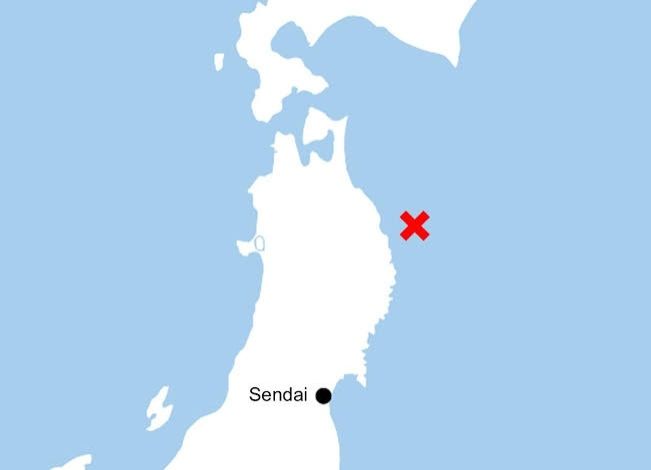
A powerful 7.2-magnitude earthquake struck beneath the waters off Iwate prefecture on Japan's main island of Honshu on Thursday morning, sending tremors across a vast swathe of the nation but causing only scattered minor damage and no confirmed casualties. The undersea event, which occurred at 7:30 am local time with its epicentre positioned 44 kilometres below the ocean surface, was registered across several hundred kilometres, with residents in Tokyo and other distant cities reporting noticeable shaking. Despite the considerable magnitude, authorities moved quickly to assess the situation and confirmed that the incident posed no immediate threat to public safety or critical infrastructure in the region.
Initially, the Japan Meteorological Agency characterised the tremor as magnitude 6.9 before revising the figure upward to 7.2 following further analysis. The decision not to issue a tsunami warning reflected both the depth of the epicentre and the nature of the fault rupture, factors that limited the risk of a potentially catastrophic ocean surge. Prime Minister Sanae Takaichi directed government ministries and agencies to coordinate closely with local authorities in affected areas, while also urging residents to remain vigilant for possible aftershocks of comparable intensity.
On-the-ground reports revealed the sorts of domestic inconveniences typical of earthquakes in this seismic zone. Mutsumi Shimohata, a 61-year-old food processing company employee in Hashikami, Aomori prefecture, described how a picture frame fell in her home, while television coverage captured kitchen cupboards disgorging saucepans and merchandise tumbling from shop shelves. Her employer instructed staff to remain home as a precaution after the facility's automated door system malfunctioned and sections of the office ceiling gave way—a reminder that even minor tremors can disrupt workplaces and everyday routines. The quake's intensity, registered as upper six on Japan's seven-level Shindo scale in Aomori, meant that many people found it difficult to maintain their footing without support, while unsecured furniture threatened to overturn and window glass risked shattering.
Transport networks experienced disruption as several shinkansen bullet train services were suspended pending safety inspections, and a primary school in Hashikami closed temporarily. Emergency services received multiple calls, including reports of people trapped in a lift and a tanker truck that overturned on local roads. However, fire departments in the affected cities of Hashikami and Hachinohe managed the incidents without reports of serious injury, and traffic in major urban centres such as Hachinohe continued to flow normally despite the shaking. Government spokesman Minoru Kihara indicated that comprehensive damage assessment was ongoing, though initial findings suggested no loss of life.
Regulatory authorities moved swiftly to confirm that nuclear power stations in the region experienced no abnormalities, a reassurance that carries particular weight for Japan given the nation's ongoing relationship with atomic energy. The 2011 Fukushima disaster, triggered by a 9.0-magnitude undersea quake and its ensuing tsunami that killed or left missing approximately 18,500 people, remains a potent reminder of how seismic events can spiral into catastrophe when combined with other factors. That tragedy transformed how Japan approaches nuclear safety and earthquake preparedness, ensuring that every tremor of this magnitude prompts immediate checks at generating facilities across the nation.
Japan's extraordinary exposure to seismic activity is rooted in its precarious geological position atop four major tectonic plates along the Pacific Ring of Fire. The nation experiences hundreds of earthquakes annually, accounting for roughly 18 percent of the world's seismic activity despite occupying less than one percent of Earth's land surface. For Southeast Asian readers, Japan's experience offers sobering lessons: the region itself sits within the wider Pacific Ring of Fire, and countries including Indonesia, the Philippines, and Malaysia face comparable long-term seismic and tsunami risks that demand sustained investment in early warning systems and disaster preparedness infrastructure.
This latest event arrives merely two months after an April 20 earthquake measuring 7.7 struck Japan's north, causing at least 10 injuries and prompting authorities to issue a rare special advisory warning of elevated risk for earthquakes reaching magnitude 8.0 or stronger. That advisory was withdrawn after seven days, but the sequence of powerful events has underscored the unpredictable nature of seismic hazards in the region. Scientists remain unable to forecast major earthquakes with precision, meaning that Japan's sophisticated monitoring networks and rapid response protocols represent perhaps the world's most advanced defence against seismic surprises.
The swift recovery and minimal damage from Thursday's quake reflects decades of investment in earthquake-resistant building standards, automated safety systems, and public education campaigns. Japanese homes and commercial structures now routinely incorporate reinforced foundations, flexible joints, and damping systems designed to absorb the energy of ground motion. Equally important is the cultural acceptance of seismic risk as an inescapable feature of life on the archipelago, fostering a national habit of earthquake drills and preparedness that extends into schools, workplaces, and neighbourhoods. For a nation of approximately 125 million people living in constant seismic jeopardy, such comprehensive preparation has transformed potential catastrophe into manageable disruption.
Prime Minister Takaichi's public statement asking residents to remain alert for additional earthquakes reflects an understanding that major tremors frequently trigger a cascade of smaller aftershocks, some of which can themselves cause injuries or structural damage if the ground remains weakened from the initial rupture. The depth and offshore location of Thursday's epicentre, combined with the relatively modest intensity registered at the surface in populated areas, meant that the cascading consequences remained limited. Nevertheless, the incident serves as a potent reminder that Japan's seismic neighbour relationship remains eternally unpredictable, requiring constant vigilance and investment in disaster response capacity even when individual events prove less destructive than they might have been.

