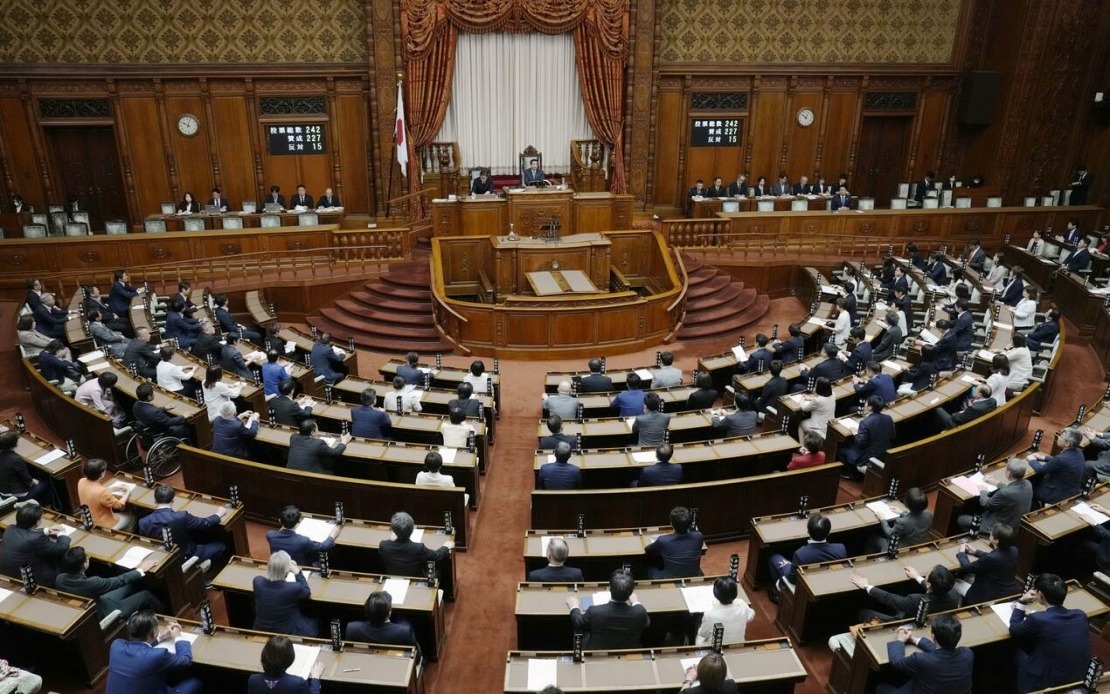
Japan's parliament has enacted sweeping defence legislation that formally recognises space as a critical military domain, restructuring the nation's Air Self-Defence Force to incorporate dedicated space operations capabilities. The House of Councillors approved the measure on Friday, marking a significant strategic pivot as Tokyo confronts an increasingly contested security environment in Asia-Pacific waters and orbital space. The reorganisation signals Japan's determination to modernise its military posture and acquire independent space-based surveillance capabilities at a time when regional powers are rapidly expanding their space programmes.
The renamed force, scheduled to commence operations during the fiscal year concluding in March 2027, will establish a dedicated space operations group under a lieutenant general's command. This newly created unit will assume primary responsibility for space domain awareness—the ability to monitor and track objects in orbit—and enhance satellite surveillance operations that underpin contemporary military operations. The elevation of space to equal standing alongside air defence reflects an acknowledgment that modern conflicts increasingly depend on uninterrupted access to orbital assets, whether for communications, reconnaissance, navigation, or early warning systems.
Defence Minister Shinjiro Koizumi articulated the civilian dimensions of this strategic shift during a press conference, emphasising that space infrastructure has become inseparable from everyday Japanese life. Navigation systems guiding vehicles and pedestrians, mapping applications embedded in smartphones, and weather forecasting systems that protect public safety all depend on satellite networks. By strengthening institutional capacity for space operations, Koizumi suggested, the Self-Defence Forces can better protect the underlying infrastructure upon which Japanese society fundamentally depends. This framing connects military modernisation to broader societal resilience, a rhetorical approach that domestic audiences increasingly understand and support.
The legislation also authorises the creation of a second senior vice defence minister position, a structural innovation designed to distribute administrative and operational burdens more effectively. This additional senior post will prove particularly valuable during national contingencies and major natural disasters, contexts where defence ministry involvement becomes critical to coordinated response efforts. The move also expands capacity for high-level defence diplomacy, allowing Japan to conduct more frequent and substantive security dialogues with the United States and other Indo-Pacific partners at senior ministerial levels.
Personnel management challenges within the Self-Defence Forces have motivated additional provisions within the legislation. Japan's military has struggled with recruitment and retention for years, particularly as the civilian labour market tightens and younger generations demonstrate declining interest in military service. To address these structural challenges, lawmakers approved increases to post-retirement benefits for SDF members, whose mandatory retirement ages tend to occur substantially earlier than civilian government service positions. Enhanced retirement security could prove instrumental in retaining experienced personnel and making military careers more attractive to potential recruits evaluating long-term financial stability.
Simultaneously, the legislation addresses regional security priorities by elevating Japan's 15th Brigade, stationed in Naha in Okinawa Prefecture, to full divisional status. This upgrade reflects mounting concern about vulnerabilities in Japan's southwestern island chain, particularly the Ryukyu Islands that form a strategic buffer between mainland Japan and potential security threats. China's increasingly assertive maritime posture, coupled with expanded naval operations across the East China Sea and South China Sea, has convinced Japanese strategic planners that robust defensive infrastructure in remote southwestern territories has become essential. Divisional status allows the unit greater operational independence, enhanced logistics capacity, and expanded command authority.
For regional observers, Japan's defence restructuring carries significant implications. The country's pivot toward space-based capabilities demonstrates how Washington's Asian security partners are responding to evolving military technologies and shifting strategic competition. Japan's decisions inevitably influence broader alliance calculations, particularly regarding the interoperability of Japanese systems with American space reconnaissance networks. As Japan develops independent space surveillance capabilities, questions arise about how these systems coordinate with existing US military space operations and whether they establish precedents for other regional partners seeking comparable independence.
Malaysia and other Southeast Asian nations monitoring these developments should recognise that Japanese defence modernisation occurs within a competitive regional context. China's expanding space programme, including military reconnaissance satellites and anti-satellite weapons development, creates pressures that ripple across Asia. Japan's response demonstrates how technologically advanced democracies approach space militarisation, balancing offensive capabilities against defensive requirements and maintaining civilian oversight of space-based systems. These choices establish patterns that influence technological trajectories and strategic expectations across the region.
The appointment of an additional senior vice defence minister, anticipated during summer 2024, signals Japan's commitment to treating defence portfolio responsibilities with expanded institutional resources. This administrative enhancement reflects recognition that contemporary defence challenges—spanning cybersecurity, space operations, alliance management, and traditional security domains—exceed what single-track ministerial structures can effectively manage. For Japanese defence diplomacy particularly, the additional senior post enables more consistent engagement with major partners while maintaining operational focus on emerging challenges.
Implementation of these changes across the 2024-2027 period will reveal how effectively Japan integrates space operations into its broader military framework. Success will depend on attracting technical talent to newly created space operations positions, ensuring seamless coordination between air and space command elements, and developing doctrine and procedures suited to the unique challenges of orbital warfare and space domain awareness. These implementation challenges are not merely technical; they reflect organisational culture shifts required within institutions accustomed to conventional air defence paradigms.
Japan's legislation ultimately demonstrates how advanced democracies are reorganising military institutions to address twenty-first century security requirements. The explicit elevation of space, the administrative innovations in ministerial structure, and the targeted enhancements to personnel management all reflect deliberate strategic choices about how to maintain military effectiveness amid rapid technological change. For observers across Southeast Asia, Japan's restructuring offers instructive lessons about transitioning defence institutions toward space-centric security frameworks while maintaining civilian democratic control and alliance relationships that have historically anchored regional stability.

