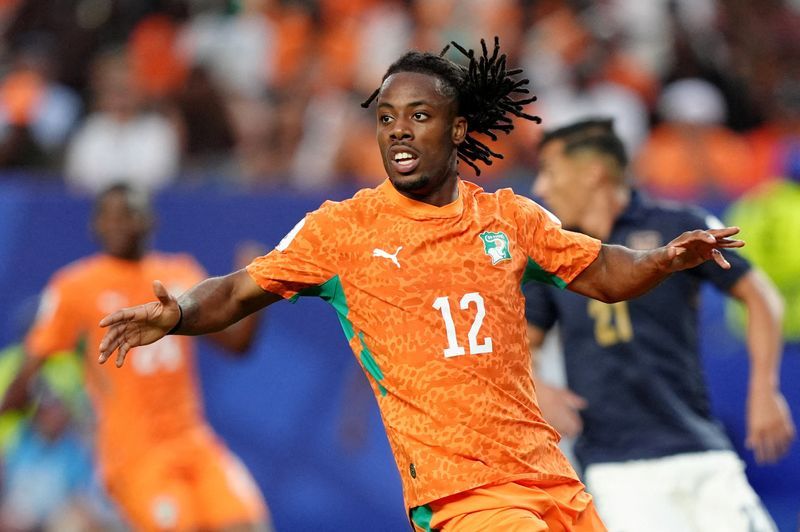
Ivory Coast will face Germany in Toronto this weekend without star forward Elye Wahi, who has been ruled out of the crucial World Cup qualifier after administrative hurdles prevented his travel to Canada. The Ivorian Football Federation announced the decision on Thursday, just one day after the striker became embroiled in a suspected sports corruption investigation connected to a Ligue 1 fixture.
The federation's statement emphasised that Wahi retains its complete confidence and remains a valued member of the national squad. However, the lack of necessary travel authorisations to enter Canadian territory has forced officials to leave the 22-year-old behind when the delegation departs for North America. According to the FIF, Wahi will remain in the United States while his teammates compete in what promises to be a decisive group-stage encounter.
French authorities identified unusual betting patterns surrounding a yellow card the Nice midfielder received during a Ligue 1 match last month. This development triggered immediate suspicion among gambling regulators, who flagged the transaction patterns as potentially indicative of match-fixing or wagering manipulation. The investigation into these anomalies appears to have complicated Wahi's international clearance status, creating bureaucratic obstacles that his federation has struggled to resolve within the compressed timeframe.
The FIF stressed that it has not received any formal legal notification or administrative summons regarding Wahi. This careful distinction suggests the player himself is not formally accused of wrongdoing, but rather caught in the procedural aftermath of a broader investigation into suspicious betting activity. The federation's defensive posture reflects wider concerns about protecting player reputations while authorities pursue their inquiries.
Wahi's absence represents a significant blow to Ivory Coast's attacking options as they pursue qualification from Group E. Their opening fixture saw them narrowly defeat Ecuador 1-0, a result that underscores the competitive intensity of this qualification campaign. Against a resurgent Germany side, maintaining attacking potency will prove essential if the Ivorians hope to extend their unbeaten start to the group stage.
Germany arrives in Toronto on the back of an emphatic 7-1 demolition of Curacao, a statement victory that suggests renewed cohesion and attacking threat under their current setup. The scale of that triumph positions them as clear favourites in the matchup, particularly with Ivory Coast now deprived of one of their key attacking assets. The Ivorian team must adapt tactically to compensate for Wahi's forced exclusion.
The timing of this situation creates an awkward narrative surrounding Ivory Coast's preparation. Rather than concentrating entirely on tactical preparation and squad cohesion, coaching staff must now recalibrate their attacking approach and manage the emotional fallout from an external investigation affecting one of their players. Such distractions can prove corrosive in international football, where psychological equilibrium often determines the margins between success and failure.
From a Southeast Asian perspective, this incident underscores the vulnerability of footballers to complications arising from the intersection of gambling regulation and international sport. As betting markets expand across Asia and globally, players increasingly risk exposure to investigations and procedural complications unrelated to their actual conduct on the pitch. The case highlights how modern athletes must navigate complex regulatory environments that extend far beyond traditional athletic competition.
The Canadian government's decision to withhold entry clearance, presumably based on the investigation's status, reflects heightened security protocols around individuals under investigation by French authorities. Such administrative caution, while bureaucratically sound, creates collateral damage for athletes whose involvement may ultimately prove peripheral or innocent. Wahi's plight illustrates the practical consequences when international jurisdictions apply strict procedural standards to individuals merely connected to ongoing inquiries.
Looking forward, Ivory Coast's performance without Wahi will provide an important test of their squad depth and tactical flexibility. Alternative attacking options must step forward to fill the void, an opportunity that could determine their trajectory through the remainder of the qualifying campaign. Meanwhile, the resolution of French authorities' investigation will likely determine whether Wahi's exclusion extends beyond this particular fixture or signals longer-term complications for his international availability.
The incident also raises questions about communication protocols between national federations, international football bodies, and government immigration agencies. Clearer frameworks governing such situations would prevent individual players from becoming victims of administrative gridlock that undermines both their careers and their nations' competitive interests. As international football becomes increasingly entangled with complex regulatory frameworks, governing bodies must ensure that procedural fairness and transparency guide decision-making around player eligibility and travel.

