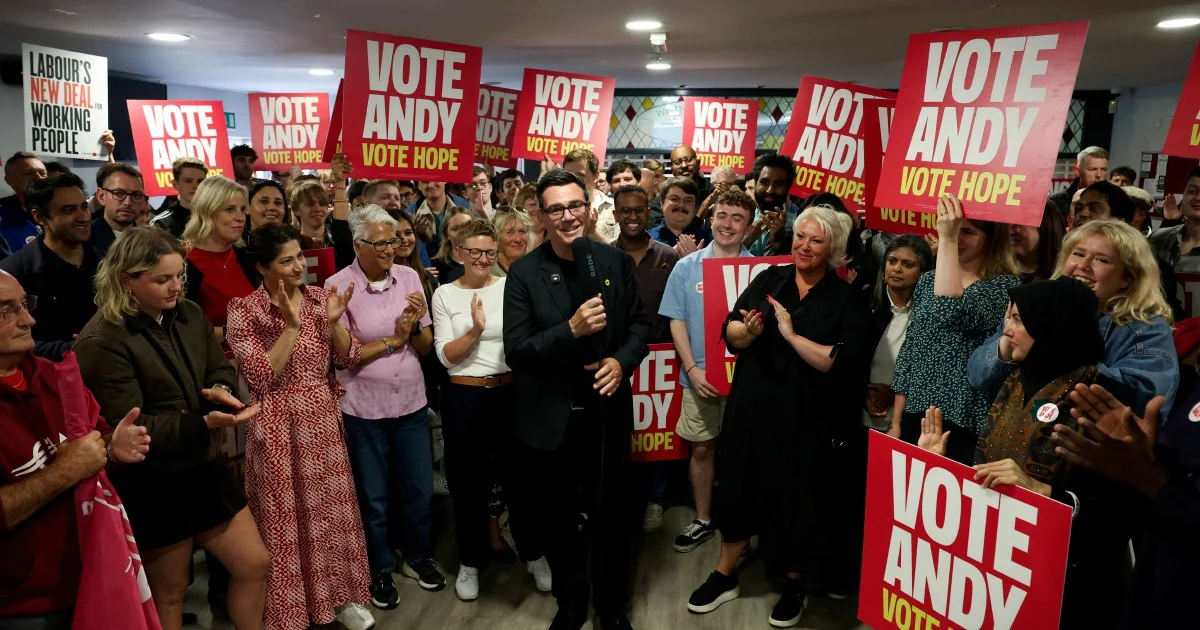
Andy Burnham's prospects of mounting a serious challenge to Prime Minister Keir Starmer for Britain's top job may receive an unexpected boost from the very political opponents he would eventually face. The Labour figure is preparing for Thursday's election contest in Makerfield, a seat fundamental to establishing the parliamentary standing necessary for a future leadership bid. Yet his path to victory appears strengthened not by his own political strengths but by a damaging rift between two populist right-wing movements that threatens to scatter their combined voter base across competing candidates.
The British political landscape has undergone seismic shifts over the past decade, with traditional two-party dominance giving way to fractured allegiances and protest voting patterns. Populist movements on the right have emerged as significant electoral forces, fundamentally reshaping how conservative voters distribute their support. This splintering of the right-wing electorate, historically the Conservative Party's domain, represents a structural weakness that left-of-centre parties can exploit in tight electoral contests. Makerfield exemplifies precisely this dynamic, where the divided opposition could allow Burnham to secure victory with a plurality rather than a commanding majority.
Burnham's elevation to the Prime Minister's role would represent an unconventional path to power by modern standards. Rather than ascending through traditional party hierarchies and Westminster backbench experience, he has built his political profile through regional administration and increasingly prominent national commentary. His current trajectory toward becoming a serious contender for the premiership hinges significantly on establishing undisputed control over his home constituency. A loss in Makerfield would severely undermine any credible claim he might make for national leadership, making Thursday's election outcome consequential for his personal political future.
The right-wing feud that threatens to undermine Conservative electoral prospects in seats like Makerfield reflects deeper ideological tensions within Britain's populist movement. These competing factions have struggled to present a unified alternative to the established parties, instead offering overlapping but distinct visions of conservative politics. Their inability to cooperate strategically leaves their voters scattered between multiple candidates, a mathematical disadvantage in first-past-the-post electoral systems where vote splitting almost guarantees defeat. In closely contested constituencies, this fragmentation can prove decisive.
For Malaysian observers of British politics, the parallels to Southeast Asian political fragmentation are instructive. Multiparty systems across the region frequently feature multiple conservative or nationalist movements competing for overlapping constituencies, producing similar vote-splitting dynamics. The British example demonstrates how ideological proximity without organisational unity can inadvertently strengthen political opponents. This phenomenon has played out repeatedly in Malaysian, Indonesian, and Thai elections, where divided opposition movements have benefited incumbents or unexpected challengers.
Burnham's potential victory in Makerfield would not represent an organic endorsement of his leadership credentials but rather a consequence of structural electoral disadvantages facing his opponents. This distinction matters significantly for assessing his subsequent viability as a national leader. A narrow victory achieved through opposition fragmentation does not necessarily translate into commanding party support or public enthusiasm for his eventual candidacy for the premiership. He would inherit a seat won partly by accident rather than design, a foundation that future rivals could exploit when scrutinising his mandate for higher office.
The broader implications for British politics extend beyond Burnham's individual prospects. The perpetual fragmentation of the right-wing vote suggests that Labour may enjoy a structural advantage in Westminster politics for the foreseeable future. Parties lacking unified opposition face reduced pressure to adopt policies responsive to conservative constituencies, potentially allowing them greater ideological flexibility. Conversely, the right-wing movements' failure to consolidate represents a significant missed opportunity. Had these factions recognised the mutual benefits of strategic coordination, they could have presented a more formidable challenge to Labour across multiple constituencies.
Thursday's election outcome in Makerfield will therefore carry implications extending well beyond that single seat. A Burnham victory would validate his political positioning and remove a significant obstacle to his emergence as a plausible alternative Prime Minister. It would simultaneously demonstrate the continued electoral weakness of a fragmented right-wing landscape unable to coalesce around shared objectives. For Starmer and Labour, the unintended consequence of right-wing infighting is the removal of potential threats to their political dominance before they fully materialise.
The timing of this internal right-wing division coincides with Starmer's consolidation of power following Labour's decisive election victory. Rather than facing a unified opposition capable of mounting consistent, coordinated attacks on government policy, the Prime Minister confronts multiple smaller movements presenting contradictory alternatives. This fractured opposition landscape permits Labour greater freedom in policy-making and reduces the effective parliamentary scrutiny available to backbench critics and opposing parties. Burnham's particular ascendancy becomes possible precisely because the traditional conservative coalition has splintered beyond effective repair.
Looking forward, the trajectory of British politics depends significantly on whether right-wing factions eventually achieve the organisational unity that currently eludes them. Should they continue competing separately, the mathematical advantages accruing to Labour will compound across multiple election cycles. Should they somehow reconcile their differences and present a unified platform, the political landscape could shift dramatically. For now, however, Burnham and Labour appear positioned to benefit substantially from divisions that their opponents have failed to resolve.