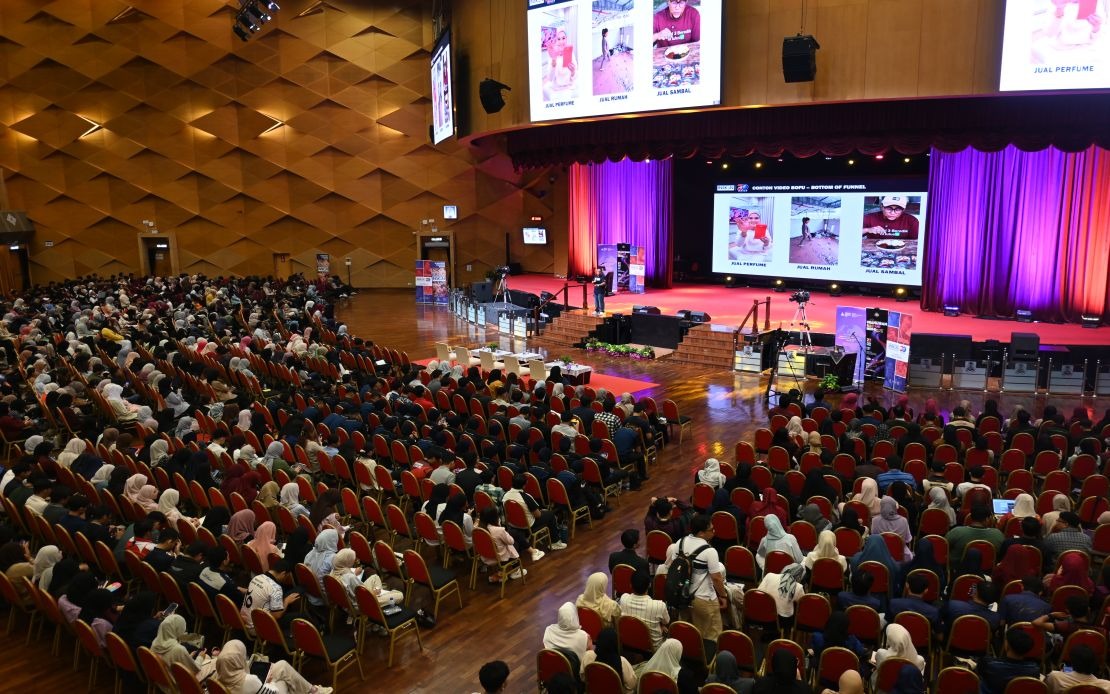
A landmark entrepreneurship seminar organised by the National Entrepreneurship Institute (INSKEN) has set a new national record, drawing 6,877 students and participants to what the Malaysia Book of Records has recognised as the largest student-focused entrepreneurship seminar in the country. Held at Dewan Agung Tuanku Canselor at UiTM Shah Alam on June 23, the Usahawan MADANI Mega (SUM MEGA) 2026 event represents a significant milestone in Malaysia's efforts to cultivate an entrepreneurial mindset among younger generations, marking a watershed moment in the nation's push to develop homegrown business innovators.
The scale of attendance—combining both in-person and virtual participants—underscores the substantial appetite among university students across Malaysia for business knowledge and networking opportunities. Structured in partnership with the Malaysian Academy of SME and Entrepreneurship Development (MASMED) and Universiti Teknologi MARA (UiTM), the seminar assembled students from institutions nationwide to participate in knowledge-sharing sessions and capacity-building workshops designed to equip the next wave of entrepreneurs with practical business acumen. This coordination between government institutions, universities, and development agencies reflects a deliberate strategy to embed entrepreneurial education within Malaysia's higher education ecosystem.
Datek Mohamad Alamin, deputy minister for Entrepreneur and Cooperatives Development, framed the record-breaking attendance as evidence of shifting attitudes toward business creation among younger Malaysians. Rather than viewing entrepreneurship as a risky venture to be avoided, he suggested that students increasingly recognise it as a credible and attractive career trajectory. This perception shift is crucial for Malaysia's long-term economic resilience, as the nation grapples with labour market pressures and the need to diversify economic drivers beyond traditional employment sectors. The Ministry of Entrepreneur and Cooperatives Development (KUSKOP), under the MADANI government framework, has positioned entrepreneurship development as central to economic strategy, viewing business creation as foundational to job generation, supply chain strengthening, and innovation outcomes.
The deputy minister articulated a comprehensive vision of entrepreneurship's economic role, extending beyond individual business success to encompass systemic contributions to national prosperity. His remarks emphasised that entrepreneurs function as catalysts for employment creation and local economic development, particularly in regions where formal job opportunities remain constrained. Within Southeast Asia's competitive landscape, where nations vie for talent and investment, Malaysia's ability to nurture indigenous entrepreneurs becomes a strategic advantage. Supporting this ecosystem through targeted financing, digitalisation infrastructure, and business development services represents the government's commitment to translating entrepreneurial ambition into sustained economic contribution.
Datuk Mustaffa Kamil Ayub, chairman of INSKEN's Board of Trustees and a UiTM board member, characterised the overwhelming response to SUM MEGA 2026 as validation of Malaysia's emerging entrepreneurial culture. His observation that entrepreneurship must transcend career categorisation—functioning instead as a cultural movement and mindset—captures an important philosophical shift in how the nation approaches business creation. When entrepreneurship becomes embedded in educational culture and social values rather than presented as a specialist choice, broader populations engage with business concepts, increasing the likelihood of identifying and nurturing genuine innovative potential across demographic lines. This cultural embedding addresses a perennial challenge in developing economies: ensuring that entrepreneurial opportunity is not confined to privileged networks but accessible to talented individuals regardless of background.
The seminar's educational framework employed the MOFA approach, which disaggregates business operations into four critical dimensions: marketing, operations, finance, and business administration. This structured methodology provides participants with a practical scaffold for understanding how successful enterprises integrate these functions. Rather than treating entrepreneurship as an abstract aspiration, the MOFA framework grounds business development in tangible operational realities, helping students transition from enthusiasm to competence. For Malaysian participants, many of whom may be first-generation entrepreneurs without family business experience, such structured knowledge transfer proves invaluable in reducing the information asymmetries that often handicap new business ventures.
Beyond the singular event, INSKEN maintains a portfolio of ongoing entrepreneurial development programmes designed to extend capacity-building beyond the seminar environment. The INSKEN Masterclass, BANGKIT, and PROTÉGÉ initiatives represent tiered engagement pathways, allowing participants to deepen specialisation depending on their business stage and developmental needs. This ecosystem approach acknowledges that single events, however large-scale, cannot sustain entrepreneurial development; rather, continuous reinforcement through mentorship, advanced training, and peer networks creates conditions for sustainable business creation. For Malaysian readers considering entrepreneurial pathways, these programmes signal institutional commitment to supporting the journey from concept to viable enterprise.
The strategic coordination visible in SUM MEGA 2026 exemplifies how Malaysia's entrepreneurship architecture has matured to involve multiple stakeholder categories: government ministries, educational institutions, financial service providers, and business communities. This multi-stakeholder engagement reflects recognition that entrepreneurial ecosystems require support across multiple dimensions—not merely training or capital, but also regulatory clarity, market access, and industry mentorship. The National Entrepreneurship Policy 2030 provides the overarching strategic framework within which initiatives like SUM MEGA 2026 operate, ensuring that localised activities contribute to nationally coherent outcomes rather than fragmented effort. For regional observers, Malaysia's institutional approach offers a potential model for how middle-income economies can systematically develop entrepreneurial capacity.
The record-setting participation also carries implications for Malaysia's position within the Southeast Asian entrepreneurial landscape. As nations across the region increasingly recognise that entrepreneurship drives competitiveness and resilience, Malaysia's demonstration of substantial student engagement signals commitment to competing in the race to develop entrepreneurial human capital. Countries like Indonesia, the Philippines, and Vietnam simultaneously pursue similar objectives, making Malaysia's track record in mobilising student participation a meaningful data point for assessing comparative commitment to entrepreneurial development. The Malaysia Book of Records designation, while symbolic, carries practical value in marketing the nation's entrepreneurial credentials to potential investors and international business communities evaluating regional ecosystems.
Looking forward, the success of SUM MEGA 2026 establishes a benchmark for future iterations while raising questions about how to sustain momentum beyond headline statistics. Conversion rates—the proportion of seminar participants who actually launch ventures or pursue entrepreneurship seriously—will ultimately determine whether the event's apparent success translates into economic outcomes. For participants, the seminar represents a beginning rather than a conclusion; accessing networks, mentorship, and financing support in the critical post-event months will determine whether enthusiasm crystallises into operational businesses. The institutional framework supporting this transition—through INSKEN's various programmes, government financing mechanisms, and university incubation facilities—will prove decisive in determining whether the 6,877 participants represented merely an audience or potentially a cohort of future entrepreneurs whose collective ventures reshape Malaysia's economic landscape.

