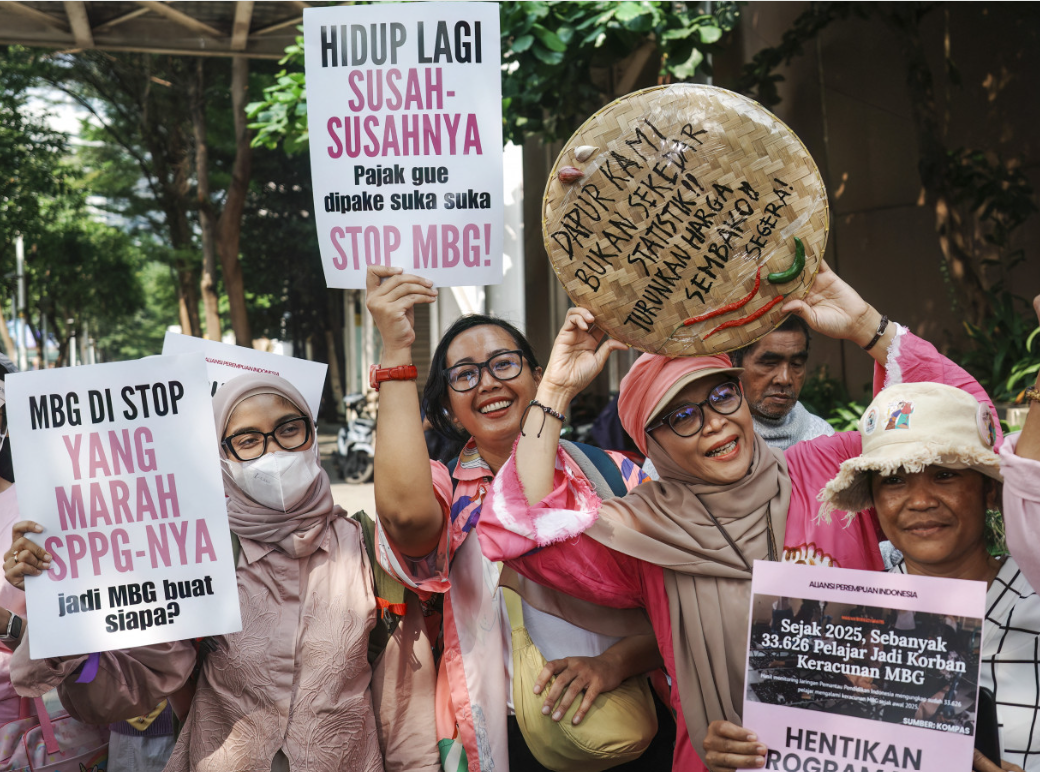
Indonesian parents enrolled in President Prabowo Subianto's ambitious free nutritious meal initiative are increasingly prepared to abandon the assistance rather than feed substandard food to their children, a striking development that underscores deepening public frustration with how the multi-billion-rupiah programme is being implemented on the ground.
The quality crisis became impossible to ignore when Nesti Nagari, a mother from Kediri in East Java, discovered that a meal provided for her eight-month-old baby consisted of an unidentifiable white paste clumped together in a portion that appalled her. She posted her experience on social media platform Threads, where the image garnered more than 11,000 likes within hours, crystallising widespread concerns about food standards. Rather than feed the meal to her child, Nagari gave it to her chickens instead. Speaking to The Jakarta Post, she expressed willingness to support either a temporary suspension or complete termination of the programme so that government resources could be redirected toward education and health care services, areas where she felt the funding would create greater social benefit.
Nagari's experience is far from isolated. Diah Farika, a breastfeeding mother in Semarang, Central Java, has been enrolled since May but encountered persistent problems with the quality and nutritional balance of meals provided. She documented instances of unripe fruit and portions she judged to be inadequate, yet reported receiving dismissive responses when she raised concerns with the nutrition fulfillment service units (SPPG) responsible for meal preparation. Farika echoed Nagari's sentiment, saying she would readily accept the assistance if meals were genuinely nutritionally balanced, but found the standard had deteriorated over time. She too endorsed the idea of a programme pause, specifically calling for comprehensive kitchen inspections by the National Nutrition Agency (BGN) to ensure quality control across all facilities.
These individual accounts reflect a broader erosion of confidence that extends beyond beneficiary families to encompass civil society and women's rights organisations. The Indonesian Women's Alliance (API) staged a significant rally in Central Jakarta on Thursday, bringing together dozens of activists and women demanding that the government halt and comprehensively review the programme. Their intervention signals that concerns about food quality and nutritional value have transcended household complaints to become a matter of public accountability and women's advocacy.
Parallel to these quality concerns, the programme confronts a complex institutional crisis stemming from a corruption scandal involving former BGN leadership. The new leadership responded by freezing further expansion of the SPPG network, which currently operates approximately 27,000 kitchens nationwide. This decision has created significant uncertainty among investors and operators who have committed substantial capital to the initiative. Last week, investors reportedly visited BGN offices seeking clarity on the programme's future viability, having invested hundreds of billions of rupiah in kitchen construction and equipment. The prospect of facility closures without compensation has amplified their anxieties about return on investment and long-term viability.
Operational disruptions have already materialised, with several SPPG facilities reporting temporary closures in early June due to delayed funding disbursements, though some subsequently reopened. These disruptions further undermine public confidence and demonstrate the fragility of an enterprise dependent on consistent government financing and coordination across thousands of distributed service points. The funding landscape itself has become precarious following public scrutiny of the programme's cost and implications for other budget priorities. The initial 2026 budget allocation of Rp 335 trillion (approximately US$18.74 billion) was subsequently trimmed to Rp 268 trillion as part of broader efficiency measures, reducing the overall scale of the intervention even as operational challenges persist.
Civil society monitoring has intensified alongside these developments. MBG Watch, an independent oversight platform established by civil society organisations, has documented mounting problems that have further damaged public confidence in the initiative. Isnawati Hidayah, a policy researcher at the Center of Economic and Law Studies (CELIOS) and initiator of MBG Watch, articulated a fundamental question being asked by parents and the broader public: what precisely is this enormous budget financing, and whose interests does it ultimately serve? This framing shifts the debate from programmatic details to questions of institutional accountability and resource allocation.
CELIOS research has additionally revealed that approximately 34 per cent of current beneficiaries, comprising around 61 million children and pregnant women, do not belong to the groups most requiring government nutritional assistance. This category includes households already economically secure or possessing adequate access to nutritious food. The finding suggests significant inefficiency in targeting, with programme resources reaching individuals who could meet nutritional needs independently. Hidayah has emphasised that beneficiary perspectives must be positioned centrally in any evaluation process, since they are best positioned to assess their actual need for assistance and experience the consequences when implementation falters.
In response to these convergent pressures, the BGN has initiated a recalibration of its approach. The agency has begun narrowing its beneficiary pool by removing recipients deemed capable of independently meeting their nutritional requirements. As of Thursday, the BGN had dropped 76 schools across Java from the programme, affecting more than 39,000 beneficiaries. This retrenchment signals acknowledgment that universal provision cannot be sustained at the promised quality level, and that a more targeted approach focused on genuinely vulnerable populations may prove more defensible and effective.
BGN deputy head and spokesperson Agustina Arumsari framed this refocusing in terms of programme efficacy, stating that the agency aims to concentrate resources on Indonesian citizens truly requiring government nutritional intervention. The BGN is additionally implementing austerity measures, including the elimination of daily incentives for kitchens during periods when they are not operationally active, and reviews of underperforming facilities designed to improve operational standards. These measures represent an implicit acknowledgment of previous inefficiencies and suggest the agency recognises that the programme's credibility depends on demonstrable improvements in both targeting and execution.
For Malaysia and other Southeast Asian nations observing Indonesia's experience, the unfolding controversy offers important lessons about the complexity of scaling large-scale nutritional interventions. While the goal of combating stunting and childhood malnutrition remains unquestionably important, the Indonesian case demonstrates that programme success depends not merely on budgetary commitment or administrative reach, but critically on sustained quality control, community confidence, and the alignment of programme design with actual beneficiary needs. Regional policymakers contemplating similar initiatives must account for the institutional capacity required to oversee distributed service delivery at scale, the necessity of quality assurance mechanisms, and the importance of maintaining public trust through transparent communication about both achievements and shortcomings.

