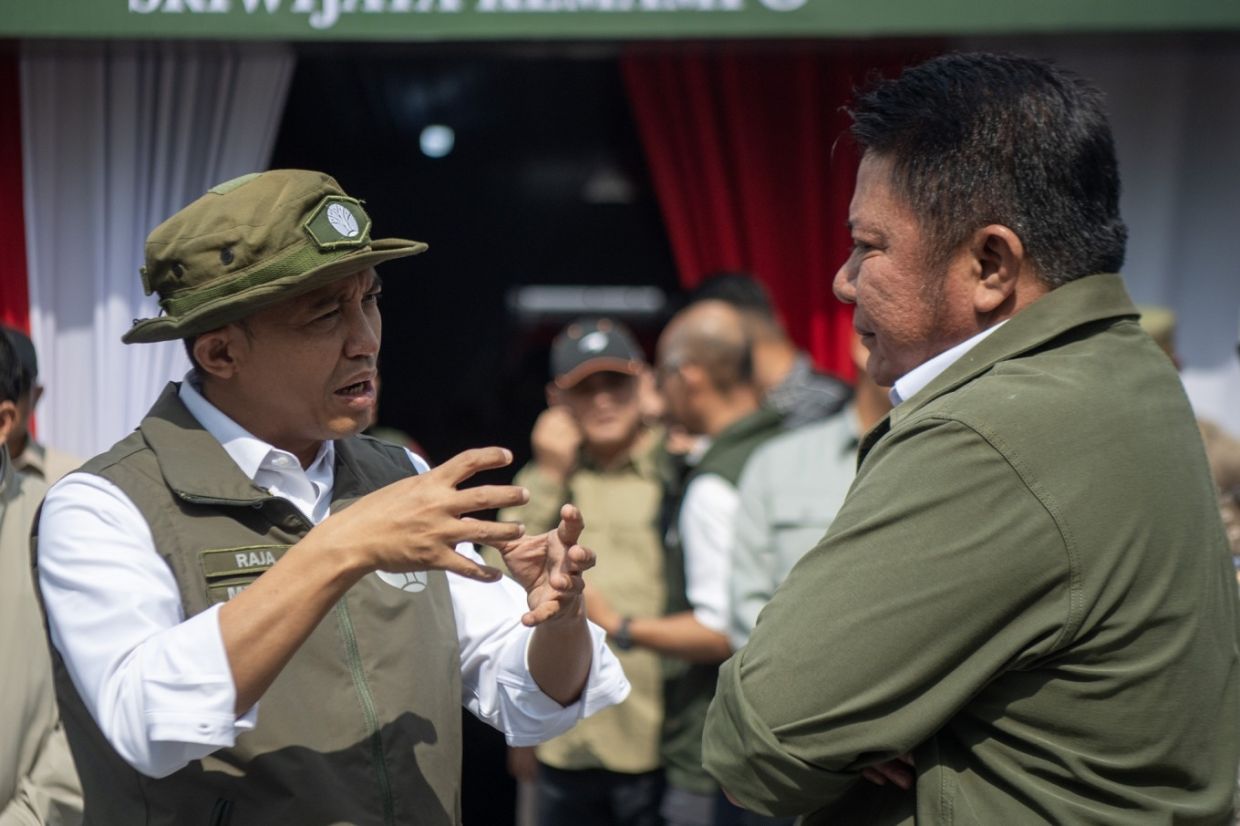
Indonesia's Corruption Eradication Commission (KPK) has reopened an investigation into Forestry Minister Raja Juli Antoni, focusing on suspected inconsistencies in the amount of illicit money he claims to have received and subsequently returned to Suhardiman Amby, the regent of Kuantan Singingi in Riau province. The antigraft agency's renewed scrutiny represents a significant escalation in a corruption case that already threatens the credibility of one of Jakarta's most visible cabinet members and underscores the vulnerability of Indonesia's resource management sector to organised graft.
According to KPK spokesperson Budi Prasetyo, investigators are examining what they believe to be a discrepancy between the total amount of Singapore dollars that Suhardiman allegedly handed to the minister during a June 2 meeting and the sum that Raja Juli subsequently reported returning. The envelope purportedly contained S$14,000—approximately US$10,919—in cash, which the regent allegedly presented after discussions between forestry officials and the Kuantan Singingi administration. The investigation carries particular weight given that Raja Juli initially claimed he rejected the payment outright, a narrative that the KPK's findings now appear to contradict.
The timeline of Raja Juli's actions following the alleged transfer raises red flags within the antigraft framework. The minister reported the bribery attempt to the KPK on July 3, more than a month after the June 2 meeting, claiming he had refused to accept the envelope and subsequently returned it on June 12 at the Kuantan Singingi Police headquarters. However, this sequence itself violated Indonesia's statutory requirements. Under prevailing legislation, public officials receiving improper gifts connected to their official positions must report such incidents to the KPK within 30 days of acceptance, not to local police authorities. The reported late notification and choice of reporting channel suggest either a misunderstanding of legal obligations or an attempt to shield the matter from the specialised anticorruption machinery.
The underlying motivation for Suhardiman's alleged bribe attempt appears connected to longstanding forestry politics in Riau. The Kuantan Singingi administration had requested that the Forestry Ministry reclassify more than 1,800 hectares of limited production forest—designated in Indonesian law as HPT—into land categories permitting other uses such as settlement or industrial development. Such reclassifications represent significant economic prizes for local administrations and private interests, creating obvious incentive structures for corruption. The allegation that cash was changing hands in relation to these classification requests demonstrates how Indonesia's forest governance remains vulnerable to capture by regional power brokers seeking to convert state forest assets into commercially exploitable properties.
Evidence suggests a pattern rather than an isolated transaction. Budi disclosed that Raja Juli had met with Suhardiman on at least three separate occasions spanning April, May, and June, though he declined to specify whether these encounters were connected or concerned overlapping subject matter. This frequency of contact between a national minister and a provincial regent becomes notable when viewed against the backdrop of a specific administrative request pending before the ministry. The multiple meetings hint at sustained effort to influence the minister's decision-making, a dynamic that procurement officials and transparency advocates argue characterises high-level corruption schemes in resource-rich Indonesian provinces.
The KPK case expanded considerably when Suhardiman, a member of President Prabowo Subianto's Gerindra Party, was arrested in late June and designated a suspect in an investigation concerning alleged kickbacks received from the regency's secretary Zulkarnain in exchange for the latter's appointment. Investigators subsequently broadened the inquiry to encompass the alleged payments to the Forestry Ministry, effectively linking local administrative corruption with ministerial-level misconduct. This expansion reflects evolving investigative strategy within the KPK, which increasingly treats high-profile graft cases as networks of related transactions rather than isolated incidents.
Raja Juli's position as both Forestry Minister and secretary-general of the Indonesian Solidarity Party (PSI)—a moderate reformist political force—initially protected him through appeals to his party's anti-corruption brand. However, the KPK's investigation has triggered formal parliamentary scrutiny. Members of the House of Representatives Commission IV, which oversees forestry planning, moved to summon Raja Juli for clarification, signalling that legislators viewed the allegations as sufficiently serious to warrant direct examination. When Raja Juli absented himself from a scheduled July 14 meeting with Commission IV, citing an umrah (minor pilgrimage) commitment, the episode appeared to reinforce public perception that he was evading accountability.
The evidentiary scope of the investigation extends beyond Raja Juli personally. Other ministry officials allegedly received kickbacks totalling S$12,500 from various Kuantan Singingi officials, suggesting a coordinated scheme to distribute payments across multiple layers of the bureaucracy. This distribution pattern—compensating several officials rather than concentrating benefits on a single decision-maker—represents standard practice in organised corruption networks, as it diffuses culpability and creates multiple stakeholders invested in maintaining silence. The involvement of junior officials raises questions about institutional culture within the Forestry Ministry and whether supervisory mechanisms exist to detect such schemes.
In response to the investigation, the Forestry Ministry issued a statement reaffirming its cooperation with the KPK and commitment to supporting the inquiry with requested documentation. Officials emphasised that the ministry had not yet approved the Kuantan Singingi reclassification requests, noting that the three recent proposals from the regency administration had been either rejected outright or remained under verification. This defensive posture attempts to contain reputational damage by emphasising procedural restraint, yet it does not address the underlying question of whether bribery attempts influenced ministerial decision-making in other cases or administrative spheres.
For Malaysian observers and regional governance analysts, the case illuminates persistent structural vulnerabilities in Southeast Asian natural resource management. Despite institutional reforms following major anticorruption campaigns, Indonesia's forestry sector remains susceptible to transactional corruption involving cash payments to senior officials. The involvement of a serving minister—individuals typically shielded by executive privilege and political patronage networks—demonstrates that even elevated institutional positions offer inadequate protection against investigation once allegations achieve sufficient public prominence. The KPK's willingness to pursue an active minister signals institutional independence, yet also reveals how such investigations often occur reactively, following disclosure rather than proactive detection.
The discrepancies at the heart of this reinvigorated investigation carry broader implications for transparency in forest governance across Southeast Asia. If investigators confirm that Raja Juli accepted and incompletely returned bribes, the case will establish precedent for holding ministerial-rank officials accountable for failures to properly report and return improper gifts. Conversely, if the investigation stalls or produces acquittals, sceptics will cite it as evidence that Indonesia's anticorruption machinery struggles when confronting well-connected political figures. The outcome will influence whether regional governments view strict asset-reporting requirements and conflict-of-interest regulations as enforceable constraints or merely aspirational norms.
Pending resolution of the outstanding investigative questions regarding exact payment amounts and Raja Juli's full accounting, the case already serves as a cautionary reminder that Indonesia's forestry sector—controlling vast tracts of globally significant tropical forest—remains entangled with personalised corruption networks operating across local and national administrative levels. Suhardiman's alleged provision of cash to multiple officials across hierarchical layers reflects deliberate strategy to establish quid pro quo relationships capable of influencing forest classification decisions worth millions in potential development value. Until structural reforms address the incentive architectures that make such bribery schemes profitable, Indonesia's forest governance will continue attracting transactional corruption involving state officials at multiple levels.

