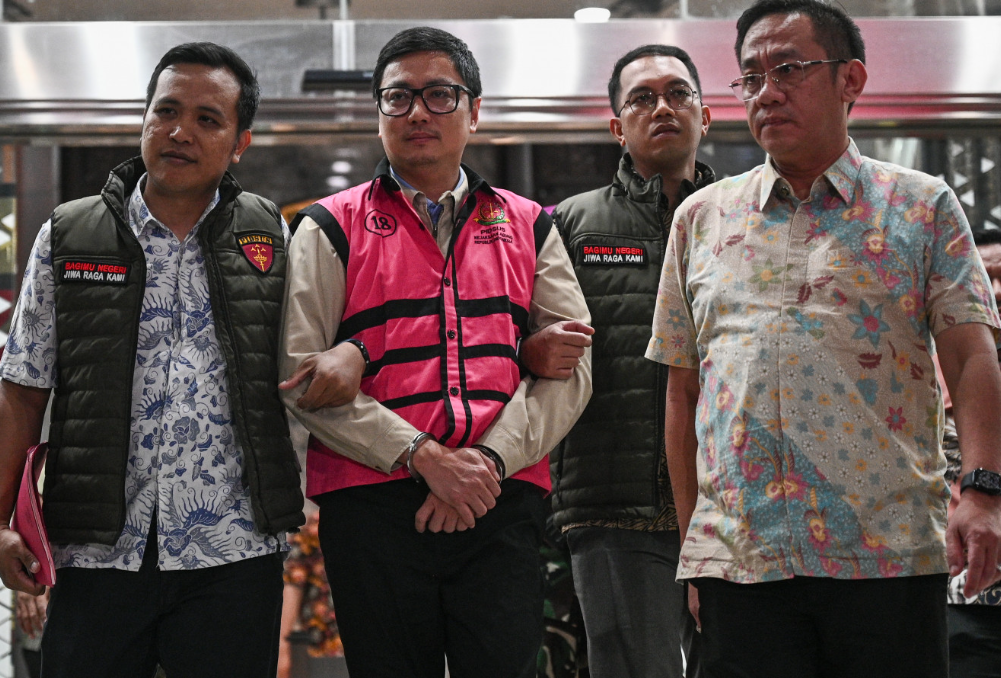
Indonesia's anti-corruption apparatus has significantly expanded its investigation into graft within the country's flagship free nutritious meal scheme, with the arrest of a logistics company official bringing the total number of suspects to five. The Attorney General's Office on Friday arrested Andri Mulyono, a commissioner at logistics firm PT Yasa Artha Trimanunggal, following his interrogation in connection with alleged irregularities in the multitrillion-rupiah programme designed to combat malnutrition across the archipelago.
Andri stands accused of manipulating procurement processes to artificially inflate the cost of over 21,000 electric motorcycles intended for free meals programme kitchens throughout Indonesia. Investigators allege that his actions enabled the scheme to reach the Rp 1.03 trillion budget ceiling set by the National Nutrition Agency, with the inflated prices allowing him and his associates to siphon off substantial sums. According to Syarief Sulaeman Nahdi, investigation director at the Office of Assistant Attorney General for Special Crimes, Andri "unlawfully gained [extra money from] the manipulated procurement," indicating a deliberate effort to exploit public funds through price distortion rather than genuine operational necessity.
The electric motorcycle procurement itself has become a focal point of public controversy, with widespread criticism emerging in April over the questionable urgency of the purchase. The decision to acquire such vehicles for meal distribution kitchens struck many observers as an extravagant expense in a country facing economic headwinds, particularly given the rupiah's recent weakness. Finance Minister Purbaya Yudhi Sadewa subsequently announced that no additional electric motorcycle purchases would proceed in 2026, attributing the mishap to internal miscommunication within the ministry that resulted in portions of the proposal being greenlit without sufficient oversight or justification.
The investigation has progressively widened to ensnare multiple layers of the scheme's management structure. Earlier in the week, investigators arrested Asep Yusuf Somantri, a businessman with close ties to Sony Sonjaya, the former deputy head of the National Nutrition Agency. Asep allegedly leveraged his connection to Sony to gain improper access to the verification process for prospective meal programme partners, effectively circumventing quality control mechanisms. His involvement enabled kitchen registrations to proceed and applications to be facilitated even after official registration periods had closed, suggesting a coordinated effort to favour certain vendors and contractors regardless of their actual qualifications or compliance with programme standards.
The three initial arrests set the trajectory for the expanding investigation. On June 3rd, the Attorney General's Office apprehended Sony Sonjaya and fellow deputy head Lodewyk Pusung, along with former agency chief Dadan Hindayana, following President Prabowo Subianto's swift termination of all three from their positions. The rapid sequence of arrests and dismissals underscored the severity with which authorities regarded the allegations, demonstrating political commitment to accountability within the programme despite the potential embarrassment to the administration.
In a significant development, investigators are now preparing to re-interrogate Sony as part of their evaluation of his application for justice collaborator status. Such a designation would allow him to provide detailed testimony implicating additional individuals involved in the scheme in exchange for potential leniency in his own prosecution. According to reports, Sony has indicated his willingness to disclose the identities of over twenty additional persons allegedly connected to the corruption network, suggesting that the actual scope of wrongdoing may extend well beyond the five currently charged suspects. Syarief indicated that questioning would proceed "as soon as possible," though specific timelines and details regarding the nature of expected revelations remain undisclosed.
The free meals programme itself represents one of Indonesia's most ambitious recent social initiatives, targeting over eighty million schoolchildren and pregnant women nationwide in an effort to address the persistent challenge of malnutrition and stunting across the nation. Yet its implementation has been severely tainted by operational failures compounding the corruption scandal. Since launching in early 2025, the scheme has recorded at least 33,000 documented cases of mass food poisoning, raising acute concerns about food safety protocols, vendor oversight, and the adequacy of inspection mechanisms. These incidents have transformed what was intended as a symbol of state commitment to human development into a flashpoint for public health anxieties and governmental competence.
Public dissatisfaction crystallized dramatically on Friday when students organized a protest movement branded #MenujuIndonesiaBangkrut, literally "Indonesia heading for bankruptcy." Demonstrators characterized the free meals programme as emblematic of misplaced governmental priorities, questioning the rationale for allocating billions to such an evidently corruption-ridden and poorly-managed initiative while the national currency weakens and economic pressures mount on ordinary Indonesians. The framing of the protest suggests deeper anxiety about fiscal sustainability and the allocation of scarce resources, particularly in an environment of currency depreciation and external economic uncertainty typical of regional challenges facing Southeast Asian economies.
Government authorities have sought to defend the programme despite mounting criticism and the expanding corruption investigation. Muhammad Qodari, head of the Government Communications Agency, reiterated on Saturday that the free meals initiative would continue operating, asserting that it remains strategically important for reducing stunting rates among vulnerable populations. His statement that "any programme will inevitably face challenges during its implementation and operational stages" appeared to acknowledge the difficulties while suggesting they represent normal administrative friction rather than fundamental flaws requiring programme termination. The retort that "only dead people have no problems" struck some observers as dismissive of legitimate concerns about corruption and food safety failures, yet it articulated an administration position that programmatic persistence and iterative correction should supersede calls for abandonment.
The investigation's trajectory and expanding suspect list raise important questions about institutional capacity for oversight and coordination among Indonesia's sprawling state agencies. That multiple layers of management from the National Nutrition Agency itself appear implicated in corruption suggests systemic vulnerabilities in accountability mechanisms and potential gaps between procurement regulations and enforcement practices. For Malaysia and other Southeast Asian economies observing Indonesia's challenges, the case illustrates the vulnerability of large social welfare programmes to exploitation when institutional controls prove inadequate and political will for sustained oversight weakens. The ability to reform and strengthen such mechanisms will largely determine whether Indonesia can rescue the free meals programme's original intent or whether public trust erodes irreparably.