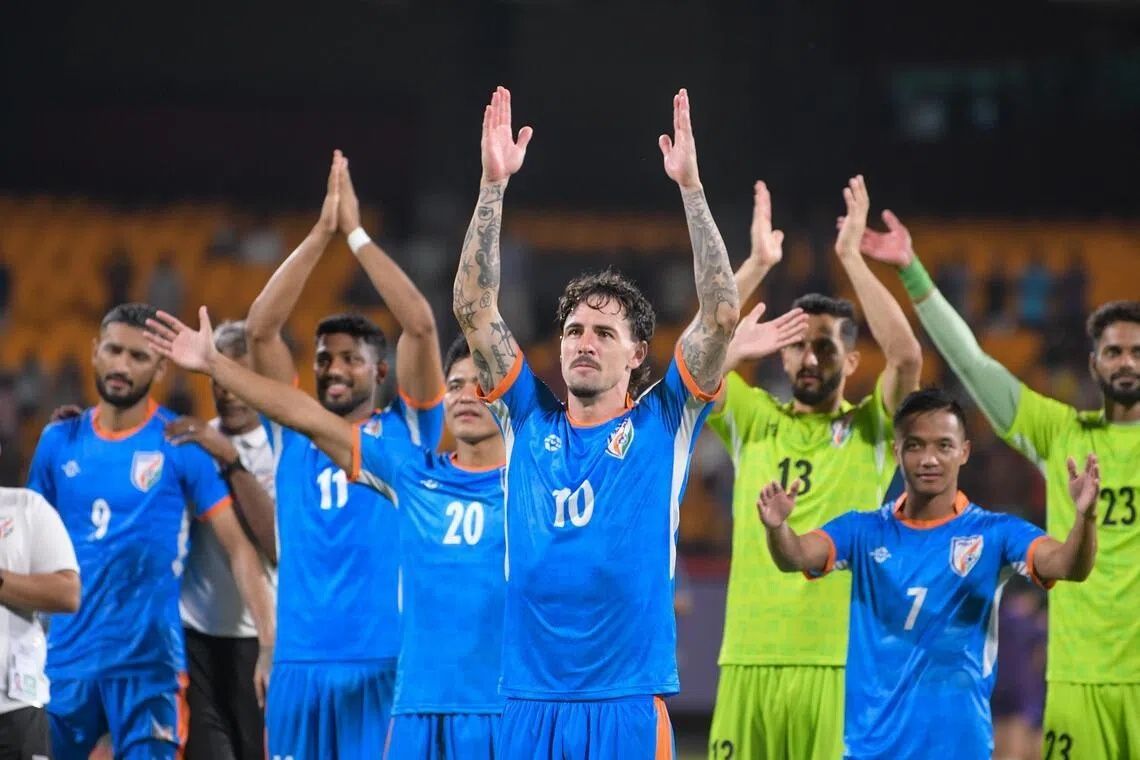
India's sports establishment faces a peculiar frustration every World Cup cycle. As the country's football team languishes at a FIFA ranking of 139 and fails to qualify for major tournaments, Indian social media accounts have spent the 2026 competition season documenting the Indian-origin players performing for other nations — from Tahsin Mohammed Jamshid, the Qatar forward with Malayalee parents, to Samuel Moutoussamy of the Democratic Republic of the Congo, whose father is Tamil. This recurring disappointment has prompted India's Ministry of Youth Affairs and Sports to float an ambitious proposal that could reshape the nation's international sporting landscape: a Sports Passport framework allowing citizens of other countries with Indian ancestry to represent India without acquiring full citizenship.
The proposal, reportedly submitted to the Prime Minister's Office by the Ministry of Youth Affairs and Sports, would extend eligibility to athletes holding Overseas Citizen of India (OCI) or Person of Indian Origin (PIO) status — official designations for foreign nationals of Indian descent who are not full citizens. According to sources quoted by sports news outlet Khel Now, the government could take six to eight months to deliberate on the framework before reaching a decision. This initiative reflects a broader recognition that India's current citizenship rules create an artificial constraint on national sporting ambitions, particularly in sports like football, basketball and tennis where global talent competition has intensified dramatically.
The timing of this proposal carries significant weight when viewed against India's recent sporting setbacks. The men's football team's failure to qualify for both the 2026 FIFA World Cup and the AFC Asian Cup 2027 has exposed structural weaknesses in Indian football development. Meanwhile, the country's women's football team ranks 69th globally, indicating systemic challenges across the sport. India's population exceeds 1.4 billion people, yet the nation has historically underperformed in international sporting competitions beyond cricket, burdened by bureaucratic inefficiency, inadequate grassroots infrastructure, and the sport's overwhelming dominance of public interest and resource allocation. The sports passport concept essentially attempts to circumvent these domestic constraints by tapping into one of the world's most valuable untapped resources: the Indian diaspora.
India's overseas population represents the largest immigrant diaspora globally, exceeding 37 million people spread across wealthy developed nations with strong sporting infrastructure and professional sports systems. Many possess athletic talent that has been channelled into representing their adopted countries. The proposed sports passport would create a mechanism to redirect some of this talent toward Indian national teams, without requiring the permanent sacrifice of foreign citizenship that current rules mandate. This represents a significant policy reversal. Before 2008, overseas Indians did represent the nation across various sports including swimming, rugby and tennis. However, the sports ministry changed course that year, restricting representation to Indian passport holders exclusively, a decision intended to protect opportunities for domestically-based players against overseas competition.
Sports lawyer Nandan Kamath, managing trustee of the GoSports Foundation, articulates the fundamental tension that the sports passport proposal seeks to resolve. While Indian law prohibits dual citizenship — mirroring policies across much of Asia including Singapore, Malaysia and Japan — international sports governance operates according to entirely different principles. FIFA's regulations permit athletes to represent any nation with which they can demonstrate genuine connection through ancestral ties, residence, or other qualifying criteria. This mismatch between national immigration law and international sporting rules creates an inefficiency that other nations have already exploited. Gulf states like Qatar employ Mission Passports, Spain and Turkey maintain athlete visa systems, and Bahrain operates comparable frameworks — all mechanisms designed to attract foreign-born talent to strengthen national squads without disrupting citizenship law.
The statistics underlying this global sporting trend underscore why nations are increasingly adopting such policies. In the early 2000s, approximately 10 percent of World Cup players represented nations other than their birthplaces. At the current 2026 FIFA World Cup, nearly a quarter of all players compete under a flag different from their country of birth, reflecting the increasingly globalized and migratory nature of elite sports. For a nation like India, which possesses the numerical human capital to compete internationally but lacks the domestic infrastructure and professional systems to fully develop that talent, the sports passport represents a strategic response to evolving global sporting reality.
The case of Tahsin Mohammed Jamshid embodies both the opportunity and the current limitation facing Indian talent. At nineteen years old, Tahsin represents Qatar in the 2026 World Cup, having qualified through Qatar's Mission Passport system — a document that grants him playing rights in international competition while granting no citizenship status or social benefits. Tahsin's credentials exemplify the proposition's logic: his father worked as an accountant in Qatar, Tahsin was born in Doha, yet he holds Indian citizenship and possesses Malayalee heritage. Under India's sports passport proposal, such a player could theoretically represent India while maintaining his foreign residency and professional commitments abroad. This flexibility distinguishes the sports passport from previous overseas player integration, which required permanent citizenship acquisition — a commitment few athletes prove willing to make.
Ryan Williams, an Australian-born forward, presents the opposite case study. Williams qualified for Indian citizenship through his Anglo-Indian mother, who herself played football for Australia after immigrating. Williams played five years for an Indian Super League team before surrendering his Australian citizenship to take up Indian nationality, ultimately scoring the fastest goal ever recorded by an Indian debutant upon his international debut. His example demonstrates both the potential and the friction within the current system. Acquiring Indian citizenship required more than a year of bureaucratic processing, a timeline that effectively precludes any spontaneous squad reinforcement. The sports passport would bypass such delays, allowing time-sensitive recruitment during competition windows.
Kunaal Majgaonkar, formerly the head of content and media at JSW Sports, characterizes what such a framework would mean practically for Indian football specifically. Football represents a heavily professionalized sport requiring consistent, world-class talent in most positions to compete internationally. The addition of genuinely skilled foreign-born players trained in elite global systems could fundamentally alter India's competitive standing. Unlike cricket, which India dominates through a combination of domestic talent development and financial resources, football requires external expertise and international experience that remains difficult to cultivate domestically. The sports passport would compress the timeline for assembling competitive squads, transforming what currently requires years of grassroots development into a more immediately implementable strategy.
The proposal also appears strategically timed with India's broader sporting ambitions. The National Sports Policy 2025 outlines a comprehensive strategy to engage the diaspora, positioning the sports passport as one component within a larger nation-building narrative. Beyond immediate competitive concerns, sources suggest the framework also prepares India for its bid to host the 2036 Olympic Games, an event requiring demonstrable international sporting strength across multiple disciplines. Successfully fielding competitive basketball, tennis and football teams would strengthen India's candidacy significantly. Several nations have hosted Olympics while simultaneously strengthening their international sporting presence through exactly such talent-integration strategies.
However, the proposal faces legitimate criticism rooted in structural concerns about team authenticity and motivational dynamics. Arata Izumi, a midfielder who surrendered his Japanese citizenship in 2012 to take up Indian nationality, argues that sustainable national teams cannot rely on parachuted foreign talent without addressing underlying domestic problems. His critique points toward a broader tension: if India implements a sports passport, does this address the systemic weaknesses — inadequate funding, poor grassroots infrastructure, administrative inefficiency — that created the need for external talent recruitment in the first place? Critics contend that the proposal represents a shortcut around structural reform rather than a complement to it, potentially demoralizing domestic players who observe foreign-born teammates receiving opportunities without having navigated Indian football's often-frustrating development pathway.
The six to eight month deliberation timeline affords the government opportunity to consider such criticisms substantively. Any implementation would require coordination between the Ministry of Youth Affairs and Sports, individual sports federations like the All India Football Federation, and potentially revisions to broader immigration policy frameworks. International sporting bodies would also require advance notification, though FIFA and other governing organizations have demonstrated flexibility regarding such national policy innovations previously. The proposal's success would ultimately depend on whether it functions as a tactical supplement to improving domestic development or whether it instead becomes a structural crutch limiting long-term capacity building.
For Malaysian readers and Southeast Asian sports observers, the Indian sports passport proposal carries particular relevance. The region's various nations likewise compete against India across multiple sports while grappling with similar constraints around population talent development and infrastructure investment. How India's government responds to this proposal will likely influence policy conversations across Southeast Asia regarding talent recruitment and national team composition. The decision also speaks to broader questions about how nations in Asia navigate the tension between preserving domestic opportunity and maximizing international competitiveness within an increasingly globalized sporting ecosystem.

