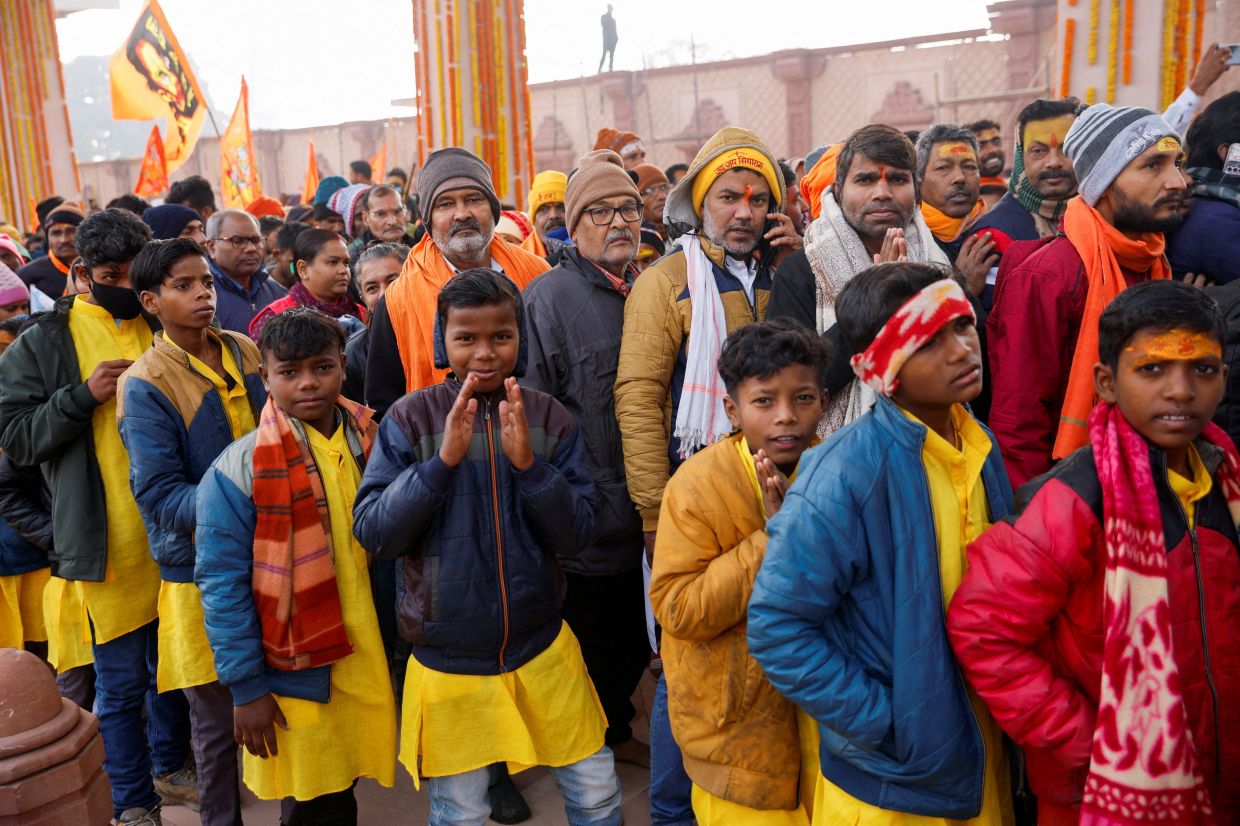
India's newly inaugurated Ram temple in Ayodhya has become the focal point of a broader reckoning with how the country's most revered religious institutions manage the enormous sums of money and precious metals entrusted to them by millions of devotees. A criminal investigation launched in June has resulted in the arrest of eight individuals employed in donation handling roles at the shrine, bringing into sharp relief the financial vulnerabilities that persist at India's largest pilgrimage destinations despite their massive scale and public prominence.
While authorities have refrained from officially confirming the amounts involved, media reports suggest that approximately 30 million rupees—equivalent to roughly US$314,000—may have been diverted through gaps in the temple's donation collection and accounting procedures. The specifics of how the funds were allegedly removed remain unclear, but investigators have identified significant weaknesses in surveillance systems and manual counting protocols that would have enabled undetected theft. The case arrives at a particularly awkward moment for India's most prominent religious institution, which only began formal operations after Prime Minister Narendra Modi's inauguration in 2024 and now attracts some 90,000 visitors daily, each potentially contributing offerings in cash, gold, or other valuables.
For ordinary devotees, the revelation strikes at the core of their religious faith and personal sacrifice. Ashok Prasad Kushwaha, an auto-rickshaw driver from Delhi who has made three pilgrimages to the Ram temple within two years, articulates the emotional impact felt by worshippers across India's deeply religious society. The money that devotees contribute, often from limited personal resources, represents a profound spiritual act undertaken with the conviction that their offerings will directly support religious and charitable work. When donations disappear through administrative negligence or criminal misappropriation, the breach extends far beyond simple theft—it represents a violation of the sacred trust that underpins the relationship between devotees and their temples.
The Ram temple case belongs to an unfortunate pattern that has emerged across India's religious landscape in recent years. Previous scandals have implicated major pilgrimage sites including the Badrinath shrine and the Tirumala Tirupati Devasthanams, a temple trust with documented assets valued at approximately US$31 billion, making it one of the world's wealthiest religious organisations. Each incident has reinforced the reality that India's major temples now operate on scales comparable to multinational corporations, managing budgets that would rival significant commercial enterprises, yet they frequently lack the corresponding financial infrastructure and accountability mechanisms that such scale demands.
The institutional challenge is multifaceted and reflects India's complex regulatory environment. Rahul Easwar, a Hindu activist and grandson of a former chief priest at the prominent Sabarimala temple in Kerala, identifies the fundamental systemic problem as rooted in absence of meaningful transparency and accountability structures within religious institutions. Major temples accumulate vast sums through donation drives that can span entire nations—the Ram temple's construction fundraising campaign itself raised approximately US$341 million—yet many operate with donation management processes that would be considered dangerously antiquated in any secular financial institution. Easwar advocates for comprehensive reforms including mandatory receipt issuance for all donations, replacement of manual systems with digital accounting platforms, extensive closed-circuit television monitoring throughout donation collection areas, and most critically, independent external oversight by authorities unaffiliated with temple management.
The specific vulnerabilities identified at the Ram temple exemplify how even newly constructed facilities can harbour outdated practices. The accused individuals allegedly capitalised on deficient procedures in the physical counting and recording of collected donations, combined with surveillance blind spots that would have concealed their activities from detection. These are not sophisticated crimes requiring technical expertise but rather elementary frauds enabled by neglectful systems that would shame any modern financial organisation. That such lapses exist at India's most visible religious shrine, one literally built under the scrutiny of national political leadership and international attention, underscores how deeply embedded these institutional weaknesses have become across India's religious sector.
The Ram temple itself carries profound historical and political significance that renders these financial allegations particularly sensitive. The shrine stands on a location at the centre of one of independent India's most protracted religious and legal disputes. Hindu tradition holds that the god Ram was born at this exact spot over seven millennia ago, yet for centuries a mosque constructed by a sixteenth-century Muslim emperor occupied the site. This dispute erupted catastrophically in 1992 when Hindu nationalist crowds demolished the Badri mosque, triggering communal violence that claimed more than two thousand lives across India. The 2019 Supreme Court judgment awarding the site for temple construction concluded decades of litigation and religious tension, making the subsequent fundraising drive and temple inauguration occasions of immense symbolic importance to India's Hindu majority.
The political dimensions of the temple compound the urgency of addressing these financial vulnerabilities. Inaugurated by Prime Minister Narendra Modi himself, the Ram temple has assumed a position as one of India's pre-eminent religious and political symbols. Allegations of financial mismanagement at such a high-profile institution inevitably invite questions about oversight and governance that extend beyond religious circles into broader conversations about institutional integrity. The capacity of authorities to respond decisively to wrongdoing at this particular temple will set important precedents regarding accountability across India's religious establishment.
Beyond the immediate Ram temple investigation, the incident illuminates a systemic challenge throughout India's religious sector. The country's temple, church, and mosque systems operate under fragmented legal frameworks and multiple taxation systems, lacking any unified national standard prescribing consistent financial transparency requirements. According to Sonam Chandwani, managing partner at legal firm KS Legal & Associates, this regulatory fragmentation means that oversight standards and accountability mechanisms vary dramatically between institutions, creating opportunities for manipulation and unauthorised fund diversion. A temple in one jurisdiction might operate under entirely different financial reporting requirements than an identical institution in another state, leaving devotees with no consistent baseline assurances regarding fund management.
The scale of India's religious economy adds urgency to these governance questions. Consultancy firm IMARC valued India's religious and spiritual market at US$70.14 billion in 2025, with projections indicating growth to US$135.41 billion by 2034—representing a nearly doubling of financial flows through religious institutions within a single decade. This explosive growth in religious sector revenues makes current governance deficiencies increasingly untenable. Mass pilgrimage events such as the Kumbh Mela, where millions of devotees gather simultaneously and temple staff collect enormous quantities of offerings across multiple days, present particularly acute challenges for maintaining security and transparency. Easwar specifically highlights these mass gatherings as situations where current systems prove wholly inadequate to the scale of financial flows involved.
Political and institutional analysts stress that religious organisations must modernise their financial infrastructure to match their contemporary operational reality. Political analyst Anurag Naidu emphasises that temples have fundamentally transformed from traditional places of worship into complex institutions comparable to large public sector organisations in their financial reach and operational complexity. These institutions now require management systems, financial controls, and independent oversight equivalent to those in major corporations or government agencies. The alternative—permitting vast religious institutions to operate with nineteenth-century financial practices while handling twenty-first-century volumes of money—represents an unsustainable policy position that undermines both public trust and the institutional legitimacy of India's religious establishments.
The path forward requires coordinated action across multiple stakeholders. Religious institutions themselves must voluntarily adopt enhanced transparency measures and digital financial systems; regulators must establish consistent national frameworks prescribing minimum standards across all major temples; and independent oversight bodies must be empowered to conduct regular audits and investigations. For Malaysian and broader Southeast Asian observers, the Ram temple case serves as instructive cautionary example regarding the vulnerabilities that can emerge when massive financial flows concentrate within institutions lacking modern governance structures. As religious institutions across the region similarly accumulate substantial financial resources, questions of accountability and transparency—currently more acute in India—will inevitably surface in Malaysia and other countries with significant religious sectors, making India's current reckoning with temple finances particularly relevant.

