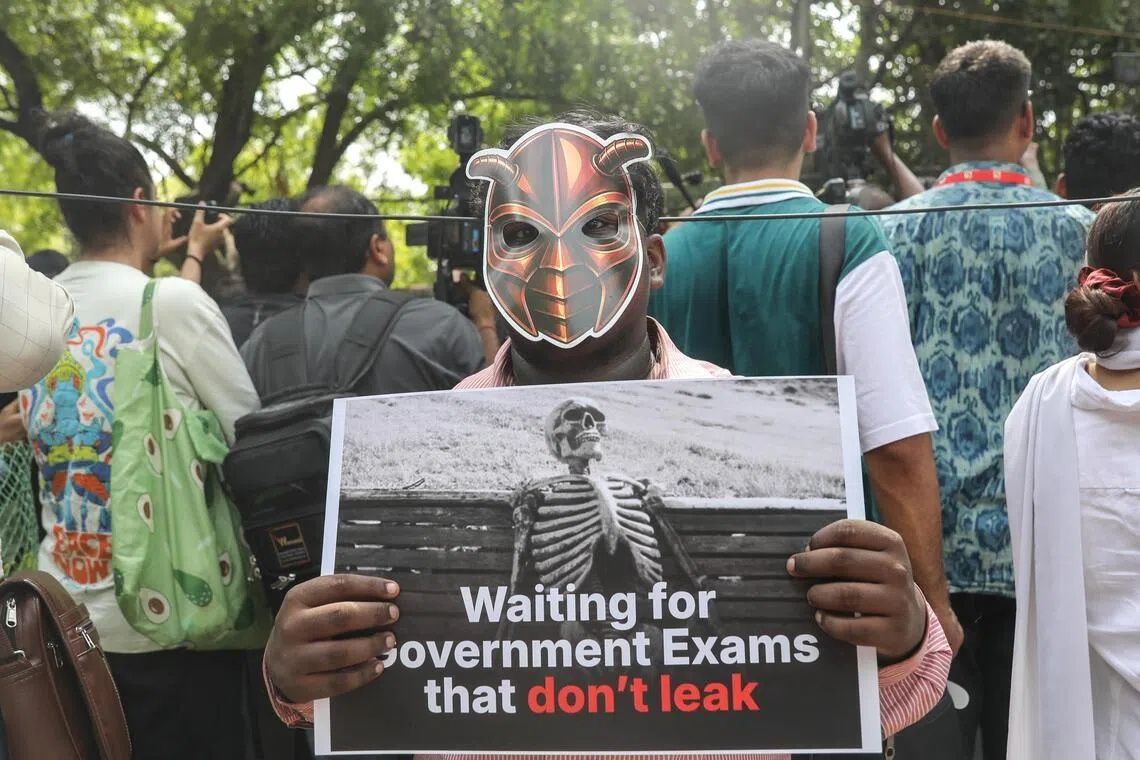
India's ambitious medical entrance examination, a gateway determining the futures of over 2 million students annually, proceeded under unprecedented security protocols on Sunday as authorities attempted to restore credibility to a testing system rocked by a major fraud scandal. The National Eligibility cum Entrance Test, known as NEET, saw its May iteration scrapped entirely after question papers circulated illegally, triggering a cascade of youth protests and public anger that forced the postponement. The retest marked a critical juncture for India's educational establishment, which faces mounting scrutiny over its ability to manage one of the world's most competitive entrance examinations fairly and transparently.
The sheer scale of India's medical education bottleneck explains the intensity surrounding NEET and the desperation that fuels fraud in the system. With roughly 2.2 million candidates competing annually for approximately 100,000 undergraduate medical seats, the examination represents a defining moment in the lives of countless young Indians. The odds are brutally unforgiving—fewer than five per cent of test-takers secure admission to government or private medical colleges. This scarcity has transformed NEET into far more than an academic assessment; it has become a make-or-break gateway that shapes career trajectories and family expectations across the country. The intensity of this competition has inevitably created market conditions that criminal networks and unscrupulous insiders are willing to exploit for profit.
What began as a technical examination failure escalated into a broader institutional crisis when the May paper leak merged with a separate controversy involving the marking of high school board examinations. Reports emerged that students sitting for the online marking system had received incorrect grades or that results were assigned to wrong candidates—a shocking administrative failure affecting nearly two million teenagers. The accumulating failures suggested systemic vulnerability within India's National Testing Agency, raising fundamental questions about whether the organization possessed adequate technical infrastructure and oversight mechanisms. The compounding scandals transformed what might have been contained as isolated incidents into a referendum on the competence and integrity of India's educational administration.
The alleged kingpin identified by India's Central Bureau of Investigation was a chemistry lecturer, highlighting how the leak exploited trusted insiders within the education system. This revelation proved particularly damaging because it demonstrated that no amount of external security could fully protect against determined individuals positioned within institutions themselves. The messaging app Telegram became the identified conduit for sharing leaked materials, with criminal networks using the platform's encrypted channels to distribute question papers to paying clients. The NTA subsequently imposed a week-long ban on the application, though Telegram's founder Pavel Durov immediately dismissed this approach as ineffective, arguing that cheating networks would simply migrate to alternative applications. His assessment pointed to a uncomfortable truth: technology-focused solutions alone cannot address fundamentally human problems of corruption and greed.
For Malaysia and other Southeast Asian nations watching India's examination crisis, the situation offers instructive lessons about the challenges facing educational systems managing mass testing at scale. India's experience demonstrates how rapid expansion of testing infrastructure without adequate safeguards can create vulnerabilities that sophisticated fraudsters are equipped to exploit. The incident also underscores the psychological toll on students when trust in examination integrity collapses. Reports indicated that some teenagers had taken their own lives following the leak and cancellation, reflecting the crushing pressure and despair that emerges when students believe the system has failed them irredeemably.
The retest deployed comprehensive counter-measures designed to prevent recurrence of the May catastrophe. Authorities positioned more than 200,000 officials, including police personnel, across examination centres nationwide. The National Testing Agency implemented what it termed a "multi-layered security framework" encompassing biometric authentication systems, artificial intelligence-enabled camera surveillance monitoring examination halls, and GPS tracking of physical question papers to monitor their movement and prevent unauthorized distribution. These technological layers represented a significant investment in security infrastructure, reflecting the government's determination to salvage the testing system's reputation. The examination commenced at 2pm local time under these fortified conditions.
Yet the security measures themselves triggered debate about proportionality and the message being conveyed to students. The heavy police presence and surveillance apparatus transformed examination centres into highly controlled environments that some observers felt diminished the educational experience and reflected a fortress mentality. The week-long ban on Telegram, while symbolically significant, proved controversial among citizens who questioned whether restricting a communication platform served educational integrity or instead demonstrated governmental overreach. These tensions highlighted the difficulty of responding to institutional failures in ways that are simultaneously reassuring to stakeholders while avoiding measures that appear heavy-handed or counterproductive.
The political ramifications extended into the upper echelons of India's government, with Education Minister Dharmendra Pradhan facing mounting demands for resignation. Public anger crystallized around the unprecedented emergence of a satirical political movement—the self-described "Cockroach People's Party"—which accumulated millions of followers following its May launch. While satirical in presentation, the movement's demands for ministerial accountability reflected genuine frustration with governance failures. The movement represented a creative form of youth political expression and illustrated how examination failures can galvanize broader critiques of governmental competence and educational administration.
The underlying issue that Telegram's Pavel Durov highlighted—that organizational insiders rather than technological vulnerabilities represented the fundamental problem—suggested that even comprehensive security measures might fail to fully prevent future leaks without systemic reforms addressing corruption within institutions. India faces the challenging task of rebuilding institutional trust while simultaneously implementing technological safeguards and investigating whether other officials beyond the identified chemistry lecturer were complicit in distributing examination materials. The retest represented one chapter in a longer narrative of institutional reform that will likely extend well beyond the immediate examination cycle.
For students who had already experienced the trauma of a cancelled examination, prepared extensively for a second attempt, and now faced heightened security procedures, the retest carried emotional weight beyond its technical or administrative dimensions. Many candidates expressed anxiety about whether the retest would proceed without further complications, whether their preparations would prove sufficient, and whether the postponement had disadvantaged them relative to medical students in other countries. The examination process had transformed from a straightforward assessment into a symbol of institutional dysfunction and, for many, a source of psychological distress. India's medical education system, once it weathered this immediate crisis through the successful completion of the retest, would need to address deeper questions about structural reform to prevent recurrence of such failures and to restore confidence among the hundreds of millions of students who depend upon fair and transparent entrance examinations for their educational advancement.

