The battle against human trafficking in Malaysia appears to be gaining ground, with official rescue figures tumbling dramatically over the past three years. Data unveiled by the Deputy Human Resources Minister suggests that enforcement strategies are bearing fruit, though he tempered optimism with a crucial caveat: the documented numbers may represent only the tip of a much larger iceberg of exploitation occurring beyond official view.
The Peninsular Malaysia Manpower Department released figures showing a stark compression in identified victims. In 2023, authorities rescued 70 individuals trapped in trafficking and forced labour situations. That number halved to just 10 by 2024, then climbed modestly to 17 in 2025 before tapering to four cases recorded through May 2026. Taken at face value, this trajectory suggests intensifying government action is successfully disrupting trafficking networks and identifying vulnerable persons. Datuk Khairul Firdaus Akbar Khan acknowledged the positive signal these statistics send while immediately injecting a note of caution about what remains hidden from official radar.
The declining trend arrives as Malaysia intensifies its compliance with international labour standards. The government has ratified protocols through the International Labour Organisation addressing forced labour and trafficking, anchoring its domestic enforcement agenda within a global framework designed to combat these crimes. This alignment with ILO requirements signals growing institutional commitment to systematising anti-trafficking work across government departments and enforcement agencies. The convergence of domestic law enforcement with international protocols creates multiple pressure points on trafficking operations, theoretically tightening the noose around exploiters.
Behind the headline statistics lies substantial operational activity. From January through May 2026 alone, authorities conducted 386 enforcement operations targeting labour exploitation nationwide. These operations generated 311 investigation papers, meaning roughly 80 percent of inspections uncovered sufficient evidence to warrant formal investigation. The sheer volume of operations indicates Malaysia's enforcement bodies are actively hunting for violations rather than passively waiting for reports to arrive. This proactive posture differs markedly from enforcement models that rely primarily on victim complaints or NGO referrals.
Yet the minister's candid acknowledgement that unreported cases likely dwarf the official figures carries profound implications. Human trafficking thrives in invisibility—victims isolated by language barriers, immigration status, debt bondage, or psychological coercion rarely approach authorities. Women and girls trafficked into sex work, migrant workers locked into debt-servitude arrangements, and domestic servants confined to private homes often remain beyond enforcement sight. The official four cases recorded through May 2026 almost certainly represent rescued individuals whose situations became visible through workplace inspections, NGO intervention, or victim self-reporting. Countless others endure exploitation in the shadows, making the true prevalence of trafficking substantially higher than raw rescue statistics suggest.
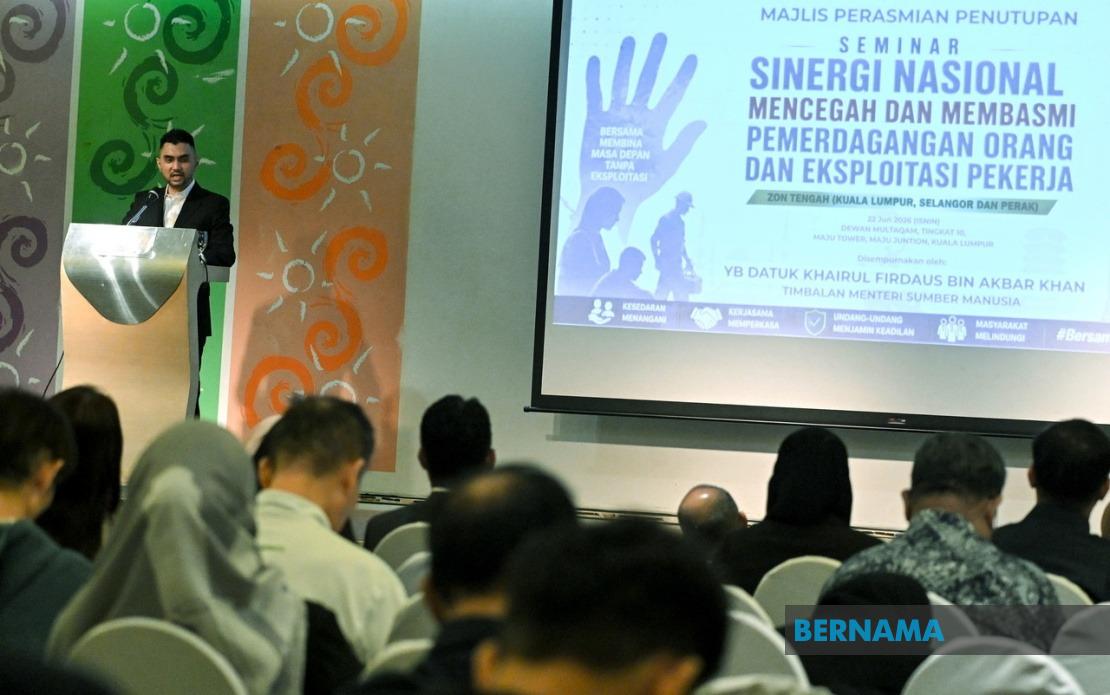
Government officials have undertaken what they term National Synergy Seminars to build awareness and coordinate responses across regions. These knowledge-sharing forums, held in Sungai Petani in Kedah during the North Zone session, Kluang in Johor for the South Zone, and the Central Zone in Kuala Lumpur, attracted nearly 1,000 participants drawn from various stakeholder communities. By convening police, labour inspectors, NGOs, businesses, and civil society actors, these seminars attempt to weave trafficking prevention into the operational consciousness of frontline workers and institutional actors. The seminars serve an educational function while also surfacing ground-level intelligence about trafficking patterns and vulnerabilities.
The geographical spread of these awareness initiatives reflects acknowledgment that trafficking operates differently across Malaysia's regions. Coastal and border areas face distinct trafficking patterns compared to urban manufacturing zones or agricultural regions. Rural Kedah may experience different labour trafficking dynamics than industrial Johor or the Federal Territories. Tailoring messaging and capacity-building to regional realities increases likelihood that frontline workers will recognise warning signs and respond appropriately. This decentralised approach contrasts with one-size-fits-all national campaigns that sometimes miss region-specific vulnerabilities.
Malaysia's trafficking challenge occurs within a broader Southeast Asian context of highly mobile populations, porous labour markets, and significant wage differentials that create economic incentives for exploitation. Migrant workers flowing from Myanmar, Bangladesh, Indonesia, and Cambodia into Malaysian employment sectors including construction, manufacturing, domestic work, and agriculture represent substantial vulnerable populations. These workers often arrive through brokers who extract recruitment fees, creating immediate debt that traffickers exploit to bind workers to unfavourable employment terms. The regional dimension of Malaysia's trafficking problem extends enforcement challenges beyond bilateral cooperation into complex multilateral coordination across ASEAN nations.
The reported declining trend must therefore be contextualised within Malaysian discussions about enforcement capacity and resource allocation. If fewer victims are being rescued because enforcement intensity has genuinely disrupted trafficking networks, that represents meaningful progress. Conversely, if declining numbers simply reflect constrained investigative resources, overwhelmed inspection regimes, or worker populations becoming more cautious about approaching authorities, then official figures mask deteriorating ground conditions. The distinction between these possibilities carries critical implications for policy adjustment and resource planning.
Looking forward, Malaysia's anti-trafficking architecture appears to rest on three interconnected pillars: active enforcement operations generating investigation cases, awareness and capacity-building among frontline actors, and alignment with international labour standards that create enforcement consistency across borders. The modest decline in official rescue figures may indeed reflect some effectiveness within this framework. However, sustained progress requires acknowledging that each officially rescued victim likely represents dozens whose situations remain unknown, embedding humility within bureaucratic assessment of anti-trafficking progress and maintaining pressure on enforcement systems to expand their reach into trafficking's hidden spaces.

