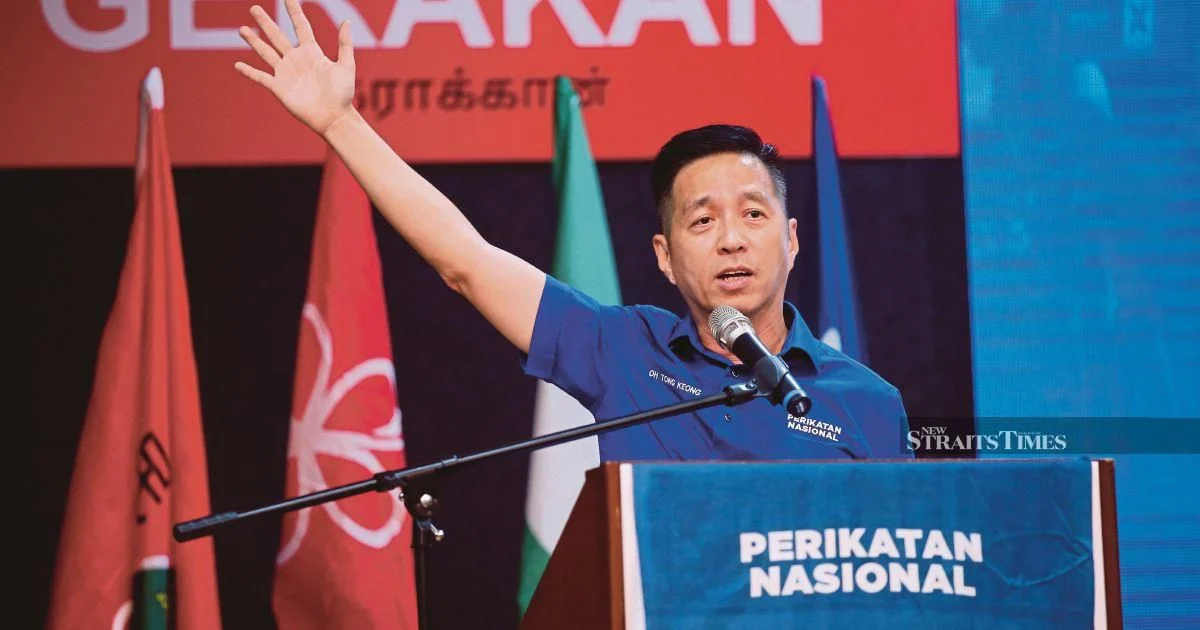
Gerakan, the Malaysian Chinese Association's political cousin that has long sought relevance in national and state politics, has chosen to step back from contesting the Johor state election. The decision, disclosed by party election director Oh Tong Keong, represents a strategic recalibration that sees the party prioritizing support for other Perikatan Nasional component parties rather than fielding its own candidates in Malaysia's second-largest state by population.
This move reflects a broader shift in Gerakan's positioning within the PN coalition, which has emerged as a substantial political force particularly in Peninsular Malaysia. By vacating the electoral arena in Johor, Gerakan is effectively consolidating its influence by amplifying the candidacies of its coalition partners, signalling a deeper integration of electoral strategies across the PN bloc. The party's recognition that its own electoral competitiveness in Johor may be limited has led to what party leadership views as a more pragmatic allocation of political capital.
The context surrounding Gerakan's withdrawal is crucial for understanding contemporary Malaysian coalition politics. Gerakan historically served as an important moderate voice within Barisan Nasional, the ruling coalition that held power for six decades until 2018. However, the party's electoral fortunes have declined substantially, with its parliamentary representation shrinking to minimal levels. The party's decision to support PN partners rather than contest directly suggests that party strategists have concluded that channelling resources toward allied parties offers better prospects for influence within government structures following elections.
Perikatan Nasional itself has undergone significant evolution since its formation in 2019. Originally positioned as an alternative to BN, the coalition now incorporates both conservative Islamic-leaning and secular-liberal parties, making it a complex political entity. Gerakan's role within this framework is to maintain the coalition's appeal to Chinese voters and urban constituencies, a demographic calculus that may not require the party to field numerous candidates directly. By acting as a force multiplier for PN component parties, Gerakan can maintain presence and leverage without shouldering the financial and organizational burden of full electoral participation.
Johor carries outsized significance in Malaysian politics due to its size, economic importance, and historical role as a kingmaker in coalition mathematics. The state has experienced volatile political fortunes in recent years, with the 2022 state election resulting in a complex arrangement where no single coalition achieved outright majority. This fragmented environment has created opportunities for smaller parties to occupy pivotal positions, which may partly explain Gerakan's strategic recalculation. By supporting established PN allies rather than attempting to build its own mandate, the party positions itself as a cooperative partner whose interests would be respected in any coalition-building negotiations.
Gerakan's electoral withdrawal also carries implications for Chinese political representation in Malaysia. The party has traditionally positioned itself as guardian of moderate Chinese interests, contrasting with Democratic Action Party, which represents more left-leaning and opposition-oriented Chinese voters. By consolidating behind PN partners rather than contesting independently, Gerakan implicitly acknowledges that Chinese voter preferences may be more effectively channelled through established parties with stronger organizational infrastructure and electoral appeal. This represents a rationalization of what has become an increasingly crowded field for Chinese-focused political representation.
The party's election director Oh Tong Keong's public announcement of this decision signals that the withdrawal is neither temporary nor tactical. Rather, it appears to reflect considered strategic judgment about how best to leverage the party's remaining organizational assets and goodwill. This transparency also serves to frame the withdrawal positively—as a mature coalition decision rather than a result of factional defeat or electoral desperation. Such framing becomes important for maintaining party morale and preventing the perception that Gerakan has been sidelined by PN leadership.
Looking forward, Gerakan's supporters and members will be watching closely to assess whether the party gains meaningful dividends from its coalition loyalty. If PN partners who benefit from Gerakan's non-participation subsequently advance party interests in state and federal governments, the withdrawal strategy will be vindicated. Conversely, if Gerakan finds itself marginalized despite its cooperative stance, internal pressures may mount for a return to more independent political contestation. This dynamic will shape not only Gerakan's trajectory but also broader coalition stability within PN.
The implications extend to Malaysian electoral strategy more broadly. Gerakan's move exemplifies how smaller parties in coalition environments face constant pressure to optimize their political positioning, sometimes by reducing rather than expanding their public-facing electoral presence. For Malaysian voters, particularly those accustomed to seeing Gerakan candidates on ballots, the withdrawal represents a further concentration of electoral choice around larger party vehicles. Whether this consolidation ultimately strengthens or weakens coalition governance remains an open question that will become clearer as election results and subsequent coalition negotiations unfold in Johor and beyond.

