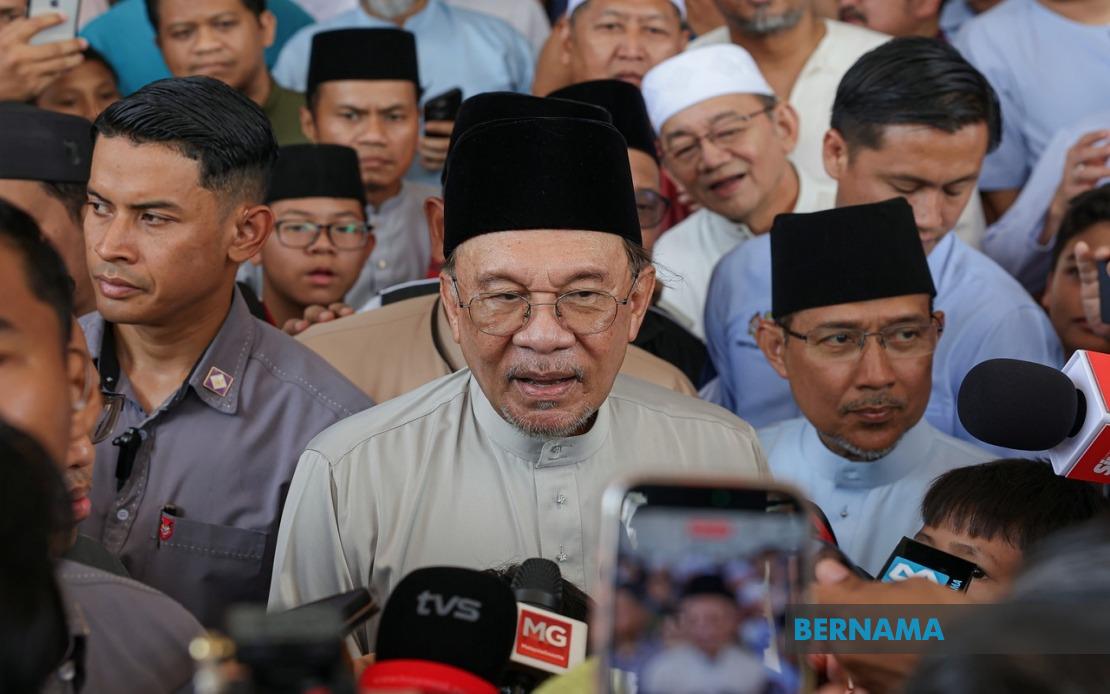
Prime Minister Datuk Seri Anwar Ibrahim has declared that the government has made public the entire Royal Commission of Inquiry report into Tabung Haji's management and operations without suppressing or removing any sections, marking a significant move towards institutional transparency in Malaysia's governance. Speaking to journalists after Friday prayers at Masjid Kariah Paroi Jaya in Seremban on July 31, the Prime Minister emphasised that the decision to release the 211-page document in its full form reflected the government's commitment to accountability and public oversight. The report, initially published by the Department of Islamic Development Malaysia (JAKIM) the previous Wednesday, examines Tabung Haji's operations across the period from 2014 to 2020.
Anwar's assertion that no censorship occurred carries particular weight given Malaysia's complex political environment and the historical tendency of governments to carefully control sensitive information. By stating categorically that the Prime Minister's Department made no modifications to the content, Anwar signalled a departure from previous approaches where official reports were sometimes withheld or redacted to protect certain interests. The comprehensive nature of the disclosure—including not merely findings but also recommendations and procedural documentation—demonstrates an intention to enable substantive public and expert analysis rather than merely selective information release. This approach contrasts sharply with earlier patterns in Malaysian governance where institutional inquiries were sometimes delayed or published in heavily modified form.
The Prime Minister underscored that the government's primary motivation in releasing the full report was to facilitate learning across Malaysian society, particularly among the Muslim majority who form Tabung Haji's primary constituency. By making the document accessible for public examination, Malaysian citizens and civil society organisations can scrutinise the commission's conclusions independently rather than relying on government interpretation or media summaries. This approach acknowledges that institutional failures require sustained public engagement and memory to prevent recurrence. Anwar's framing positioned transparency not as a political favour but as an essential foundation for systemic reform, suggesting that withholding any portion of the report would undermine its educational and preventive value.
Crucially, Anwar indicated that the Cabinet had explored extending the inquiry's scope beyond the 2014-2020 period during its deliberations. The suggestion that the government considered examining events after 2020, and potentially events before 2014, reveals awareness that institutional problems typically do not confine themselves neatly to arbitrary timeframes. By releasing the published report while acknowledging internal discussion about broader coverage, Anwar demonstrated nuanced thinking about accountability—recognising that a thorough reckoning requires understanding both historical context and subsequent developments. The implicit suggestion that additional review of post-2020 management measures and current Tabung Haji board actions may follow indicates this inquiry should not be viewed as conclusive but rather as an opening to ongoing scrutiny.
The Prime Minister's emphasis on prosecutorial accountability represents another critical dimension of the transparency move. Anwar stated unequivocally that individuals found responsible for wrongdoing must face investigation and legal consequences according to established judicial processes. This declaration attempts to bridge the gap between transparency and accountability, suggesting that releasing information is merely the preliminary step toward formal consequences for misconduct. By anchoring potential prosecutions within established legal frameworks rather than extra-judicial action, Anwar signalled respect for due process while maintaining that transparency cannot become an empty gesture divorced from substantive accountability.
The question of whether full disclosure might destabilise the Unity Government coalition provides important context for understanding this decision's political dimensions. Anwar's response that Deputy Prime Minister Datuk Seri Dr Ahmad Zahid Hamidi and other Cabinet colleagues supported the full release offers reassurance about internal coalition stability. By explicitly crediting Zahid's support, Anwar prevented the transparency decision from being portrayed as unilateral action imposed by the Prime Minister's office. This collaborative framing suggests that even politically sensitive institutional inquiries can be navigated within Malaysia's current multiparty government structure, though the very need to emphasise Zahid's backing indicates that publishing such reports does involve calculated political risk management.
When questioned about whether the timing of the report's release might influence voter sentiment ahead of the Negeri Sembilan state election scheduled for the following day, Anwar rejected the suggestion that electoral considerations had influenced the disclosure. His assertion that institutional failure constitutes too serious a matter to be subordinated to short-term political gains reflects an attempt to position the government above partisan manipulation. However, the fact that this question arose and required explicit denial underscores how Malaysian voters and observers naturally assess whether government actions serve institutional reform or electoral advantage. Anwar's acknowledgment that voters might struggle to comprehend the report's significance within a brief timeframe was notably candid, suggesting realistic assessment of public attention and political education challenges rather than naive assumption of instant comprehension.
Tabung Haji itself represents an institution of considerable social and financial significance in Malaysia. As the pilgrimage savings fund serving millions of Muslim Malaysians, its management affects not only individual life savings but also broader perceptions of how the state manages religiously significant institutions. Failures in Tabung Haji's governance therefore strike at multiple levels—personal financial security, institutional integrity, and public confidence in state management of Islamic affairs. The Royal Commission of Inquiry emerged precisely because accumulated concerns about management quality, investment decisions, and operational transparency had reached sufficient severity to warrant formal investigation. Releasing the full report acknowledges that these accumulated problems require public awareness and collective problem-solving rather than bureaucratic containment.
The release of the Tabung Haji RCI report without redactions establishes a precedent with implications extending beyond this single institution. Future inquiries into governance failures will now face public and media expectations that findings be released in complete form, creating pressure for consistency in institutional transparency. This precedent-setting function may prove as significant as the immediate transparency of Tabung Haji's particular problems. Malaysian civil society, opposition parties, and independent analysts will likely reference this full disclosure when demanding comprehensive release of other sensitive institutional inquiries. The government's decision thus reflects not merely response to immediate circumstances but rather a potentially consequential shift in expectations around official accountability and public access to institutional information.
For Southeast Asian readers and observers, Malaysia's approach to the Tabung Haji inquiry offers insights into how developing democracies navigate the tension between transparency and institutional stability. The region comprises diverse governance models, with some nations maintaining far more restrictive approaches to official information disclosure. Malaysia's move toward comprehensive public release of sensitive institutional inquiries demonstrates one pathway for balancing openness with stability, though implementation remains imperfect. The question of whether this precedent will be consistently followed, or whether future politically sensitive inquiries receive less comprehensive treatment, will substantially influence whether this moment represents genuine institutional transformation or selective transparency employed in specific circumstances.

