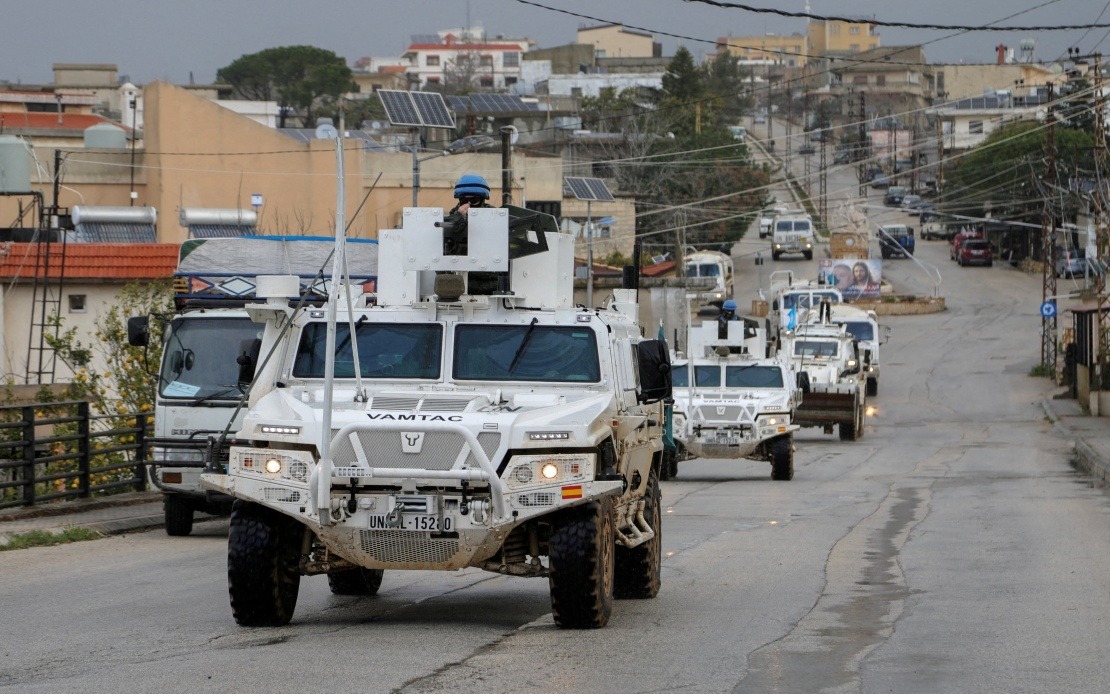
France and Italy have committed to building a multinational coalition that will step in to support Lebanon once the United Nations Interim Force in Lebanon wraps up its operations at the end of December, French President Emmanuel Macron announced following talks with Italian Prime Minister Giorgia Meloni in Antibes on Thursday. The initiative represents a coordinated European response to a potential security vacuum that could emerge as the decades-long UN peacekeeping deployment draws to a close.
Macron articulated the coalition's primary objectives as strengthening Lebanon's institutional capacity and bolstering its armed forces, while operating in close cooperation with both the European Union apparatus and the United Nations system. The French leader emphasised that preventing Lebanese territory from becoming a flashpoint for wider regional tensions remains a central concern driving the partnership. This framing reflects growing anxiety among Western capitals about the strategic consequences of UNIFIL's departure and the risks of power vacuums being exploited by hostile actors in the volatile Eastern Mediterranean.
Meloni reinforced these concerns, cautioning that allowing an "extremely dangerous" security void to develop in Lebanon could trigger instability with far-reaching consequences. Italy's position underscores how European nations beyond France view the stakes as existential for regional order. The coalition concept acknowledges that traditional UN peacekeeping mechanisms may no longer suffice for maintaining stability in an increasingly complex conflict environment.
The timing is significant given that Security Council Resolution 2790 mandates UNIFIL's operational cessation on December 31, with complete personnel withdrawal scheduled within twelve months thereafter. This compressed timeline creates genuine operational challenges for designing and deploying an alternative framework. Unlike UNIFIL, which operated under a UN mandate with associated legitimacy and resource frameworks, a new European-led coalition would require separate legal authorisation and funding mechanisms that remain to be negotiated.
For Southeast Asian observers, the Lebanon scenario offers instructive parallels to regional peacekeeping dynamics. Malaysia has maintained consistent engagement with Lebanese affairs through diplomatic channels and has contributed to UN operations across the Middle East. The French-Italian model of building multinational coalitions outside formal UN structures might influence how regional powers approach potential peacekeeping gaps in Southeast Asia, where similar questions about post-mission stability arise in contexts ranging from Myanmar to the South China Sea.
The coalition concept also reflects evolving European strategic thinking about burden-sharing in global stability operations. Rather than relying exclusively on UN mechanisms, which have become increasingly hamstrung by Security Council gridlock, European states are exploring flexible multilateral arrangements that can mobilise resources and political will more rapidly. This pragmatic approach signals frustration with traditional institutions while attempting to maintain some coordination architecture.
Lebanon's internal political fragmentation complicates any external support effort. The country has struggled with state capacity challenges for decades, and institutional weakness predates UNIFIL's arrival. A post-UNIFIL coalition would need to navigate sectarian sensitivities carefully, ensuring that foreign military presence does not become a lightning rod for domestic political divisions or serve as a pretext for Iranian and proxy-aligned forces to consolidate territorial control in the north and eastern regions.
The absence of explicit details about military capabilities, troop numbers, or command structure in the initial announcement suggests negotiations remain in early phases. How contributors will be selected, whether forces will operate under a unified command, and what rules of engagement will govern their operations remain unresolved. These practical questions will determine whether the coalition functions effectively or becomes a hollow gesture unable to prevent deterioration.
Regional states including Saudi Arabia, the United Arab Emirates, and Israel hold stakes in Lebanon's trajectory that will shape their responses to European coalition plans. Coordination with these actors, particularly Israel given its border concerns, will prove diplomatically delicate. European messaging emphasizing Lebanese sovereignty and institutional strengthening may resonate in some quarters while drawing suspicion from actors fearing Western dominance over Lebanese affairs.
The coalition initiative also reflects implicit recognition that Lebanon's stability cannot be separated from broader Middle Eastern geopolitical competition. Without addressing underlying regional tensions involving Iran's regional posture, Israeli security concerns, and Palestinian-Israeli dynamics, any multinational force risks becoming trapped in a symptom-management operation rather than enabling genuine conflict resolution.
For Malaysia and other Southeast Asian nations, the European approach offers lessons about constructing alternatives to stalled UN processes while maintaining some legitimacy through coordination with the international system. Whether this model proves durable or becomes another example of ad-hoc foreign interventions producing limited results will shape perceptions of multilateral peacekeeping architecture for years ahead.
As planning proceeds toward implementation, the coalition's credibility will depend on securing adequate resources, establishing robust command relationships among participating nations, and securing explicit consent from Lebanon's government. The coming months will reveal whether this represents genuine strategic commitment or optimistic rhetoric that crumbles when operational realities emerge.

