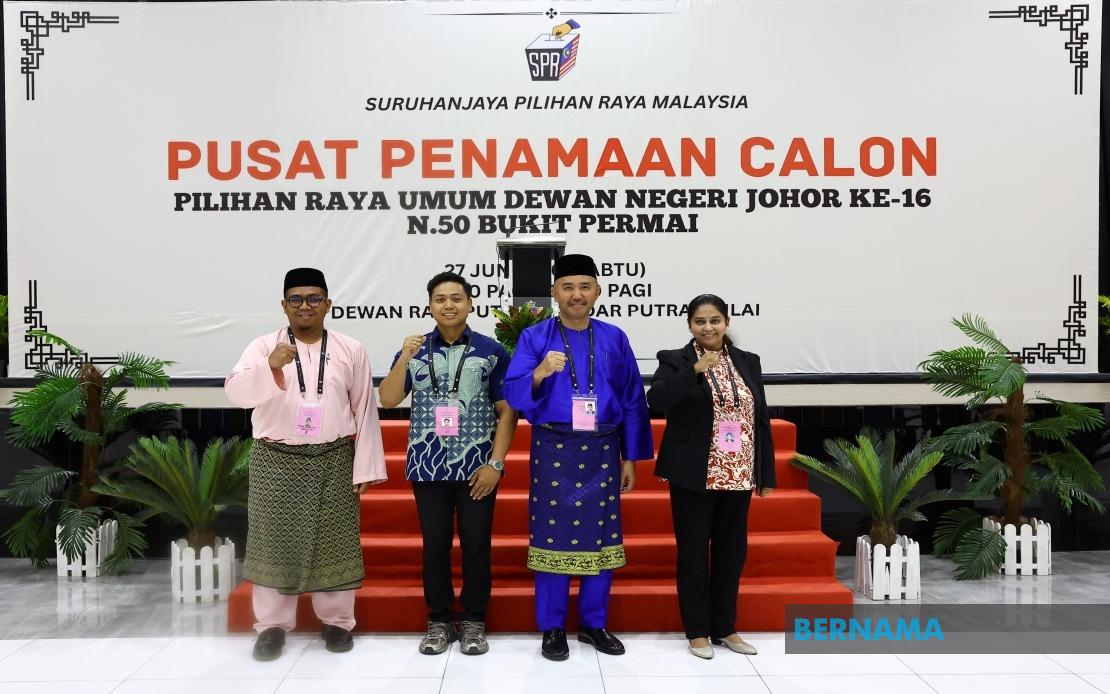
The Bukit Permai state assembly seat in Johor is set for a keenly contested four-way battle as incumbent Barisan Nasional representative Datuk Mohd Jafni Md Shukor makes his bid for re-election in the 16th state election. The returning officer formally confirmed the slate of candidates after the nomination process concluded on June 27, setting the stage for what promises to be a closely watched contest in the southern state.
Mohd Jafni faces three challengers seeking to unseat him from the Bukit Permai constituency. Mohamad Shafwan Ani represents the opposition Pakatan Harapan coalition, while M. Lina Manoh carries the Perikatan Nasional banner. The fourth contestant, Muhammad Aidil Riduan Mohd Yusof, campaigns under the banner of the newer Parti Bersama Malaysia, reflecting the increasingly fragmented political landscape in Malaysian electoral contests.
The nomination process unfolded at Dewan Raya Putra in Bandar Putra, where returning officer Afzan Azhari officially announced the competing candidates following the 10 am deadline. The presence of Johor DAP chairman Teo Nie Ching at the nomination centre, accompanying Mohamad Shafwan's candidacy, underscores the importance that the Pakatan Harapan coalition places on the Bukit Permai seat as it seeks to challenge the long-standing dominance of Barisan Nasional in the region.
Mohd Jafni enters this election campaign from a position of relative strength, having successfully defended the seat in the 2022 Johor state election with a commanding majority of 4,755 votes, even when facing a four-cornered contest that year. His track record suggests he has built substantial support within the constituency, though the changing political dynamics and the emergence of new political actors could complicate his path to another victory.
The composition of this electoral contest reflects broader patterns in Malaysian politics post-2022. The presence of four distinct candidates indicates that the traditional two-coalition framework has become more porous, with Parti Bersama Malaysia's participation representing an attempt to carve out political space beyond the established BN-PH-PN alignments. This fragmentation could potentially redistribute votes in unpredictable ways, creating opportunities for surprising results.
For Pakatan Harapan, Bukit Permai represents strategic importance as the coalition attempts to consolidate and expand its support base across Johor. The state has historically been a BN stronghold, and any gains here would represent meaningful progress for the opposition. Mohamad Shafwan's nomination reflects PH's determination to contest aggressively across the state's marginal and even seemingly safe seats.
The Perikatan Nasional challenge through M. Lina Manoh adds another layer to an already complex electoral equation. PN's presence in Johor contests serves to complicate the opposition vote in ways that could ultimately benefit the incumbent, though the specific voting patterns in Bukit Permai remain uncertain. The presence of multiple non-BN candidates raises questions about whether opposition votes will consolidate behind a single alternative or splinter across multiple candidates.
Muhammad Aidil Riduan's candidacy for Parti Bersama Malaysia marks the most unpredictable element in this contest. As a relatively new political vehicle in Malaysian electoral politics, the party's appeal and mobilisation capacity in constituencies like Bukit Permai remain largely untested. Nevertheless, any votes captured by Bersama could prove decisive in a closely contested race.
Election officials have already set the calendar for the poll process, with early voting scheduled for July 7 and the main polling day fixed for July 11. This timeline provides candidates with limited weeks to campaign and persuade voters, particularly given the need to navigate the constraints of the campaigning period and the complexity of appealing to a diverse electorate in a four-way contest.
The Bukit Permai contest will offer valuable insights into voting behaviour across Johor, particularly regarding how electors respond to increased electoral fragmentation and what factors drive decision-making when multiple credible alternatives compete for their support. The seat could serve as a microcosm for understanding broader electoral trends shaping the state and the nation.
For Malaysian political observers, the Bukit Permai race encapsulates the evolving nature of electoral competition in major states. The interplay between an entrenched incumbent, a resurgent opposition, a regionally competitive third force, and an emerging political newcomer creates a complex dynamic that reflects the underlying fluidity within the Malaysian political system despite superficial appearances of stability.

