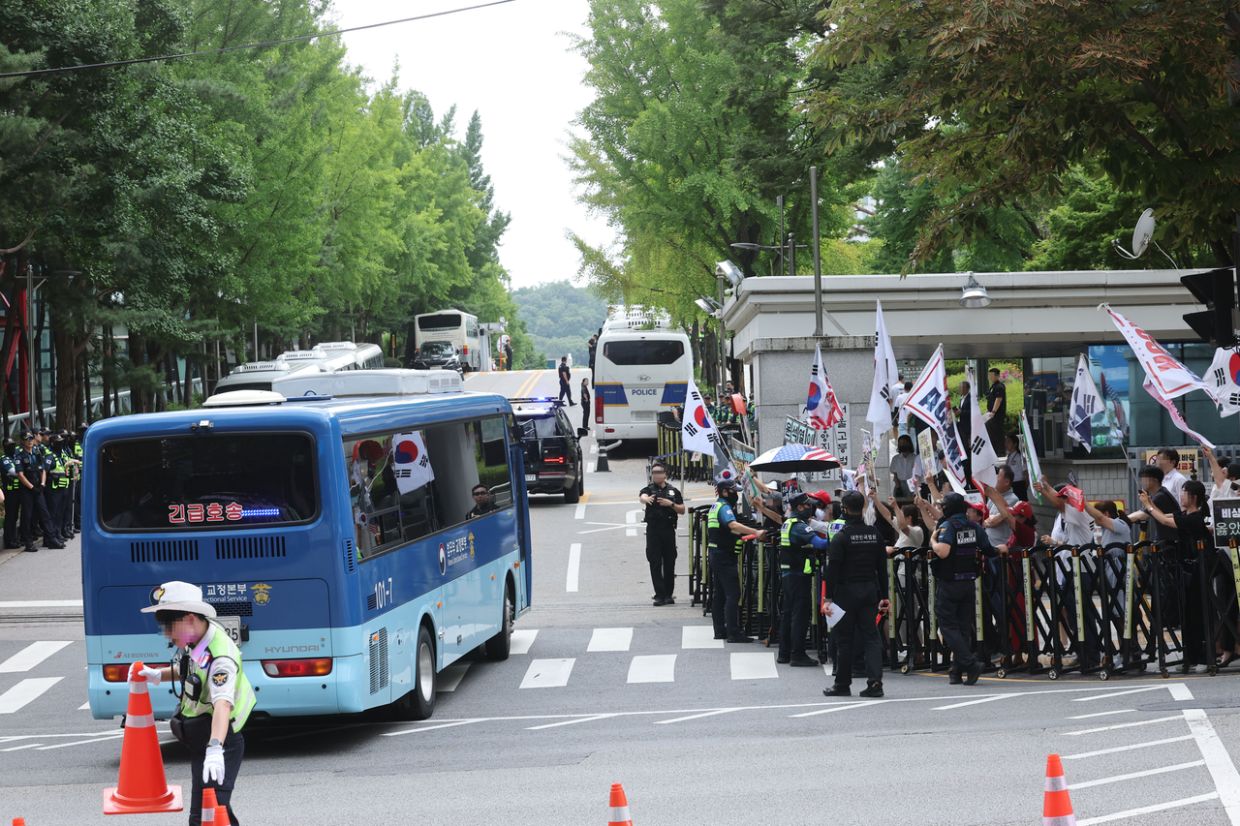
Former President Yoon Suk Yeol received a two-year prison sentence on Monday after the Seoul Central District Court found him guilty of breaching South Korea's Political Funds Act by accepting complimentary polling services during his presidential campaign. The court determined that political broker Myung Tae-kyun provided 14 surveys worth 27.92 million won ($18,600) to Yoon's team without proper legal documentation or compensation, constituting an illegal in-kind campaign contribution. The conviction marks a significant moment in South Korean politics, as it holds a former head of state accountable for campaign finance violations at a time when the nation grapples with accountability mechanisms for its political elite.
The judicial findings established that Yoon and his wife, former First Lady Kim Keon Hee, orchestrated the arrangement with Myung through a series of informal agreements and tacit understandings rather than explicit written contracts. The court determined that Kim Keon Hee authorized Myung to control crucial aspects of the polling operations, including timing, content, methodology, and decisions about which results would be made public. Yoon, according to the judgment, was fully informed of this arrangement and implicitly consented to it by accepting the survey data and leveraging the insights for strategic campaign decisions. This finding of successive and tacit agreement proved crucial to the conviction, demonstrating that campaign finance violations need not involve crude, explicit transactions to constitute law-breaking.
Presiding Judge Lee Jin-gwan articulated the court's reasoning by emphasizing the foundational role of opinion polls in democratic processes. The judge stressed that when political actors receive contributions outside the strict framework established by the Political Funds Act, and polling agencies respond by providing survey results in kind, the entire electoral system faces distortion. Public opinion becomes a commodity to be manipulated rather than an authentic reflection of voter sentiment, undermining the fairness essential to competitive democracy. This judicial philosophy reflects growing international concern about how financial advantages in campaigning translate into informational asymmetries that benefit well-funded candidates and disadvantage challengers operating within stricter financial constraints.
The prosecution had initially alleged that Yoon received 58 free surveys valued at more than 270 million won across an eighteen-month window from June 2021 through March 2022. However, the court's evidentiary threshold proved more exacting. Judges found sufficient proof to convict Yoon only for 14 of the surveys, calculating the total financial benefit at 27.92 million won. This more restrictive finding suggests the court applied rigorous standards to the evidence presented, declining to extrapolate from the pattern established by the proven violations to encompass the entire alleged scheme. The distinction between what prosecutors charged and what judges convicted demonstrates the importance of documentary evidence and corroboration in Korean campaign finance jurisprudence.
Beyond the polling services themselves, the court found that Yoon leveraged his influence to fulfill a quid pro quo arrangement with Myung. Specifically, Yoon promised that former lawmaker Kim Young-sun would receive the ruling People Power Party's presidential nomination in return for the polling services. The court traced Yoon's subsequent efforts to execute this commitment, documenting how he exerted influence over the party's nomination process through Chang Je-won, who served as chief of staff to the president-elect. This element of the case demonstrates how campaign finance violations frequently intersect with patronage systems and party control mechanisms, where campaign contributions translate into concrete political favours and preferential treatment.
Interestingly, the court indicated that establishing the quid pro quo arrangement was not technically necessary to prove a Political Funds Act violation. This legal principle holds significant implications for future campaign finance prosecutions, as it allows courts to convict politicians of accepting illegal contributions without requiring prosecutors to demonstrate an explicit exchange of campaign support for political benefits. The ruling essentially recognizes that the mere acceptance of valuable services outside the prescribed legal framework constitutes sufficient violation, even if the underlying motivation remains ambiguous or multifaceted.
Myung Tae-kyun, the political broker who facilitated the arrangement, received an 18-month prison sentence and was taken into custody immediately upon the verdict. His more lenient sentence compared to Yoon's reflects his lower position in the political hierarchy and arguably his smaller degree of culpability. As a professional pollster accustomed to working with political figures, Myung arguably faced greater pressure from a former presidential candidate than vice versa. Nevertheless, his conviction underscores that individuals providing in-kind contributions to campaigns also face legal exposure, creating incentives for stricter adherence to campaign finance regulations throughout the political ecosystem.
Notably, the court's treatment of Yoon diverged significantly from its earlier rulings regarding Kim Keon Hee in her separate case involving identical polling services. Kim faced acquittal at both trial and appellate levels on related Political Funds Act charges. Judge Lee explained that the allegations concerning the polling services provided by Myung differed substantially between the two cases, though the specific factual distinctions were not exhaustively detailed in available court documents. In Kim's case, lower courts concluded that prosecutors failed to demonstrate she received measurable financial benefit equivalent to the surveys' cost or that the polling services were granted in exchange for Kim Young-sun's party nomination.
The divergent outcomes for Yoon and Kim Keon Hee raise intriguing questions about legal culpability, evidentiary standards, and the differing roles played by spousal partners in political operations. The fact that Kim received acquittals despite being involved in authorizing Myung's operations suggests the courts may have applied different causality standards or required more direct evidence of her personal benefit. Alternatively, judges may have determined that Yoon bore greater responsibility as the politician directly seeking office and thus bearing fuller accountability for the campaign apparatus. The Supreme Court's scheduled Thursday ruling in Kim's case will provide additional clarity regarding these distinctions.
The Yoon conviction carries broader significance for South Korean democracy and governance at a moment when the nation confronts sustained political turbulence. Campaign finance violations have historically plagued Korean politics, with multiple former presidents facing prosecution for corruption and illegal fundraising. Yet convicting a former sitting president represents an exceptional development, signalling that courts are willing to hold the highest offices accountable to campaign finance law. For Malaysia and other Southeast Asian democracies observing South Korean institutional developments, the case illustrates both the vulnerability of campaign finance regulations to sophisticated circumvention and the judiciary's potential role in enforcing electoral integrity when legislative and executive branches prove insufficiently vigilant.
The broader implications for regional politics merit consideration. Many Southeast Asian nations struggle with campaign finance transparency and enforcement, relying on poorly resourced election commissions and legislatures with limited incentive to impose strict regulations on their own members. The South Korean example demonstrates that judicial intervention, when courts possess sufficient independence and prosecutorial support, can create accountability mechanisms that formal campaign finance laws alone cannot achieve. Yet it also reveals how wealthy candidates and political operators develop sophisticated schemes—such as Yoon's use of informal arrangements and tacit agreements—to circumvent ostensibly strict regulations. The arms race between regulatory frameworks and those seeking to evade them continues to intensify across East and Southeast Asia.

