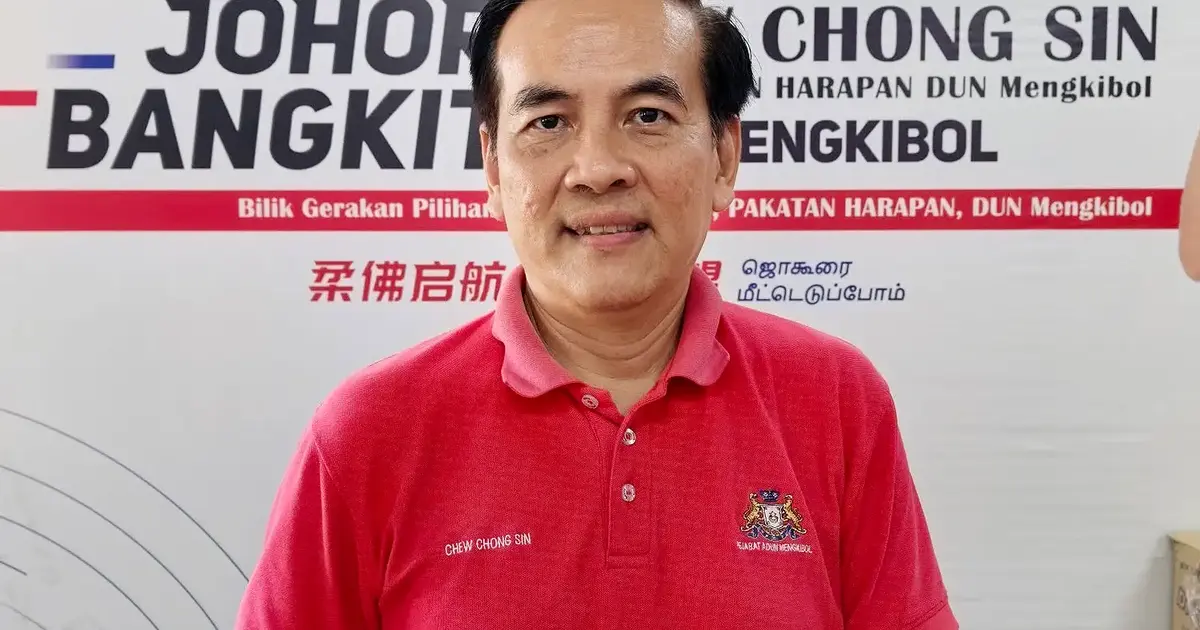
A former Dewan Rakyat member from the Democratic Action Party has publicly alleged that Barisan Nasional and Perikatan Nasional maintain what he describes as a tacit understanding—an unspoken but understood agreement—to establish a unified state government in Johor. Chew Chong Sin, who previously represented the party in Parliament, made the assertion with a warning that such an arrangement would fundamentally reshape Johor's political trajectory and legislative priorities toward more conservative positions.
The claim arrives amid ongoing political manoeuvring in Malaysia's most developed state, where electoral mathematics and coalition building continue to dominate discussion among analysts and party operatives. Johor has historically been a bellwether for national political trends, given its size, economic importance, and diverse voter demographics spanning urban, suburban, and rural constituencies. Any structural shift in state governance carries implications not merely for local policy-making but for broader alignment patterns that could influence national politics.
Chew's allegation fundamentally addresses the nature of political cooperation in Malaysia's evolving coalition landscape. Rather than explicit formal agreements negotiated through public channels, the suggestion of a tacit understanding implies mutual recognition and acceptance without written commitment or formal announcement. This distinction matters considerably, as it suggests political actors may be coordinating without the transparency typically associated with coalition arrangements, where component parties negotiate portfolios, policy platforms, and governance structures openly.
The potential formation of a BN-PN unity government in Johor would represent a significant reconfiguration of the state's political alignment. Both coalitions have traditionally presented themselves as distinct alternatives, with Perikatan Nasional positioning itself as a reformist challenge to the established Barisan Nasional order. A collaborative arrangement would suggest pragmatic accommodation superseding ideological differentiation, a pattern increasingly visible across Malaysian politics at state and federal levels where electoral incentives often override doctrinal purity.
Chew's specific warning regarding conservative policy direction deserves analytical attention in the Malaysian context. A BN-PN state administration would likely combine UMNO's traditional emphasis on Malay-Muslim interests with PAS's religiously-informed governance approach, potentially tilting state policy toward more stringent Islamic law implementation, restrictive cultural policies, and reduced emphasis on secular governance frameworks. This contrasts sharply with DAP's multicultural, secular-democratic positioning and represents the ideological chasm between these competing coalitions.
The implications for Johor's non-Malay populations—particularly Chinese and Indian communities—merit consideration. These communities have traditionally found representation through DAP and other opposition parties emphasizing religious pluralism and equal citizenship rights. A rightward policy shift would affect everything from vernacular school funding to entertainment licensing, inter-faith dialogue frameworks, and enforcement of religious codes affecting non-Muslim residents. For Malaysian businesses operating in Johor, regulatory direction and social policy stability constitute investment considerations.
From a broader Southeast Asian perspective, Johor's governance direction carries subtle regional significance. As Malaysia's primary economic gateway to Singapore and a crucial component of the Iskandar development corridor, Johor's policy environment influences cross-border commerce and investment flows. Political instability or sharp ideological realignment could unsettle business confidence, particularly among multinational corporations and regional investors accustomed to Johor's relatively cosmopolitan governance approach under previous administrations.
The credibility of Chew's claim depends partly on his political standing and access to information. Former parliamentarians retain networks and insights potentially unavailable to ordinary observers, though political motivations must be weighed when evaluating such allegations. As a DAP figure, Chew possesses incentive to highlight threats to opposition interests, yet this does not automatically invalidate his observations about political negotiations occurring behind public view.
Malaysia's political culture increasingly features informal power-sharing arrangements and unannounced understandings between ostensible opponents. The 2020 collapse of the Sheraton Move illustrated how such arrangements can suddenly crystallize into constitutional action. Voters and civil society observers have grown attuned to detecting signs of behind-the-scenes political dealing, making allegations of tacit understandings more resonant in public discourse, even absent definitive proof.
For opposition parties in Johor and nationwide, Chew's warning underscores the precariousness of electoral gains in Malaysia's fluid political environment. Even winning state-level majorities provides no security against post-election realignment when component parties within opposing coalitions find common ground on power-sharing. This dynamic has prompted some observers to argue for constitutional reforms establishing clearer regulations around coalition formation and government transitions, though such measures face significant political obstacles.
The question of whether such an understanding genuinely exists—and whether it translates into actual post-election cooperation—remains open. Electoral outcomes will ultimately determine Johor's political configuration, and voter decisions may render moot whatever private arrangements political leaders contemplate. Nevertheless, Chew's allegations highlight the complex, often opaque nature of Malaysian coalition politics, where public competition frequently masks backroom accommodation and where yesterday's enemies can become tomorrow's governing partners.

