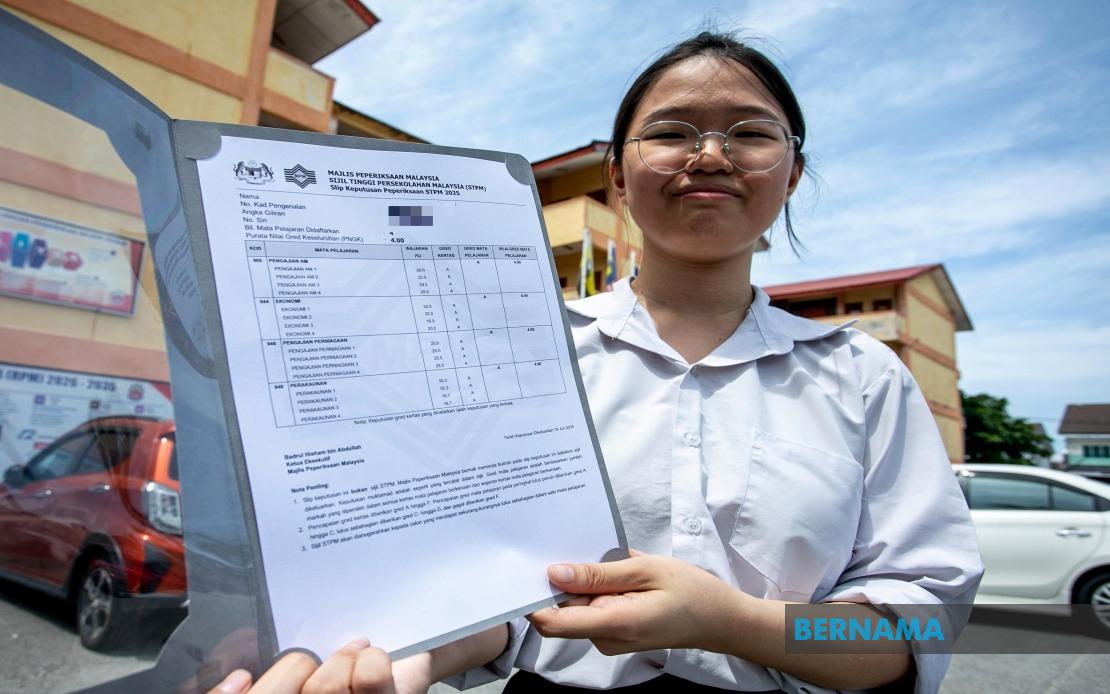
Twenty-year-old Yong Xin Yi from SMK Jalan Tasek in Ipoh has secured one of the year's most coveted academic achievements: a flawless 4As result in the 2025 Sijil Tinggi Persekolahan Malaysia examination. Her success stemmed not from any secret formula but from an unrelenting commitment to a highly structured daily routine that prioritised both classroom engagement and disciplined revision sessions. The consistency of her approach offers valuable insights for Malaysian students navigating the increasingly competitive landscape of upper secondary education.
At the heart of Xin Yi's success lies a straightforward yet demanding schedule: five consecutive hours of revision stretching from 5:00 pm to 10:00 pm, conducted every single day after formal school hours concluded. However, what distinguishes her methodology from that of many other high-achieving students is her conscious prioritisation of classroom attention. Rather than viewing schoolroom instruction as secondary preparation for the "real" learning that happens at home, Xin Yi inverted this hierarchy by treating lessons as the foundation upon which evening revision could build. This distinction between passive attendance and active engagement proved decisive in her learning journey.
The psychological benefits of Xin Yi's classroom-first approach cannot be overstated, particularly in the context of Malaysian secondary education where teaching delivery standards vary considerably across different schools and subjects. By concentrating fully during lesson time, she maximised her comprehension of teacher explanations while simultaneously reducing the cognitive burden that inevitably accompanies reviewing poorly understood material late in the evening. This efficiency gain meant her five-hour evening sessions could focus on consolidation and deeper exploration rather than struggling to decode concepts encountered only once in class. The cumulative effect across an entire academic year represents substantial gains in both retention and critical thinking capacity.
Beyond timetable management, Xin Yi demonstrated sophisticated awareness of task completion as a learning mechanism rather than mere administrative obligation. She insisted that every piece of homework assigned by her teachers be completed thoroughly, recognising that these exercises served diagnostic and mastery functions beyond their surface purpose. Homework completion forced her to actively apply concepts rather than passively reviewing them, creating the kind of productive struggle that neuroscience research increasingly validates as essential for durable learning. For Malaysian students often tempted to skip assignments when deadlines approach, her commitment to this foundational discipline carries particular relevance.
Xin Yi's examination performance, reflected in her 4.00 Cumulative Grade Point Average and uniform A grades across General Studies, Principles of Accounting, and Economics, places her among an elite cohort. She was one of only five students at SMK Jalan Tasek to achieve this benchmark in 2025, underscoring both the rarity of perfect performance and the individual determination required to reach it. Her success becomes even more noteworthy when contextualized within Malaysia's broader educational landscape, where STPM results significantly influence university admissions and scholarship allocations.
General Studies emerged as her most formidable intellectual challenge, a reality that speaks to the subject's genuine difficulty rather than any particular weakness on her part. The subject demands not merely knowledge accumulation but sophisticated writing ability, precise understanding of examination format specifications, and intimate familiarity with marking rubrics. Rather than allowing this subject to become a source of discouragement, Xin Yi responded by allocating disproportionate attention to it, deliberately investing extra study time to identify and rectify the specific gaps that threatened her overall performance. This adaptive response to difficulty—rather than avoidance or passive acceptance—exemplifies the growth mindset that separates high achievers from merely competent students.
The family context surrounding Xin Yi's achievements deserves careful consideration, as it illuminates the role of parental support in academic outcomes. As an only child whose parents work as a clerk and phone salesman respectively, she benefited from households that prioritised educational advancement despite modest household incomes. Her parents provided sustained encouragement throughout her studies, a form of psychological scaffolding that research consistently identifies as crucial for adolescent academic persistence. Their presence in the narrative is not peripheral but central: Xin Yi explicitly attributes significant portions of her success to their continuous backing, refusing to accept sole credit for achievements that clearly emerged from family partnership.
Yin Yi's expressed motivation to improve her family's economic circumstances through educational success represents a powerful driver that extends beyond personal ambition. This intergenerational responsibility, common among Malaysian students from working-class backgrounds, functions simultaneously as motivation and pressure. She frames her university aspirations and career planning not as personal self-actualisation but as means of rewarding parental sacrifice and ensuring that their investments yield tangible returns. This perspective, while potentially creating stress, also cultivates the kind of extrinsic motivation that can sustain effort through challenging academic periods.
Her intention to pursue economics at Universiti Putra Malaysia flows naturally from her STPM subject selection and demonstrated aptitude. Economics offers Malaysian graduates genuine career prospects in government, corporate finance, and development sectors, a practical consideration that shaped her decision-making alongside intellectual interest. Her aspiration to become an economist reflects deliberate career planning grounded in realistic appraisal of sectoral opportunities rather than vague romantic notions of professional prestige. This pragmatic orientation toward tertiary education characterises many Malaysian students from modest socioeconomic backgrounds who view university primarily as a pathway to professional stability and social mobility.
Xin Yi's journey offers several lessons for Malaysian students contemplating their own STPM performance or planning their pre-examination routines. First, the consistency of daily practice matters far more than intensive last-minute cramming; her five-hour daily routine sustained over many months accumulated knowledge far more effectively than emergency revision sessions. Second, classroom attention represents genuine learning time rather than mere institutional obligation; students who treat lessons as the primary learning arena rather than supplementary overview sessions gain significant advantages. Third, completing assigned work thoroughly serves learning purposes distinct from satisfying teacher requirements, and this distinction becomes clearer when students adopt homework completion as a learning strategy rather than a chore. Finally, parental encouragement and family support create an enabling environment that amplifies individual effort, suggesting that academic success rarely emerges from individual determination alone but rather from supportive ecosystems encompassing family, school, and student commitment working in concert.