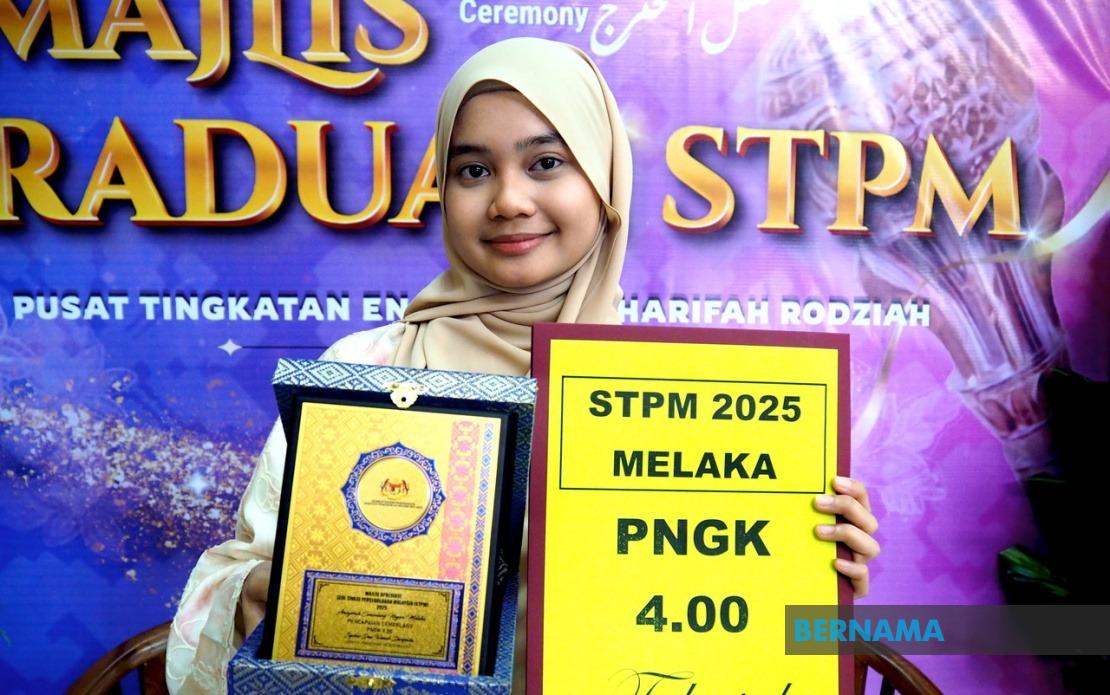
Nurfariesya Nasywa Hamedee's path to academic excellence has been shaped as much by personal tragedy as by determination. The 21-year-old from Sekolah Menengah Kebangsaan Agama Sharifah Rodziah in Melaka secured a flawless Cumulative Grade Point Average of 4.00 in the 2025 Sijil Tinggi Persekolahan Malaysia examination, a result announced this week at the state-level ceremony officiated by Datuk Rosli Abdullah, the State Deputy Exco for Education, Higher Education, and Religious Affairs.
The foundation of her success lies in a conversation that now carries profound emotional weight. When her father, Hamedee Asri, died from a heart attack just days before her Sijil Pelajaran Malaysia trial examination years ago, the loss threatened to derail her education entirely. The grief that followed was severe enough that Nurfariesya seriously contemplated leaving school to take employment and help support her family financially. It was during this darkest period that her late father's parting counsel—delivered through her mother, Yusnita Ruslan—crystallised into the motivational force that would sustain her through subsequent years of study.
That final message, emphasising the importance of not squandering her potential, transformed from simple parental guidance into a defining principle of her academic life. Nurfariesya describes how this advice became the catalyst for her emotional recovery and her commitment to educational achievement. Rather than allowing grief to become an obstacle, she redirected that energy into her studies, treating academic success as a way of honouring her father's memory and fulfilling his wishes for her future.
The third of four siblings expressed genuine surprise at her stellar result, having anticipated a slightly lower score of around 3.92 based on her trial examinations and preliminary calculations. Her trajectory through secondary education had already been impressive—she earned 7As in her SPM examination—yet she neither assumed nor expected perfection at the pre-university level. This combination of high achievement and measured expectations suggests a student driven by internal motivation rather than external pressure or overconfidence.
Beyond personal circumstance, Nurfariesya's academic pursuits reflect a genuine intellectual calling. She developed a sustained interest in Shariah law during her secondary schooling years, an interest that guided her subject selection for STPM. Her curriculum encompassed General Studies, Arabic, Usuluddin (Islamic Theology), History, and Shariah, providing a comprehensive foundation for her intended career path. This thematic coherence in her studies—where subject selection aligns with long-term professional ambitions—distinguishes purposeful learning from mere grade-chasing.
Her aspiration to become a Shariah lawyer represents an ambition that combines intellectual rigour with professional contribution to Malaysian society. To this end, she has recently completed an interview for a Bachelor's Degree programme at Universiti Malaya, positioning herself to pursue advanced studies in a field where Malaysia maintains particular institutional strength and cultural relevance. The choice of STPM as her pathway, she noted, reflected a strategic decision to compress her pre-university education while accessing a broader range of tertiary institutions.
When asked to distil the factors behind her academic success, Nurfariesya offered no mystical formula or elaborate study methodology. Instead, she articulated three fundamental principles: consistent hard work, resilience in the face of setbacks, and spiritual faith. This pragmatic assessment—coupled with her demonstrated results—suggests that sustained effort and emotional fortitude matter more than any particular technique or system. Her experience contradicts the notion that academic excellence requires elaborate intervention or specialised resources.
Parallel to Nurfariesya's achievement, another Melaka student has garnered national recognition. Ng Zhen Hong, a 20-year-old from Kolej Tingkatan Enam Tun Fatimah, has been named the recipient of the National-Level Best Student Award for the Science Stream in the 2025 STPM examination. This distinction places him among the nation's most accomplished pre-university students in scientific disciplines, a remarkable achievement that reflects both individual aptitude and sustained dedication.
Ng attributed his success to parental support, teacher mentorship, and an intrinsic passion for scientific subjects—particularly those requiring mathematical problem-solving and analytical reasoning. As the eldest of two siblings, he established a disciplined revision routine, allocating between one and two hours daily to reviewing his course material. His approach demonstrates consistency rather than cramming, and curiosity rather than rote memorisation. Having secured 10As in his SPM examination, Ng has positioned himself to pursue either Chemical Engineering or Electrical Engineering at Universiti Malaya, fields where Malaysia faces skilled workforce shortages and where his talents are likely to contribute meaningfully to national development.
These two success stories, emerging from the 2025 STPM results, illustrate distinct but complementary pathways to pre-university excellence. Nurfariesya's journey demonstrates how personal adversity can be transformed into motivational fuel, and how alignment between academic studies and professional purpose strengthens commitment. Ng's achievement showcases the power of methodical preparation and the importance of parental and institutional support in nurturing scientific talent. Both students rejected the notion that exceptional results require exceptional circumstances; instead, they emphasised the primacy of effort, faith, and purpose.
For Malaysian parents and students navigating secondary and pre-university education, these narratives offer encouragement without false promises. The students who achieve most are not necessarily those with the greatest natural gifts or the most advantageous circumstances, but rather those who maintain clarity of purpose, commit to consistent effort, and view obstacles as challenges to overcome rather than reasons to retreat. In an era where educational competition intensifies and career pathways become more complex, the examples set by Nurfariesya and Ng provide a grounding reminder that fundamental principles—discipline, resilience, and genuine interest in one's field—remain decisive factors in academic success.

