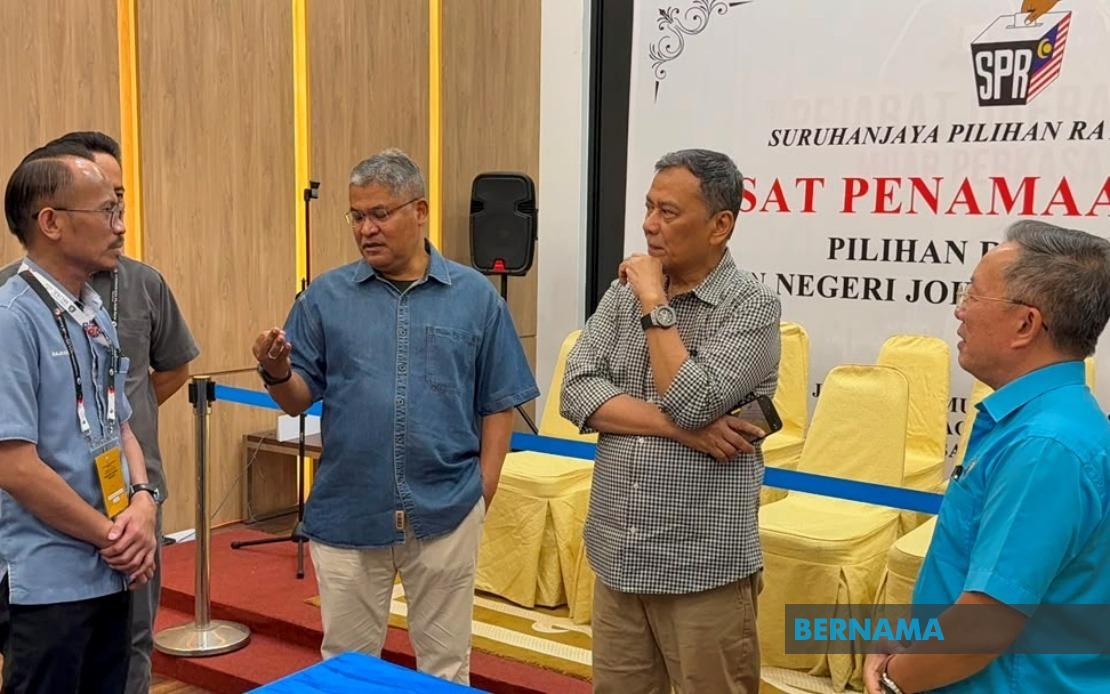
The Election Commission has confirmed it stands ready to conduct tomorrow's nomination process for the Johor state election, with final technical preparations completed across all designated centres. A survey of multiple Candidate Nomination Centres in Johor Bahru found that organisational teams were putting finishing touches to venue layouts and conducting last-minute coordination drills with partner agencies to ensure the day unfolds without disruption.
Nazatul Shima Mohamad, the returning officer overseeing the Perling state constituency centre at Dewan Jubli Intan Hall, expressed confidence that the machinery was fully operational. She emphasised that all stakeholders—from the commission's own staff to supporting agencies—had demonstrated equal commitment to facilitating a seamless process. Her message to prospective candidates underscored the practical requirements they must fulfil: arriving early, producing complete documentation, and bringing deposit money in the correct amounts. The systematic approach reflects the commission's determination to prevent last-minute administrative bottlenecks that could delay proceedings or create confusion among candidates.
Security planning has emerged as a central focus given the anticipated turnout of party supporters at nomination centres. At the Kota Iskandar centre located at Iskandar Puteri City Council's Main Hall in Medini, returning officer Shahrulizam Abdul Rashid detailed multi-layered arrangements designed to maintain order while accommodating democratic participation. The measures include coordinated road closures along routes leading to centres, a 50-metre perimeter restriction preventing supporters from approaching the actual nomination venues, and the erection of tents and barriers to physically separate competing parties' supporters. These provisions acknowledge the intensity of electoral campaigns in Malaysia's increasingly competitive state politics, where passionate grassroots mobilisation is commonplace.
The emphasis on public prudence and self-restraint signals recognition that nomination days, while ostensibly technical administrative exercises, carry symbolic weight in electoral contests. The appearance of large supporter contingents outside nomination centres—though not unexpected—requires careful management to prevent confrontations that could undermine public confidence in the process or provide ammunition for claims of bias or disorder. By establishing clear spatial boundaries and enlisting police cooperation, organisers aim to channel enthusiasm constructively while preventing any escalation that might taint the election's legitimacy in voters' eyes.
The sheer scale of the electoral exercise underscores its significance within Malaysia's federal democracy. The Johor State Legislative Assembly's dissolution on June 1 triggered a compressed timeline culminating in tomorrow's nomination day, with early voting scheduled for July 7 and polling day set for July 11. This condensed calendar places considerable pressure on the Election Commission to execute flawlessly, as any procedural slippage could cascade through subsequent stages. The involvement of 2,727,926 registered voters—comprising 2,703,175 ordinary electors plus 12,041 military personnel and spouses and 12,710 police personnel and spouses—demonstrates that this is a major electoral event affecting millions across Malaysia's most economically developed state.
Johor's electoral significance extends beyond mere voter numbers. As a major economic engine and a state with competitive party politics spanning both federal coalitions, the outcome carries implications for Malaysia's national political trajectory. The nomination process tomorrow will reveal how many candidates will contest across the 56 state constituencies, signalling the intensity of competition and the strategies various parties intend to pursue. A crowded field of nominees would suggest vigorous competition, while more selective nominations might indicate parties' confidence in their chances or tactical choices to consolidate support.
The Election Commission's detailed public communications about readiness serve a dual purpose: they reassure candidates and voters that the machinery functions properly, while simultaneously establishing official records of preparedness that protect the commission against subsequent accusations of negligence or bias. By highlighting cooperation with police, completion of venue layouts, and receipt of supporting agency commitments, the commission creates a documentary trail demonstrating its professionalism. This transparency—or at least the appearance of it—remains important for electoral legitimacy in Malaysia, where questions about institutional impartiality periodically surface in political discourse.
For candidates themselves, the deadline approaching tomorrow carries practical urgency. Those still finalising nomination paperwork face mounting pressure to confirm candidacy, as the window closes after tomorrow's process concludes. The returning officers' emphasis on early arrival and complete documentation serves partly as reminder and partly as warning: the election machinery will operate according to schedules and procedures, with limited accommodation for last-minute requests or incomplete applications. This inflexibility, while administratively efficient, occasionally creates hardship for candidates managing complex party endorsement processes or those facing unexpected obstacles in assembling deposits and supporting materials.
The positioning of military and police personnel voting—separated from ordinary voter categories in the statistics—reflects constitutional provisions recognising these uniformed services' distinct electoral status in Malaysia. Their participation, though numerically modest compared to civilian voters, carries symbolic weight in elections, as their voting preferences have occasionally featured in political commentary and analysis. The Election Commission's specific tracking of their numbers suggests awareness of this dimension.
Looking forward, tomorrow's nomination day will constitute the first major test of the election machinery's capacity to handle the compressed timeline. If the process proceeds smoothly—with candidates nominated, paperwork processed, and supporters managed without incident—it will vindicate the Election Commission's preparatory efforts and suggest that subsequent stages can proceed as scheduled. Conversely, any significant disruptions would necessitate adjusted approaches and might raise questions about whether the accelerated timetable allowed adequate planning. For Malaysian observers and particularly Johor residents, tomorrow will signal whether the democratic machinery is functioning as intended, setting the tone for public confidence in the broader election process extending through July 11.

