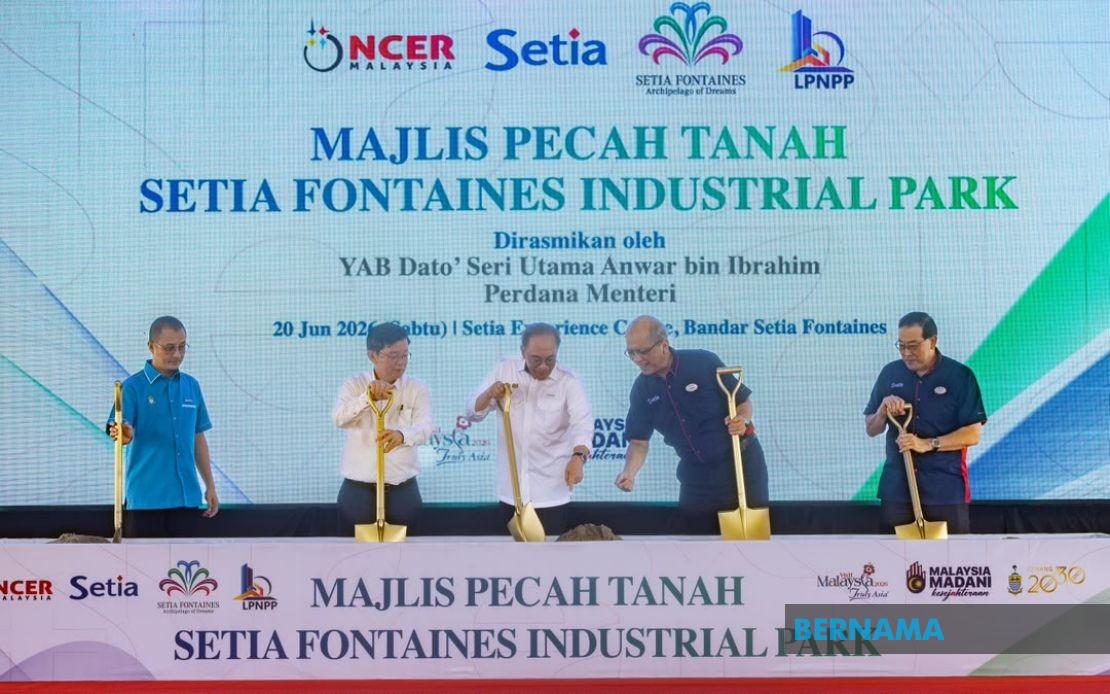
Prime Minister Datuk Seri Anwar Ibrahim has stressed that Malaysia's rapid economic development will only serve the nation if it translates into tangible benefits for citizens across all income levels. Speaking at the groundbreaking ceremony for the Setia Fontaines Industrial Park in Bandar Setia Fontaines on June 20, Anwar warned that government-linked entities and private corporations must deliberately architect their projects to include middle- and lower-income communities, or risk exacerbating the wealth gap that threatens national stability.
Anwar's intervention reflects a persistent tension in Malaysia's development model. While the country has achieved respectable GDP growth and attracted considerable foreign investment, concerns have mounted that prosperity remains concentrated among higher-income earners and well-connected corporate entities. The Prime Minister's insistence that every major approval issued to state-owned investment vehicles such as Khazanah Nasional Berhad, Permodalan Nasional Berhad, and the Employees Provident Fund must include provisions for disadvantaged groups signals official acknowledgment that market forces alone will not distribute opportunity equitably.
Anwar framed inclusive development not as corporate charity but as economic necessity. Without deliberate mechanisms to channel opportunity downward, he argued, Malaysia risks creating a stratified economy where advancement becomes the preserve of those already positioned to benefit from large-scale projects. The phenomenon has parallels throughout Southeast Asia, where rapid industrialisation has sometimes left lower-income segments behind despite national growth figures that appear robust on paper. Anwar's emphasis on measurable inclusion—real jobs, real income growth—rather than statistical achievements suggests frustration with development metrics that mask persistent inequality.
The Setia Fontaines Industrial Park serves as a specific test case for this philosophy. Located in Seberang Perai, the development is positioned to complement growth occurring on Penang Island and in the state's southern districts, creating what Anwar termed balanced regional expansion. By deliberately citing Seberang Perai's relative position in Penang's overall development trajectory, the Prime Minister highlighted how uneven investment patterns can create geographical pockets of marginalisation. The industrial park's success will therefore be measured not merely by output and investor returns but by whether it demonstrably lifts local employment prospects.
A critical dimension of Anwar's statement concerns Malaysia's industrial evolution. As the country transitions from labour-intensive back-end manufacturing toward higher-technology production, the skills requirements for workers shift dramatically. This transition creates both opportunity and risk for lower-income groups. Manufacturing roles that historically provided stable employment for workers with secondary education may disappear, but advanced sectors can generate higher-wage employment if workers possess appropriate credentials. Anwar's emphasis on aligning training provision with industry demand and technological change acknowledges that investment in infrastructure alone will not suffice.
The Prime Minister specifically highlighted the necessity for enhanced collaboration between industry, technical and vocational institutions, and universities including Universiti Sains Malaysia. This triangular partnership reflects recognition that Malaysia's human capital development lags behind its infrastructure investment. Private companies establishing operations in the Setia Fontaines Industrial Park cannot assume a ready supply of qualified personnel; educational institutions must anticipate demand and adjust curriculum rapidly as technologies evolve. Anwar's observation that technology transforms within one to two years underscores the urgency of dynamic, responsive training systems rather than static educational frameworks.
The governance implications of Anwar's remarks extend beyond individual projects. By directly instructing government agencies to prioritise equity across approvals, the Prime Minister is attempting to embed inclusivity into decision-making architecture. This represents an implicit critique of previous practice in which projects received approval based primarily on financial returns or strategic importance, with equity considerations marginalised as secondary concerns addressed through corporate social responsibility initiatives. Anwar's insistence that equity must be integral to project design, not appended afterward, suggests a more fundamental reshaping of how Malaysia evaluates major investments.
For Malaysian readers, particularly those in middle- and lower-income segments, Anwar's statement carries both encouragement and uncertainty. The rhetoric emphasises their legitimate claim to development benefits and acknowledges systemic barriers to accessing opportunity. Yet the gap between stated policy and implementation remains substantial. Previous Malaysian administrations have similarly articulated inclusive development principles while outcomes continued to concentrate wealth and opportunity among connected elites. Whether Anwar's government possesses the institutional capacity and political will to translate this vision into systematic practice remains a consequential question for Malaysia's trajectory.
The Seberang Perai context adds regional significance. The district has historically received less development attention than Penang Island, creating potential for the Setia Fontaines project to recalibrate growth patterns. If successful implementation demonstrates that large-scale industrial projects can simultaneously generate returns for investors and create accessible pathways for local lower-income workers, the model could influence investment decisions throughout Southeast Asia. Conversely, if the industrial park reproduces familiar patterns of technical-skilled positions filled by imported labour while local low-income residents remain peripheral, it would validate persistent regional critiques of development models that promise but fail to deliver inclusive growth.
Moving forward, the effectiveness of Anwar's inclusive development agenda will depend on sustained institutional attention and willingness to enforce equity requirements against corporate resistance. Companies typically favour lean staffing and imported specialists rather than investing in local training pipelines. Government agencies must develop mechanisms to monitor compliance, incentivise genuine inclusion, and penalise projects that circumvent equity obligations. The alternative is continued pursuit of development trajectories that generate impressive macroeconomic statistics while marginalising the majority of Malaysians from meaningful participation in prosperity.

