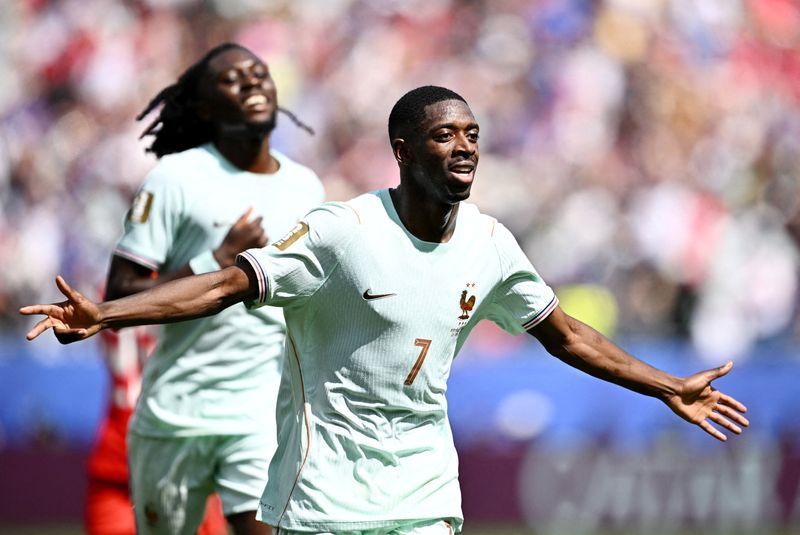
France made a decisive statement in their final Group I encounter, demolishing a heavily rotated Norway side 4-1 in Foxborough, Massachusetts on Friday to claim top spot in the competition's opening phase. The standout performance came from winger Ousmane Dembele, who inscribed his name into World Cup folklore by scoring three times within the opening half-hour of play, establishing himself as one of the tournament's most dangerous attacking threats as the tournament reaches its knockout stages.
The Les Bleus squad approached the contest with a determined mindset, having collectively pledged to pursue an emphatic victory as a gesture of solidarity towards manager Didier Deschamps, who had returned home to the United States to honour his late mother. Despite both France and Norway having already secured their progression to the Round of 32 before kickoff, the French team recognised that topping their group would yield substantial strategic advantages, particularly regarding travel logistics across the sprawling North American tournament schedule. This mathematical reality transformed what could have been a ceremonial fixture into a meaningful contest in which both teams possessed genuine motivation.
France initiated proceedings with characteristic intensity and purpose. Within twenty seconds, Kylian Mbappé produced a warning shot that cannoned off the crossbar, signalling the visitors' aggressive intentions immediately. The early momentum crystallised into tangible reward just six minutes later when Mbappé executed a sweeping cross-field pass of considerable precision to Dembele, who demonstrated composure and technical excellence by cutting inside and outside his marker before unleashing a clinical finish past goalkeeper Egil Selvik. The winger added a second goal in the twentieth minute following another Mbappé assist, with Dembele manufacturing sufficient space to place a dipping effort beyond reach.
Norway managed a brief respite when Thelo Aasgaard reduced the deficit almost immediately, but this momentary reprieve proved inconsequential as Dembele completed his remarkable treble in the thirty-second minute with a curled strike into the far corner. His three-goal haul represented only the third instance of a French player achieving a World Cup hat-trick, joining an exclusive pantheon alongside Just Fontaine and Mbappé himself. More impressively, the timeline of Dembele's achievement ranked as the second-fastest hat-trick in World Cup history, surpassed only by Austria's Erich Probst, who accomplished the feat after twenty-four minutes during the 1954 tournament against Czechoslovakia.
The structural imbalance between the two teams stemmed principally from Norway's tactical approach to squad rotation. Coach Stale Solbakken elected to rest virtually all his regular starters, conspicuously excluding goal-scoring phenomenon Erling Haaland and captain Martin Odegaard, following their midweek encounter against Senegal. This decision, whilst potentially serving longer-term squad management objectives, rendered Norway vulnerable to France's relentless attacking rhythm during the opening stages. The Scandinavian side subsequently attempted to impose greater control during the second half, with substitute goalkeeper Mike Maignan required to deny Jørgen Strand Larsen's softly-struck penalty and Oscar Bobb forcing several saves that exposed occasional defensive fragility in the French rearguard.
France ultimately sealed their dominance through Désiré Doué, who headed home a cross from substitute Bradley Barcola in the closing stages, establishing the final 4-1 scoreline. The group victory carries substantial consequences for the tournament's knockout architecture, with France's first-place finish likely positioning them to face Sweden in the Round of 32. Norway, conversely, will encounter Ivory Coast as Group I runners-up, a fixture that presents its own complexities and challenges as the competition enters its decisive phase.
For Malaysian and Southeast Asian observers, the performance underscores France's formidable credentials as genuine tournament contenders despite their runner-up status in 2022. The combination of Mbappé's creative excellence and Dembele's clinical finishing demonstrates why the French continue to command respect among Europe's elite footballing nations. Moreover, the ease with which France despatched a weakened opponent illustrates how squad depth and tactical flexibility can translate into concrete advantages in tournament football, a lesson particularly relevant for regional teams aspiring towards higher levels of international competition. As the World Cup accelerates towards its denouement, France's command of Group I positions them advantageously for a sustained knockout campaign.

