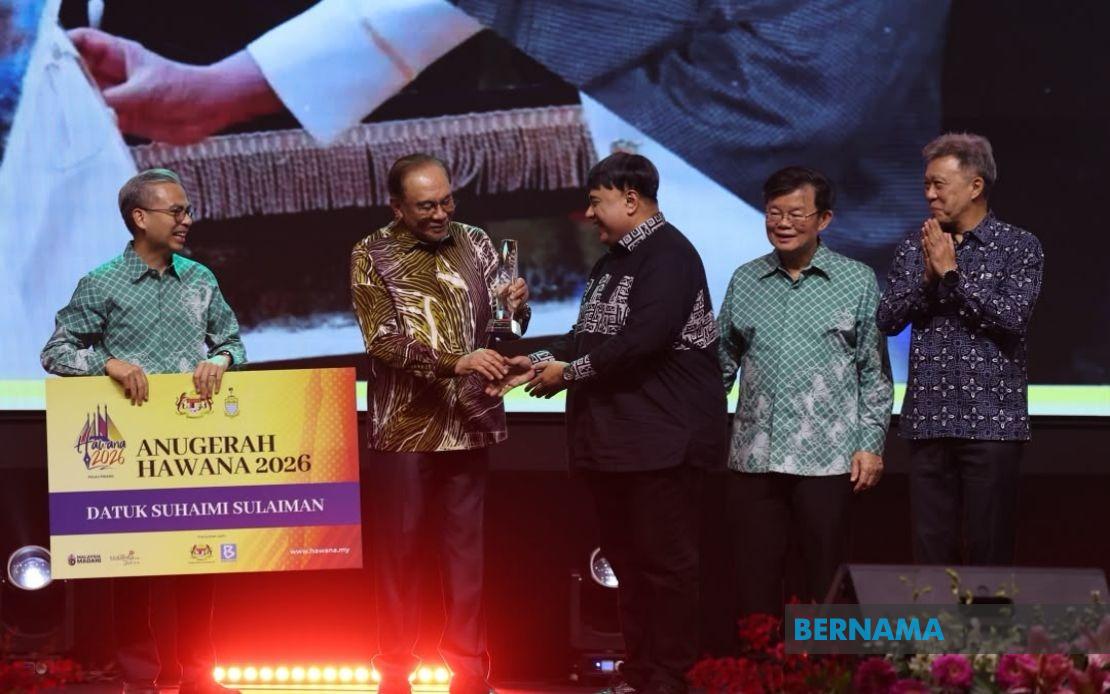
Datuk Suhaimi Sulaiman, whose career spans more than thirty years navigating the evolving worlds of broadcasting and journalism, has been recognised as a recipient of the HAWANA 2026 National Journalists' Day Award. The distinction reflects his substantial influence on Malaysia's media sector during a period of significant technological and operational transformation. Prime Minister Datuk Seri Anwar Ibrahim presented the award at the HAWANA 2026 Grand Finale held at PICCA @ Arena Butterworth Convention Centre in Butterworth on June 20, cementing this honour as an official national recognition of his professional contributions.
The ceremony brought together prominent figures from Malaysia's media and political establishments. Penang Chief Minister Chow Kon Yeow, Communications Minister Datuk Fahmi Fadzil, and Malaysian National News Agency (Bernama) chairman Datuk Seri Wong Chun Wai witnessed the presentation. The gathering underscored the significance attached to acknowledging excellence within the journalism and broadcasting professions at the highest levels of government and industry leadership. Additional attendees included Bernama chief executive officer and HAWANA 2026 Working Committee chairman Datin Paduka Nur-ul Afida Kamaludin, as well as Bernama editor-in-chief Arul Rajoo Durar Raj, reflecting broad institutional support for the award.
Suhaimi's career trajectory provides insight into the trajectory of Malaysian broadcasting during a formative period. His tenure as director-general of Broadcasting Malaysia (RTM) positioned him at the helm of the nation's oldest and most established public broadcaster during crucial years of institutional development. The award recognises not merely his administrative leadership but the substantive contributions he made to journalistic standards, operational excellence, and the advancement of broadcast programming across the organisation. His work has helped shape the regulatory and professional frameworks that continue to influence Malaysian media today.
In remarks following the presentation, Suhaimi conveyed both gratitude and philosophical perspective on the nature of professional recognition. He framed the award as an affirmation coupled with renewed responsibility to remain engaged with evolving industry challenges and opportunities. His response reflected a mature understanding of how career milestones should function—not as conclusions but as markers prompting continued growth and active participation within one's field. This disposition has likely contributed to his sustained relevance within a rapidly changing media environment.
The media landscape has undergone profound transformation during Suhaimi's career, but perhaps no force has captured more attention and generated more uncertainty than artificial intelligence. Suhaimi explicitly acknowledged this dimension in his remarks, identifying AI as a defining challenge and opportunity for contemporary media practitioners. He stressed that the sector demands constant learning and adaptation, suggesting that journalists and broadcasters must develop new competencies to remain effective contributors to their organisations and to public discourse. This recognition of AI's disruptive potential reflects broader anxieties and opportunities facing newsrooms across Malaysia and Southeast Asia.
For Malaysian media professionals, Suhaimi's emphasis on learning and knowledge acquisition in the context of technological disruption carries particular resonance. The industry faces mounting pressures from digital-native competitors, changing audience consumption patterns, and now the imminent integration of generative AI into newsrooms. His call for practitioners to embrace continuous education speaks to an essential posture for anyone seeking to remain relevant. The implication is that traditional expertise, while valuable, requires constant supplementation with new skills and understandings.
The HAWANA ceremony itself represents an institutional commitment to recognising and celebrating excellence within journalism and broadcasting. By honouring figures like Suhaimi, Malaysia's media establishment signals the values it considers essential: sustained commitment to craft, professional integrity, and willingness to navigate transformation. These symbolic recognitions help establish baselines for aspiring journalists and remind incumbent practitioners of the standards to which they should aspire.
Suhaimi's award also arrives at a moment when Malaysian media institutions face scrutiny regarding editorial independence, digital strategy, and audience trust. His three decades of service within the sector, culminating in this national recognition, suggest continuity and institutional stability. Yet the complexity of contemporary media challenges—including misinformation, declining traditional revenue models, and the need to serve audiences increasingly fragmented across platforms—means that recognition of past achievements must coexist with acknowledgment of future uncertainties.
The award ceremony's timing in 2026 places it within a broader context of regional media development. Southeast Asian nations are collectively grappling with similar questions about journalism's future, the role of artificial intelligence, and the relationship between media institutions and public service. Malaysia's formalised recognition of distinguished media careers contributes to a regional conversation about how to sustain journalistic excellence and institutional credibility during this period of transformation.
Suhaimi's career represents a particular model of media leadership—one rooted in broadcast tradition, institutional service, and professional integrity. As he acknowledges, the field continues to demand practitioners who can bridge established journalistic principles with emerging technological capabilities. His receipt of the HAWANA 2026 Award serves both as retrospective recognition of contributions already made and as an implicit challenge to the media sector to continue producing leaders capable of navigating the complex intersection of journalism, technology, and public service that will define the coming decade.

