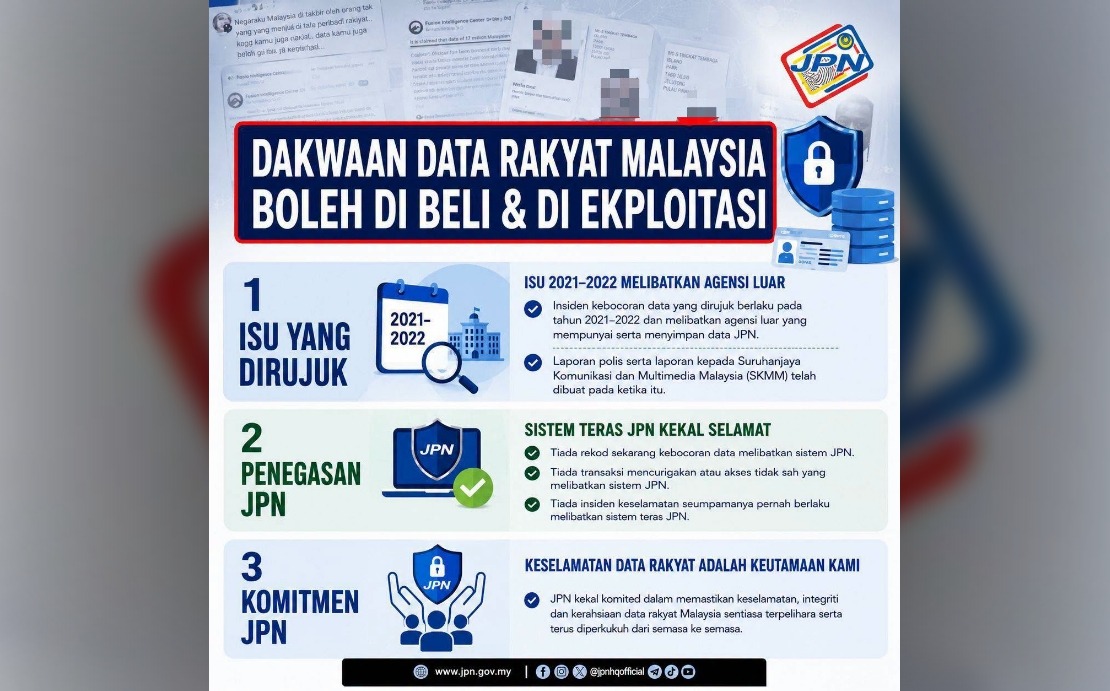
The National Security Council (MKN) has moved to counter alarm over a purported personal data leak spreading across social media platforms, insisting that the information in question originates from cybersecurity breaches predating 2022 and bears no connection to any systems currently in operation. Through the National Cyber Security Agency (NACSA), the council released a formal statement distinguishing between historical incidents and any contemporary security vulnerabilities, a clarification aimed at reassuring both the public and digital service users about the integrity of present-day infrastructure.
According to NACSA's assessment, the compromised data appears to have been extracted through unauthorised cyber intrusions targeting various systems well before 2022, subsequently repackaged and redistributed via online channels in recent weeks without proper authorisation. This distinction between the timing of the original breach and the current circulation is significant, as it suggests the leak represents the opportunistic resurfacing of stale data rather than evidence of an active or ongoing vulnerability affecting Malaysian institutions and service providers today.
The legal dimension of this situation carries substantial weight under Malaysian jurisdiction. NACSA has emphasised that the act of disseminating, providing access to, or otherwise sharing information obtained through unlawful means constitutes a criminal offence under local law, irrespective of whether the hosting infrastructure or service providers operate from foreign territories. This pronouncement serves as a warning to both those perpetuating the leak and any individuals who may be accessing or utilising the compromised data, underscoring that geographical distance offers no legal sanctuary in Malaysia's cyber governance framework.
Taking immediate remedial steps, NACSA has partnered with MyNIC and the Personal Data Protection Department to engage international service providers in systematically removing and blocking access to the websites trafficking in this unlawfully obtained information. The collaborative approach reflects the transnational nature of modern cybercrime, requiring coordination across borders to effectively curtail the spread of stolen personal records. Such enforcement measures represent an active response component of Malaysia's broader cybersecurity strategy.
Parallel to these takedown operations, NACSA is collaborating closely with the Royal Malaysia Police to undertake comprehensive digital forensic investigations. These investigative efforts focus on identifying the perpetrators responsible for the initial intrusions, the subsequent data theft, and the current redistribution activities, with the ultimate goal of prosecuting those involved and serving as a deterrent to would-be offenders. The multi-agency coordination demonstrates the government's commitment to holding cybercriminals accountable across the full spectrum of their activities.
Citizens have been counselled to refrain from engaging with services offering access to unlawfully obtained personal information, as such actions not only violate Malaysian law but also perpetuate the broader ecosystem of cybercrime by creating ongoing demand for stolen data. This public advisory positions personal responsibility as a critical component of national cybersecurity resilience, implicitly acknowledging that technological defences and law enforcement alone cannot fully address the problem without corresponding shifts in user behaviour and ethical digital conduct.
The council has leveraged this incident as an opportunity to highlight the necessity for enhanced legislative frameworks governing cybercrime. The forthcoming Cyber Crime Bill, slated for parliamentary introduction, will introduce substantially more comprehensive provisions and proportionally harsher penalties for various categories of cybercriminal conduct. The proposed legislation specifically targets unauthorised system access, damage to computer infrastructure without legitimate authority, and identity theft involving the malicious use of another person's identity to facilitate criminal activity. These additions represent an evolution in Malaysia's legal arsenal for combating digital offences.
Complementing the legislative agenda, the Cyber Security Act 2024, which became operational in August 2024, establishes mandatory security requirements for entities operating National Critical Information Infrastructure (NCII). These organisations must implement comprehensive protective frameworks encompassing adherence to established codes of practice, rigorous risk assessments, and recurring security audits. The regulatory regime aims to substantially elevate the country's overall cyber resilience by ensuring that systems processing sensitive national information meet stringent security standards.
Addressing specific public concerns, the council has clarified that MyDigital ID, which has surpassed 16 million user registrations, does not function as a personal data repository. Rather, the platform operates as a verification mechanism that authenticates user identities by directly interfacing with the National Registration Department, thereby validating identity credentials without storing personal information itself. This architectural distinction is crucial for public understanding, as it means the service's security posture depends on authentication protocols rather than data safeguarding of stored personal records.
The widespread integration of MyDigital ID across governmental and commercial applications—spanning telecommunications operators, banking institutions, and government agencies—represents a strategic investment in transactional security. As adoption proliferates, the platform's role in preventing identity misuse becomes increasingly significant, creating a more fortified landscape for digital interactions across both public and private sectors. This ecosystem approach to digital security reflects a recognition that individual technological solutions achieve maximum effectiveness within a coordinated, system-wide implementation.
Malaysia's security establishment has framed this incident within a broader developmental narrative emphasising the safe realisation of digital transformation benefits across the entire populace. The government's stated priority centres on ensuring that technological progress yields tangible advantages for citizens whilst maintaining robust cybersecurity safeguards. Both NACSA and the National Security Council have reaffirmed their operational readiness to detect, assess, and respond to emerging cybersecurity threats, positioning continuous vigilance as a foundational principle of national digital governance.

