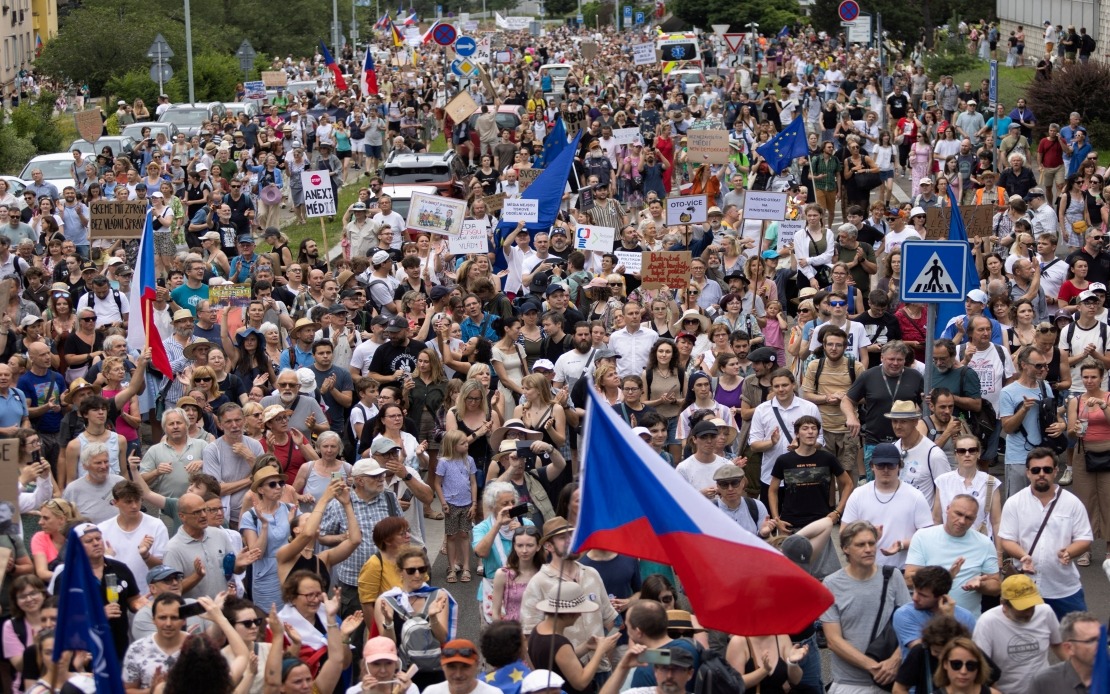
A significant public demonstration unfolded at Czech Television's Prague headquarters on Sunday, with several thousand citizens gathering to voice concerns about the government's proposed restructuring of how the nation's public broadcasters receive funding. The civic movement "A Million Moments for Democracy" organised the solidarity rally, continuing its campaign that gained momentum through coordinated protests across major Czech cities during May. The assembly reflected growing apprehension among journalists, broadcasters, and the general public about the direction of media independence in the Central European country.
The underlying catalyst for the protest stems from a recent decision by Prime Minister Andrej Babiš's government to eliminate the current licence fee system that has traditionally funded Czech Television (ČT) and Czech Radio (ČRo). Under the proposed arrangement, these broadcasters would transition to receiving direct allocations from the state budget beginning next year. This fundamental shift in financing mechanisms raises substantial questions about editorial autonomy, as state budget allocations inherently increase government leverage over broadcaster operations compared to the relative insulation provided by viewer-paid licence fees.
Crucially, the new funding model includes a reduction in total financial support compared to current levels. The Prime Minister has publicly stated that public broadcasters possess sufficient internal capacity to absorb these cuts through operational efficiencies, dismissing concerns about service quality deterioration. Babiš has also sought to reassure stakeholders by claiming the government would refrain from political interference in editorial matters. However, such assurances carry limited weight given the structural vulnerabilities created by transferring funding control to the executive branch, which critics argue creates inherent conflicts of interest regardless of stated intentions.
The composition of Babiš's governing coalition amplifies these concerns significantly. The cabinet comprises his right-wing populist party ANO, the far-right Freedom and Direct Democracy (SPD), and the Motorists party, which together have demonstrated patterns of challenging traditional institutional independence. Culture Minister Oto Klempíř, representing the Motorists party and overseeing media policy, has become a particular focus of demonstrator ire. Rally participants specifically demanded Klempíř's resignation and withdrawal of the government's proposals, viewing his ministerial authority as instrumental in advancing this agenda.
For Malaysian and Southeast Asian observers, this situation illuminates the persistent global challenge of protecting media independence from executive pressure. The Czech case exemplifies how seemingly technical budgetary decisions can fundamentally reshape the relationship between government and public broadcasting institutions. The shift from subscription-based licence fees to direct state budgeting represents a well-documented pathway through which governments in various democracies have gradually eroded broadcaster autonomy, establishing precedents that subsequent administrations exploit more aggressively.
The messaging at Sunday's rally crystallised the fundamental principle at stake. "A free society needs free media," read banners and appeals, capturing the philosophical foundation underlying public broadcasting systems across democracies. This formulation reflects the understanding that institutional independence enables broadcasters to fulfil their democratic function of holding power accountable and serving the public interest rather than political masters. The very language chosen by demonstrators suggests a sophisticated understanding that media freedom represents not merely a professional concern for journalists but a prerequisite for democratic governance itself.
The response from within Czech Television itself demonstrated internal solidarity with the protesters' message. Staff members unfurled banners from the broadcaster's building expressing gratitude toward the assembled demonstrators, signalling that the institution's workforce shares concerns about the government's trajectory. This visible alignment between external civil society and internal newsroom sentiment reinforces the perception that the policy threatens something employees across the industry consider fundamental to their professional mission.
The announcement of strike action by ČT and ČRo employees scheduled for Monday represented an escalation in the conflict, moving beyond symbolic protest into concrete workplace action. Industrial action by broadcasters carries particular significance because it directly disrupts the informational services the government ostensibly seeks to maintain. The willingness of staff to sacrifice working time and earnings demonstrates the depth of conviction about the threat these reforms pose to editorial independence and professional integrity.
Historically, challenges to public broadcaster independence have followed remarkably consistent patterns across democracies, particularly in Central and Eastern Europe where the transition from state-controlled to genuinely independent media remains contested terrain. The Czech situation reflects broader regional challenges, as neighbouring countries have witnessed similar attempts to subordinate public media to executive control through various mechanisms including leadership appointments, regulatory changes, and funding restructuring. The Prague rally accordingly holds relevance beyond Czech borders, signalling public awareness that institutional design matters profoundly for democratic accountability.
The six-month timeframe before implementation of the new funding system creates a window during which political and public pressure might still influence policy. The scale of the Prague demonstration and the breadth of the "A Million Moments for Democracy" movement suggest that the issue has transcended narrow professional circles to become a matter of genuine public concern. This mobilisation capacity may constrain the government's ability to execute these reforms without modification, particularly if sustained pressure combines parliamentary scrutiny, civil society activism, and institutional resistance from within the broadcasters themselves.
For regional media systems and democracies monitoring governance practices, the Czech situation offers instructive lessons about how structural vulnerabilities in institutional design can compromise independence even in established democracies. The contrast between licence fee systems, which establish financial buffers between government and broadcasters, and direct budget allocation, which creates direct dependency relationships, illuminates why procedural mechanisms matter as much as formal legal protections. As governments worldwide grapple with media policy amid broader polarisation and information warfare, the Czech case demonstrates that citizens recognise these stakes and will mobilise to defend institutional independence when perceived as threatened.

