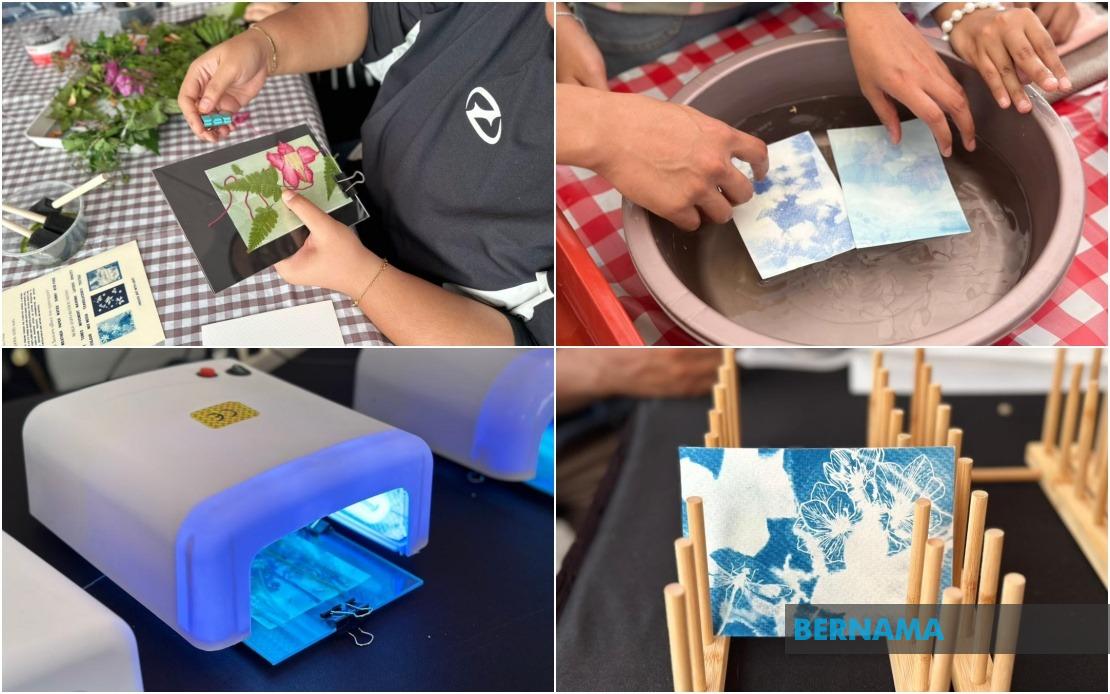
At the RIUH Pi HAWANA Carnival in Butterworth earlier this month, Puteri Mas Aishah Ramyusnali demonstrated that sunlight need not be merely a backdrop to daily life. For this 24-year-old Penang-born artist, the sun's rays are an active collaborator in her creative process, driving a photographic method known as cyanotype that transforms ordinary objects and botanical specimens into vivid cyan-blue prints. Her work illustrates how emerging Malaysian artists are harnessing ancient photographic techniques to craft contemporary conversations about humanity's relationship with the natural world.
Cyanotype is a sunlight-dependent printing process that requires patience, environmental awareness, and an understanding of how weather patterns influence artistic outcomes. The procedure begins when objects—leaves, flowers, or other materials—are arranged on paper that has been treated with photosensitive chemical compounds. This layered composition is then exposed to direct sunlight for approximately ten to fifteen minutes, during which the ultraviolet radiation triggers a chemical reaction. Once the exposure period concludes, the artist removes the botanical material and subjects the paper to a sequence of water baths using both acidic and alkaline solutions. It is during this washing phase that the distinctive blue-toned image gradually materializes, revealing the silhouettes and textures of the objects that once shadowed the treated surface.
What distinguishes Puteri Mas Aishah's approach to cyanotype is her recognition that the technique inherently bridges artistic creation with environmental observation. Unlike conventional studio-based art forms where controlled conditions dominate, cyanotype demands that artists become attuned to meteorological fluctuations and atmospheric variables. Cloud cover, humidity levels, and the intensity of ultraviolet radiation all exert measurable influence over the final print's vibrancy and tonal depth. Higher UV indices typically yield more saturated and visually concentrated shades of blue, whereas overcast conditions or diminished sun strength produce softer, more muted results. This dependency on natural forces means that no two prints are entirely identical, even when using the same botanical specimens and chemical formulations.
The artist, who is currently pursuing a Master of Fine Arts and Technology degree at Universiti Teknologi MARA, has come to view these variables not as obstacles but as essential components of her artistic vocabulary. Rather than attempting to eliminate unpredictability, she has learned to anticipate and incorporate it into her conceptual framework. This perspective shift emerged gradually during her undergraduate industrial training period, when she first encountered cyanotype and subsequently began facilitating public workshops introducing the technique to novices. Initially apprehensive about guiding participants without direct supervision from academic mentors, Puteri Mas Aishah pushed past her self-doubt and discovered that teaching others deepened her own understanding of the medium's potential.
Over the past three years since discovering cyanotype, the artist has channelled her enthusiasm into conducting regular workshops and establishing partnerships with various galleries and art studios throughout Shah Alam in Selangor. These collaborations extend beyond mere demonstration; they represent deliberate efforts to position cyanotype as a gateway through which diverse audiences might cultivate greater mindfulness of environmental factors that structure their lived experience. By inviting participants—particularly young people—to engage directly with the sunlight-dependent process, she creates opportunities for visceral understanding of how weather, light, and water interact to produce material outcomes.
For Malaysian audiences and the broader Southeast Asian creative community, Puteri Mas Aishah's work carries particular significance. The region experiences dramatic seasonal variations and distinct monsoon patterns that fundamentally affect UV exposure and climatic stability. These local conditions present both challenges and artistic possibilities for practitioners of light-sensitive techniques. Furthermore, her emphasis on environmental consciousness aligns with growing regional conversations around sustainability, biodiversity conservation, and the role of cultural practice in fostering ecological awareness. By positioning cyanotype as an art form inseparable from natural cycles and weather patterns, she challenges the notion that artistic expression occurs in a realm divorced from material reality.
The artist has become increasingly vocal about reconstituting how society perceives art's function and value. In her view, art continues to be mischaracterized as ornamental or peripheral to daily existence, when in reality it constitutes a fundamental dimension of human experience and cultural meaning-making. Through cyanotype workshops and exhibitions, she advocates for art as a medium through which people might cultivate deeper relationships with their environment rather than simply producing objects for aesthetic consumption. This pedagogical approach transforms participants from passive viewers into active practitioners who develop tangible comprehension of natural processes through direct experimentation.
The technical demands of cyanotype also cultivate disciplined observation habits. Artists working with this method must maintain detailed records of weather conditions, solar intensity measurements, and exposure times. This documentation practice mirrors scientific methodology while remaining fundamentally creative, suggesting that art and empirical investigation need not occupy separate intellectual domains. For young practitioners considering careers in creative fields, cyanotype offers a model demonstrating how artistic inquiry can incorporate rigorous environmental analysis and contribute to broader ecological literacy.
Puteri Mas Aishah's trajectory from uncertain workshop facilitator to established artist-educator reflects a broader pattern within Malaysia's contemporary art scene, where younger creators increasingly leverage historical and experimental techniques to address contemporary concerns. Cyanotype, developed in the nineteenth century but largely superseded by modern photography, has experienced renewed interest globally as artists and educators recognize its pedagogical and conceptual richness. Within the Malaysian context, her work contributes to conversations about how indigenous and traditional knowledge systems, combined with artistic innovation, might inform responses to environmental challenges facing the region.
The implications of her practice extend into cultural discourse surrounding technological determinism and environmental consciousness. By championing a technique fundamentally dependent on natural forces rather than complex machinery or digital processes, Puteri Mas Aishah subtly challenges assumptions that artistic progress necessarily involves increasing technological sophistication. Instead, she demonstrates that older methods, when engaged thoughtfully, remain capable of generating meaningful insights and fostering the kind of environmental attentiveness increasingly vital as Southeast Asia navigates rapid urbanization and ecological pressures.
Looking forward, her hope that younger Malaysians will embrace art as a vehicle for environmental connection rather than mere aesthetic decoration positions cyanotype workshops as sites of environmental education as much as artistic instruction. Each participant who learns to read weather patterns and understand UV dynamics gains practical comprehension of atmospheric science through direct creative engagement. This integration of environmental awareness with artistic practice models how cultural institutions might contribute to building more ecologically literate communities throughout Malaysia and the wider region, particularly among generations who will inherit the consequences of current environmental management decisions.

