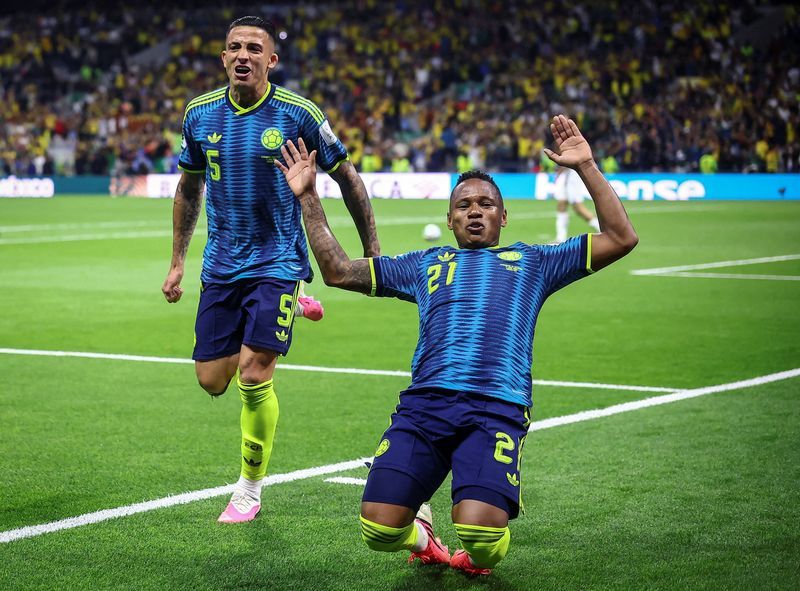
Colombia will attempt to strengthen their grip on World Cup Group K when they confront DR Congo on Tuesday, hoping to build momentum following their opening triumph over Uzbekistan. Manager Nestor Lorenzo's team enters the encounter as clear favourites, yet they remain wary of opponents who demonstrated remarkable resilience in drawing 1-1 against Portugal in their own opening fixture, signalling that this tournament holds surprises for even the continental heavyweights.
The South American side began their campaign with a 3-1 scoreline against Uzbekistan that ultimately flattered their performance. Despite the comfortable margin of victory, a concerning second-half collapse exposed defensive frailties that Lorenzo acknowledges must be rectified immediately. The manner of their opening win, rather than the result itself, has generated cautious optimism within the Colombian camp—a team aware that such vulnerabilities could prove catastrophic against more polished opponents.
A victory on Tuesday would effectively secure Colombia's advancement to the next stage, with qualification mathematics favouring Lorenzo's approach. Should Portugal simultaneously falter against Uzbekistan, a Colombian win could additionally clinch top spot in the group, providing significant psychological advantage heading into the knockout rounds. This arithmetic places Colombia in a position of control, yet football's inherent unpredictability remains ever present, particularly when facing an opponent brimming with confidence and tactical discipline.
The tournament's narrative has thus far revolved around Bayern Munich's Luis Diaz, whose electrifying performance against Uzbekistan—combining a goal and an assist—earned him the match's outstanding player accolade. Diaz's explosive pace and directness have become Colombia's primary attacking weapon, yet this reliance on a single dimension concerns Lorenzo, who recognises the necessity for greater creative contribution from captain James Rodriguez. The Madridista played a noticeably peripheral role in the opener, and Colombia's capacity to unlock defensive structures will likely hinge upon whether Rodriguez can elevate his involvement and orchestrate play with the precision expected of his experience level.
DR Congo's emergence as a genuine competitive force represents one of the tournament's compelling subplots. The nation's return to the World Cup stage for the first time since 1974—when they competed under their former identity as Zaire—came with considerable anticipation of a predictable elimination. Instead, Sebastien Desabre's squad delivered a performance of such defensive organisation and tactical maturity that they frustrated Portugal, one of the tournament's pre-tournament favourites, into accepting a stalemate. Yoane Wissa's opening goal carried profound symbolic weight, representing not merely a competitive achievement but a moment of national pride in returning to football's grandest stage after fifty years of absence.
Desabre has fashioned his approach around compactness and transitional efficiency, principles that proved devastatingly effective against the Portuguese. The Congolese manager will almost certainly replicate this tactical template against Colombia, recognising that defensive solidity coupled with devastating counter-attacking provides their optimal pathway to progression. Yet Colombia's attacking quality presents a qualitatively different challenge from what Portugal offered. Where the Europeans maintained possession and methodically probed, Colombia's strengths lie in explosive directness and vertical transitions—precisely the areas where DR Congo's elongated defensive shape and quick-break mechanisms prove most vulnerable.
Lorenzo has publicly articulated his awareness of the tactical complexities ahead. The Argentine coach specifically identified DR Congo's propensity for direct football and rapid transitions as presenting a distinctly challenging puzzle, suggesting his pre-match preparation will focus substantially on defensive organisation and possession retention. "Congo play more in transition, with long balls and quick breaks. It's going to be a very difficult match for us," Lorenzo stated, demonstrating a respect for opponents that some analysts argue reflects either genuine concern or appropriate professional caution.
Simultaneously, Lorenzo identified a persistent deficiency within his own team's framework. Colombia's excessive possession against Uzbekistan occasionally functioned counterintuitively, with players sometimes retreating into backward passing sequences rather than committing to decisive attacking combinations. This tendency toward over-elaboration in midfield, rather than incisive penetration, represents a concern that Lorenzo explicitly highlighted as requiring immediate rectification. The Colombian coach recognised that territorial dominance means nothing without clinical finishing and purposeful penetration, suggesting his tactical instructions will emphasise direct play and creation of high-quality scoring opportunities.
The atmospheric dimension will considerably favour Colombia's prospects. Thousands of Colombian supporters transformed Mexico City's Estadio Azteca into a de facto home venue during the opening victory, creating an environment of overwhelming support. With their tournament operational base established in Guadalajara, another substantial contingent of Colombian fans is expected to attend Tuesday's encounter, potentially recreating the encouraging atmosphere that contributed to their opening success. This home-field advantage, manufactured through geographic proximity and vibrant diaspora support, represents a tangible benefit that DR Congo must overcome through unwavering concentration.
The psychological undercurrents merit equal consideration. Colombia arrive burdened by expectation as a comparatively elite football nation, while DR Congo carry the liberating confidence of competitors with nothing to lose and everything to prove. Having already exceeded most observers' predictions through drawing with Portugal, the Congolese can approach this match with freedom from pressure, potentially deploying energy and aggression that Colombian players accustomed to possession dominance may find disruptive. Conversely, Colombia must balance ambition with caution, avoiding the complacency that occasionally afflicts favoured sides when facing perceived underdogs.
The broader implications extend beyond immediate group progression. Colombia's response to genuine adversity will establish the template for their tournament trajectory, while DR Congo's potential advancement would constitute a transformative moment for African football and the nation's sporting culture. This encounter thus transcends mere qualifying mathematics, embodying deeper narratives of continental aspiration and the tournament's capacity to generate compelling narratives around unexpected protagonists.

