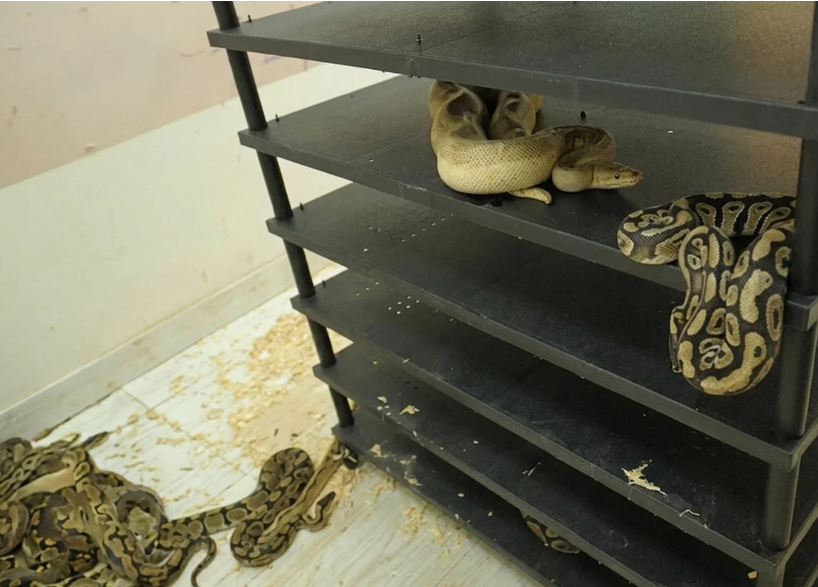
A man living in Taizhou, Zhejiang province, was convicted and jailed for illegally breeding more than 300 pythons in his residential flat, a case that highlights how modern utilities and data analysis can expose wildlife trafficking operations. The discovery unfolded after a senior citizen found an escaped python at the base of a local mountain in March 2024, triggering a police investigation that would eventually dismantle one of the region's largest illegal reptile breeding networks.
The initial report of the tawny python, described as thick as an adult's arm, seemed unremarkable on its surface, yet it prompted investigators to consider an unconventional possibility. The species does not naturally inhabit Zhejiang province, and the timing was suspicious—snakes are typically dormant in March. This combination suggested the animal had not wandered far from its source. Police hypothesised that the reptile had escaped from a nearby breeding facility, setting them on a path that would eventually expose a sophisticated operation hidden within an ordinary residential neighbourhood.
The investigative breakthrough came from an expert consultation. A professional snake raiser explained to police that pythons require precisely controlled environmental conditions, demanding temperatures between 20 and 30 degrees Celsius maintained consistently year-round. Achieving such climate control in a residential setting would require substantial and measurable electricity consumption. This insight transformed the investigation from a needle-in-a-haystack search into a data-driven operation. Authorities began screening residents in the area based on electricity usage records, methodically comparing billing patterns to identify anomalies that might indicate large-scale animal husbandry.
Police identified a man surnamed Guo as their primary suspect. Guo lived alone, was unemployed, and displayed an unusual electricity consumption pattern that deviated sharply from what would be expected for a solitary resident. Further investigation revealed a crucial pattern: a frequent visitor named Di regularly collected parcels from courier stations. Online sellers confirmed that these packages contained white mice purchased specifically for feeding reptile pets. Cross-referencing social media activity showed that Guo had shared photographs of snakes and made oblique references to selling pythons privately. Transaction records revealed that Di had brokered the sale of two pythons to a third party for 1,000 yuan, indicating the operation had already generated commercial sales.
When police executed a search warrant at Guo's flat, they encountered a sight that underscored the scale of the operation. The living space had been radically restructured to accommodate the breeding operation rather than support normal human habitation. Guo had consolidated all his personal furniture into a single bedroom while converting the remaining two bedrooms and living room into climate-controlled python enclosures. Plastic boxes stacked floor to ceiling housed individual snakes, transforming what should have been living quarters into an industrial-scale facility masquerading as a residential unit. Officers seized 309 pythons from the premises, which were subsequently transferred to a local zoo.
Guo's motivations extended beyond simple profit. During questioning, he revealed a genuine passion for herpetology, describing his interest in snakes as lifelong and expressing no fear of the creatures. He had commenced breeding operations in 2014 with an initial purchase of four pythons and had since invested considerable time researching breeding techniques and genetic variation. His own statement—"I am capable of cultivating snakes of various colours. I feel like a creature creator"—reflects the mindset of someone who viewed the operation through a lens of scientific enthusiasm combined with entrepreneurial ambition. This psychological profile, while intellectually interesting, did not diminish the severity of his violations.
The investigation expanded beyond Guo to expose a wider criminal network. A shop owner named Deng, who had sold four pythons to Guo in 2014, was identified as a key supplier. Police discovered 47 additional pythons in Deng's residence, indicating he had continued supporting illegal breeding operations despite regulations prohibiting such sales. The accomplice Di, who had managed sales and distribution, was also arrested. Together, the three individuals had sold approximately 80 pythons before their apprehension, generating substantial illicit income while circumventing environmental protections.
The magnitude of the operation becomes apparent when examining the cumulative figures. Across all three suspects, authorities seized a total of 436 pythons valued at more than 30 million yuan, equivalent to approximately US$4.4 million. This valuation underscores how wildlife trafficking can represent significant economic activity, providing powerful financial incentives for violators to accept legal risks. For organised criminal networks, the profits from such operations often exceed those from low-level drug trafficking, yet enforcement and penalties frequently remain disproportionately lenient.
China's legal framework addresses such violations through its Criminal Law, which designates pythons as Grade Two protected animals and imposes strict prohibitions on unauthorised buying, selling, breeding, and transportation. Violators face maximum penalties of five years imprisonment, though the court in Taizhou did not disclose the specific sentences imposed on Guo, Di, and Deng. The lack of transparency regarding sentencing details obscures whether penalties matched the severity of the operation or remained relatively light relative to the commercial value and environmental harm involved.
The case carries implications for Southeast Asian nations, including Malaysia, where python trafficking and illegal breeding also occur. As regional demand for exotic reptiles increases through online marketplaces and underground networks, law enforcement agencies across the region must adapt to modern detection methods. The Chinese investigation demonstrates that utility consumption data, online transaction records, and courier package tracking can provide investigative leads that traditional surveillance might miss. Malaysian authorities could apply similar analytical approaches to identify illegal breeding operations and trafficking nodes within urban areas.
Furthermore, the operation highlights the tension between conservation objectives and market demand. Python populations in Southeast Asia face pressure from habitat loss and collection for the pet trade. Illegal breeding operations, while technically producing captive-bred animals, undermine conservation efforts by normalising commercial trade in protected species and driving demand that expands into wild populations. The 436 pythons seized in this case represent animals that will never contribute to commercial trade, yet the operation likely inspired others to attempt similar ventures in less-regulated jurisdictions.
The investigation also underscores how environmental regulations intersect with urban policing and data management. The discovery mechanism—correlating unusual electricity consumption with suspected wildlife trafficking—represents an innovative application of digital forensics to environmental crime. As cities become increasingly intelligent through meter reading systems, internet of things devices, and data aggregation platforms, similar detection methods could identify other illicit operations previously concealed within urban landscapes. This technological capability presents both opportunities for enforcement and privacy considerations that societies must carefully balance.
The long-term fate of the confiscated pythons at the Taizhou zoo remains unspecified in available reports, though zoos in China typically lack capacity to permanently house large seized collections. These animals represent a conservation burden that law enforcement and wildlife agencies must address. Whether they can be returned to natural habitats, relocated to sanctuaries outside China, or must remain in captivity indefinitely remains undetermined. The case thus extends beyond prosecution to raise broader questions about managing the consequences of illegal wildlife trafficking within regional enforcement frameworks.

