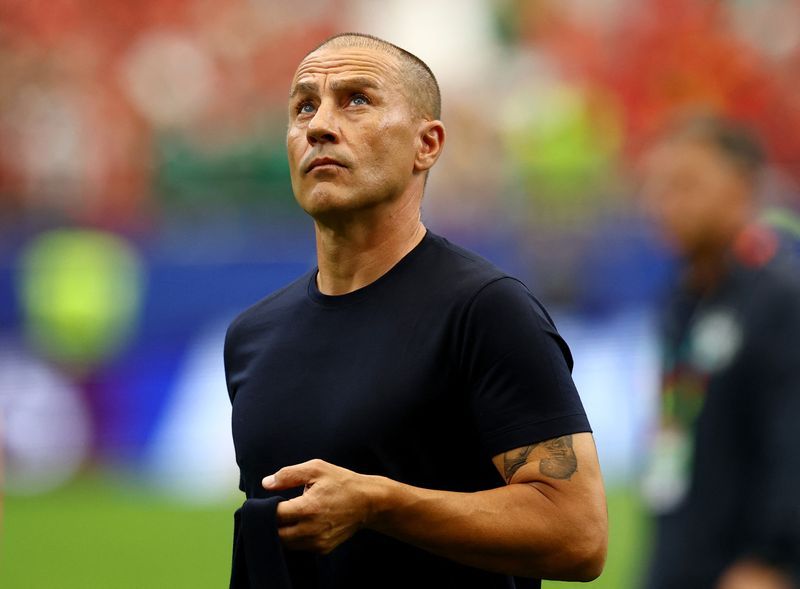
Uzbekistan's first-ever World Cup campaign suffered a crushing blow on Tuesday in Houston when they capitulated 5-0 against Portugal in Group K, leaving coach Fabio Cannavaro to publicly assume accountability for the defensive collapse. Speaking in the aftermath of the one-sided encounter, the Italian tactician—whose 2006 World Cup winning experience with Italy stands in stark contrast to Uzbekistan's maiden tournament appearance—refused to apportion blame toward his players and instead directed criticism at his own strategic and tactical decisions. This magnanimous stance from a coach of his pedigree suggests either genuine conviction in his squad's potential or an astute understanding of how fragile morale becomes following such a comprehensive defeat.
The defeat has pushed Uzbekistan to the precipice of elimination, compounding the damage done by their earlier 3-1 loss to Colombia. With only one match remaining against the Democratic Republic of Congo on Saturday, the Central Asian nation now faces an almost impossible mathematical hurdle if they harbour any remaining ambitions of advancing to the round of 32. Cannavaro acknowledged the arithmetic reality while attempting to maintain a modicum of optimism, telling assembled reporters that his team must continue fighting until numerical reality renders their tournament hopes mathematically impossible. This precarious position raises questions about the readiness of emerging football nations competing at the world's most prestigious tournament.
Cannavaro's assertion that responsibility for the loss rests squarely with him echoes the philosophy he has consistently maintained throughout his managerial career. Drawing on decades of experience both as a World Cup-winning defender and subsequent coach, he articulated a clear belief that leadership demands accountability, particularly when results disappoint so dramatically. By shielding his players from external criticism, he sought to preserve their confidence and resilience—crucial psychological commodities for a young squad navigating their debut World Cup experience. This approach reflects a recognition that morale management becomes paramount when facing potential early elimination.
A pivotal moment in the match came when Uzbekistan's Azizjon Ganiev saw what appeared to be a well-constructed goal wiped from the scoreboard due to a foul occurring during the build-up play. Cannavaro identified this decision as the psychological turning point that sapped his team's energy and belief. The disallowed goal had arrived with Portugal leading 2-0, meaning what would have been a recovery to 2-1 never materialised on the official scoresheet. The coach suggested his players had begun matching Portugal's intensity and tactical approach initially, only to lose focus and cohesion after the controversial decision. For Malaysian and Southeast Asian observers, this narrative underscores how fine margins in football often determine outcomes, particularly for less experienced sides competing against established powerhouses.
Cannavaro's background as a 2006 World Cup winner provides him with credibility when discussing tournament pressure and the mental fortitude required at football's highest level. However, his current role managing an emerging Central Asian football programme presents fundamentally different challenges from his previous positions. The contrast highlights how coaching at international tournaments demands different skill sets depending on whether you are stewarding an established football nation with tournament infrastructure or building foundations for emerging programmes. His appointment to Uzbekistan suggests faith that his championship mentality and tactical nous could accelerate the team's development, though results thus far suggest the gulf between ambition and current ability remains substantial.
The coach emphasised that he had specifically instructed his players to embrace bravery and play attacking football rather than retreat into defensive shell-shock. This tactical directive reveals how Cannavaro attempted to frame the competition as a learning opportunity rather than a battle for survival. By encouraging his squad to take calculated risks, express themselves freely, and not fear the consequences of mistakes, he sought to create an environment where individual and collective improvement might accelerate despite unfavourable outcomes. Such an approach contrasts sharply with the conservative, pragmatic defending typically prioritised by nations fighting for tournament survival.
For Uzbekistan's football development trajectory, this World Cup experience—despite the devastating results—potentially carries long-term value. The country's top players are now gaining invaluable exposure to world-class opposition and tournament environments they might not otherwise encounter for years. The pressure, intensity, and tactical sophistication required at the World Cup cannot be replicated through qualifying matches or friendly fixtures. Cannavaro seems determined to extract maximum learning value from what could otherwise be viewed as a thoroughly disappointing campaign. This development-oriented perspective proves particularly relevant for Central Asian and Southeast Asian football programmes attempting to elevate their competitive standing against established footballing nations.
The mathematical elimination possibility becomes reality only after Saturday's clash with the Democratic Republic of Congo, yet Cannavaro appears to have already pivoted toward a longer-term vision. His public comments suggest he views this tournament not as the end point of his Uzbekistan project but rather as a crucial foundation-building phase. Whether the Uzbekistan Football Association shares this patient, development-focused philosophy remains unclear, but Cannavaro's willingness to accept personal responsibility while protecting his squad indicates a coach operating according to principle rather than self-preservation. For emerging football nations in Asia, such measured responses to adversity at the World Cup level could serve as instructive examples of how to navigate catastrophic defeats without fracturing squad unity or institutional confidence.
The road forward involves marshalling Uzbekistan's remaining tournament energies for Saturday's must-win fixture while simultaneously absorbing difficult lessons about playing at World Cup intensity. Cannavaro has positioned himself as the adult in the room, absorbing criticism and projecting steadiness when circumstances might justify panic. This display of emotional and tactical maturity from the dugout could prove decisive in determining whether Uzbekistan emerges from this tournament utterly demoralized or cautiously encouraged about future competitive prospects. For Malaysian football observers, the Uzbekistan experience serves as a sobering reminder that tournament debuts, regardless of preparation quality, often expose uncomfortable truths about the distance between aspirational football ambitions and actual competitive capability.

