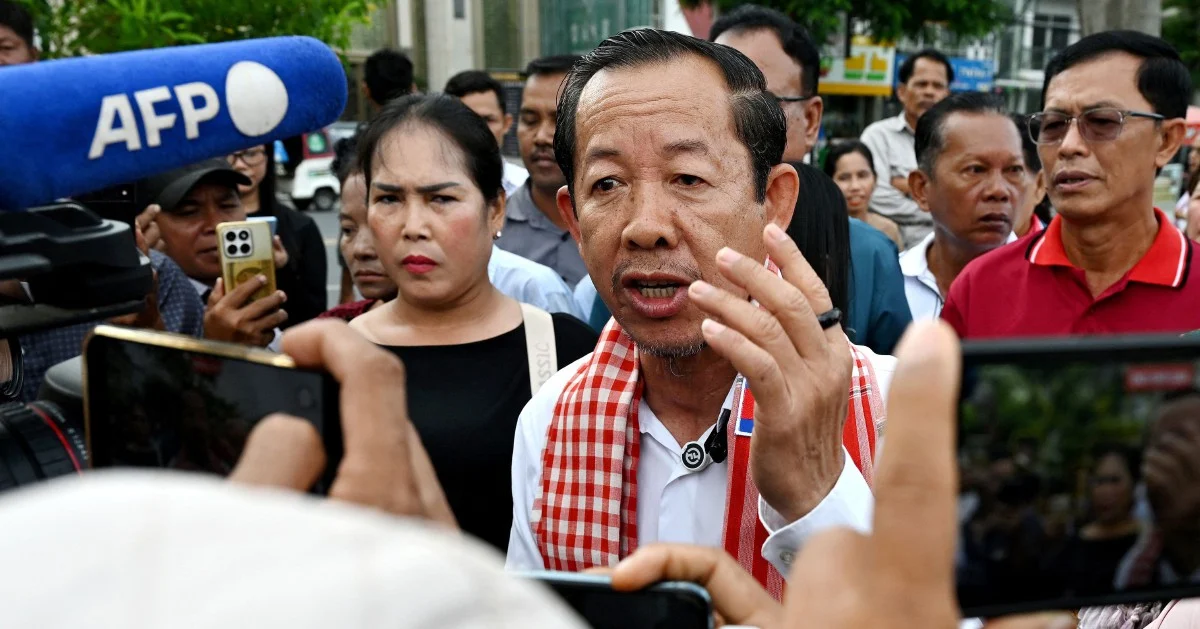
Cambodia's Supreme Court has taken a mixed approach to the case of opposition politician Rong Chhun, suspending an earlier prison sentence while maintaining a prohibition on his participation in future elections. The ruling, announced through his lawyer on Friday in Phnom Penh, represents a partial reprieve for the vocal government critic, though it leaves in place significant constraints on his political activities.
The decision to suspend Rong Chhun's prison term addresses one dimension of his legal troubles, potentially allowing him to remain active in Cambodia's political sphere without facing immediate incarceration. However, the Supreme Court's confirmation of the electoral ban represents a more consequential limitation on his future prospects. The ban effectively prevents him from standing as a candidate in national or local elections, effectively sidelining him from direct electoral competition for a specified period.
Rong Chhun has established himself as one of Cambodia's more prominent opposition voices, regularly criticizing government policies and mobilizing supporters around grassroots political causes. His legal troubles must be understood within the broader context of Cambodia's restricted political environment, where opposition figures frequently face legal charges ranging from defamation to incitement. The convergence of these cases on a single politician reflects patterns observed across Southeast Asia, where legal systems are sometimes deployed as mechanisms to constrain political opposition.
The distinction between suspending a prison sentence and maintaining an electoral ban carries important implications for Cambodian politics. A suspended sentence means Rong Chhun avoids immediate detention, which would have severely hampered his ability to continue organizing or speaking publicly. Yet the prohibition on running for election removes the traditional pathway through which opposition politicians can translate public support into legislative representation. For opposition movements in Cambodia, such restrictions effectively create a two-tier system where some activists can remain visible in civil society but cannot transition into formal political office.
This ruling occurs against the backdrop of Cambodia's broader political consolidation under the Cambodian People's Party, which has dominated governance since the early 1990s. The Supreme Court's decision reflects the limited independence that Cambodia's judiciary exercises, particularly in politically sensitive cases involving government critics. Regional observers have repeatedly noted concerns about judicial impartiality in cases touching on electoral matters or threats to incumbent power structures.
For Malaysian and other Southeast Asian readers, Cambodia's trajectory offers cautionary insights into how legal systems can be utilized to manage political opposition. While Malaysia has its own mechanisms for regulating political speech and eligibility, Cambodia's more overt constraints on opposition electoral participation demonstrate how democratic institutions can be restructured to limit competitive dynamics. The suspension of Rong Chhun's prison sentence, while appearing merciful, may actually serve to maintain the appearance of judicial reasonableness while achieving the substantive political outcome of preventing him from contesting elections.
The electoral ban particularly affects Cambodia's opposition movements by removing experienced, organized figures from future electoral campaigns. When opposition leaders cannot stand for election themselves, broader movements lose not only their most prominent spokespeople but also the organizational infrastructure and voter networks that typically coalesce around known candidates. This fragmentation weakens opposition capacity to mount coherent electoral challenges to incumbent authorities.
International observers and human rights organizations have increasingly scrutinized Cambodia's treatment of opposition figures, noting a pattern wherein legal tools are deployed against political adversaries. The Supreme Court's decision to suspend the prison sentence may reflect moderate pressure on Cambodia's judicial system to demonstrate some procedural fairness, even as substantive political constraints remain in place through the electoral ban. This balancing act allows Cambodian authorities to project an image of judicial restraint while maintaining effective political control.
Rong Chhun's situation exemplifies the precarious position of opposition voices in Cambodia. Despite his prominence and organizational capacity, legal restrictions now prevent him from channeling his political influence through electoral mechanisms. His supporters remain free to advocate for policy changes through civil society organizations and grassroots mobilization, but their most direct path to legislative influence—through electing their preferred candidate—has been closed through the electoral ban.
The broader implications for Cambodia extend beyond one individual. As the country approaches future electoral cycles, the precedent of maintaining electoral bans against prominent opposition figures establishes a template for managing political opposition. Unlike outright imprisonment, which invites international criticism and may generate sympathy for affected individuals, electoral bans achieve comparable political outcomes through formally legal mechanisms that appear procedurally neutral.
For Southeast Asian democracies monitoring Cambodia's political evolution, this case illustrates how judicial systems can be structured to reinforce political incumbency while maintaining plausible deniability regarding democratic commitment. The Supreme Court's partial reprieve in Rong Chhun's case—suspending imprisonment while upholding electoral restriction—demonstrates sophisticated understanding of how legal rulings can simultaneously appear compassionate and remain politically effective in constraining opposition capacity.

