Cambodian Prime Minister Hun Manet has committed to intensifying Cambodia's campaign against the transnational online fraud networks that have ravaged the region, yet acknowledged a sobering reality: the criminal organisations behind these operations are proving far more resilient and adaptable than previously anticipated. Speaking this week during an interview with Bloomberg Television, Hun Manet outlined his administration's strategy to dismantle what has become one of Southeast Asia's most pervasive criminal enterprises, even as he conceded that scam syndicates are restructuring themselves into smaller, dispersed operational units scattered across multiple countries.
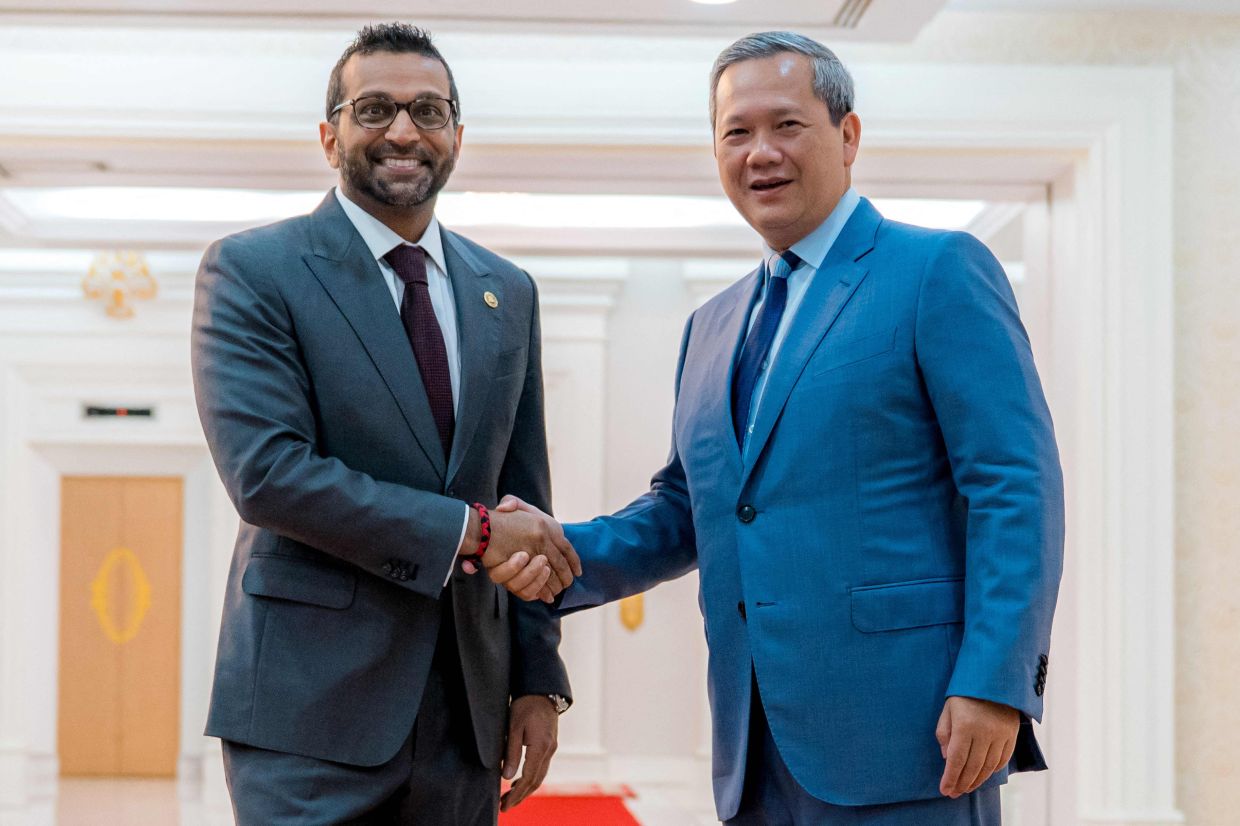
The Cambodian government has already dismantled more than 670 unlicensed scam operations, Hun Manet disclosed, while simultaneously deepening cooperative intelligence arrangements with international law enforcement agencies. His remarks came during a significant meeting this week with US Federal Bureau of Investigation Director Kash Patel, underscoring Washington's sustained concern about organised cybercrime emanating from the region. "We will make Cambodia become an area that's not easy or worth to stay for scams," Hun Manet declared, articulating an ambitious objective that reflects mounting international pressure on Phnom Penh to eliminate its reputation as a haven for large-scale fraud operations.
The sophistication of modern scam networks presents authorities with unprecedented challenges. Hun Manet acknowledged that technology has fundamentally transformed how these criminal enterprises operate, enabling them to distribute their activities across borders and reduce their vulnerability to law enforcement raids targeting centralised facilities. This decentralisation strategy represents a significant evolution from the earlier model of concentrated scam compounds housed in dedicated buildings, which had made them relatively easier to identify and shut down. The criminal syndicates have essentially adopted a network architecture that mirrors legitimate businesses seeking resilience and operational continuity, making traditional enforcement approaches increasingly ineffective.
The proliferation of online scam operations across Southeast Asia has accelerated dramatically since the COVID-19 pandemic, with Cambodia, Myanmar, and Laos emerging as epicentres of these criminal activities. The scale of the problem is staggering: the United Nations Office on Drugs and Crime reported this week that scams across East Asia, Southeast Asia, Australia, and New Zealand generated combined losses estimated at approximately US$114 billion last year alone. These figures underscore the magnitude of the challenge confronting regional governments and international partners alike, highlighting why the issue has ascended to the top tier of diplomatic and security concerns.
Hun Manet, who assumed the premiership in August 2023 following his father Hun Sen's departure after nearly four decades in power, has endeavoured to project a more technocratic and reform-oriented leadership style whilst preserving the Cambodian People's Party's authoritarian control that has endured since the Khmer Rouge's overthrow in 1979. The 48-year-old leader, a West Point graduate, inherited a state apparatus frequently criticised for institutional corruption and selective enforcement of laws. Hun Sen, though officially retired from the premiership, maintains considerable power as Senate President and ruling party chief, complicating Hun Manet's efforts to demonstrate genuine transformative commitment.
International scrutiny of Cambodia's scam networks has intensified from both Western and Asian powers. The United Nations and human rights organisations have repeatedly alleged that these multibillion-dollar fraud enterprises operate with tacit approval and protection from elements within Cambodia's political and commercial hierarchies. The United States has imposed sanctions against prominent Cambodian senators Ly Yong Phat and Kok An, accusing them of involvement in human trafficking, forced labour, and cybercrime compound networks that have defrauded American citizens. Such designations place Cambodia in an awkward diplomatic position, as Hun Manet seeks to balance international compliance with domestic political considerations.
When confronted regarding these sanctions, Hun Manet characterised them as legal disputes being litigated in courts, whilst asserting that state investigative agencies actively pursue cases involving government officials and business leaders alike. He cited examples of military generals and provincial governors who have faced dismissal and prosecution, suggesting the administration is not uniformly protecting connected individuals. However, independent observers remain sceptical about whether these enforcement actions represent genuine systemic reform or merely cosmetic gestures designed to appease international critics without fundamentally dismantling the networks that allegedly benefit regime-connected actors.
Beyond cybercrime, Hun Manet addressed Cambodia's festering border dispute with Thailand, urging Bangkok to recommence joint boundary demarcation negotiations to enable the return of more than 20,000 displaced residents to border provinces. Although a ceasefire has held since hostilities erupted a year ago, Hun Manet characterised the situation as inherently precarious, with tens of thousands of soldiers maintained in opposing positions along the frontier. He rejected Thai assertions that Cambodia's pursuit of UN maritime arbitration justifies suspending land-border talks, arguing that these remain legally and diplomatically separate matters under bilateral frameworks.
The interconnection between Cambodia's internal security challenges and its regional diplomatic standing reflects the complex geopolitical environment that Hun Manet navigates. Beijing and Washington both maintain strategic interests in Cambodia's stability and governance trajectory, creating competing pressures that complicate policy implementation. The scam networks represent not merely a law enforcement problem but a sovereignty issue, as international criminal activity on Cambodian soil generates reputational damage and invites foreign intervention. Meanwhile, the unresolved border tensions with Thailand inject additional instability into a country already grappling with institutional weaknesses and pervasive corruption.
Hun Manet's pledges to strengthen anti-scam operations must be evaluated against the structural obstacles confronting Southeast Asian governments. Transnational criminal organisations exploit weaknesses in financial systems, internet infrastructure, and law enforcement coordination across borders. Cambodia's relatively limited capacity compared to regional powers compounds these challenges. Additionally, the financial incentives driving individuals into scam operations—which offer employment opportunities substantially exceeding legitimate sector wages in one of Asia's poorest countries—ensure a steady recruitment pipeline. Addressing this requires not merely enforcement but fundamental economic transformation and credible rule-of-law reforms that remain distant prospects.
The coming months will determine whether Hun Manet's stated commitment to eliminating Cambodia's scam infrastructure translates into meaningful action or represents primarily rhetorical positioning for international audiences. Concrete metrics include the sustainability of the crackdown, the prosecution of politically connected individuals, and demonstrable improvements in cross-border law enforcement cooperation. The regional implications are substantial, as the trajectory of Cambodia's governance significantly influences Southeast Asian stability, investor confidence, and the broader geopolitical competition between major powers seeking influence across the region.

