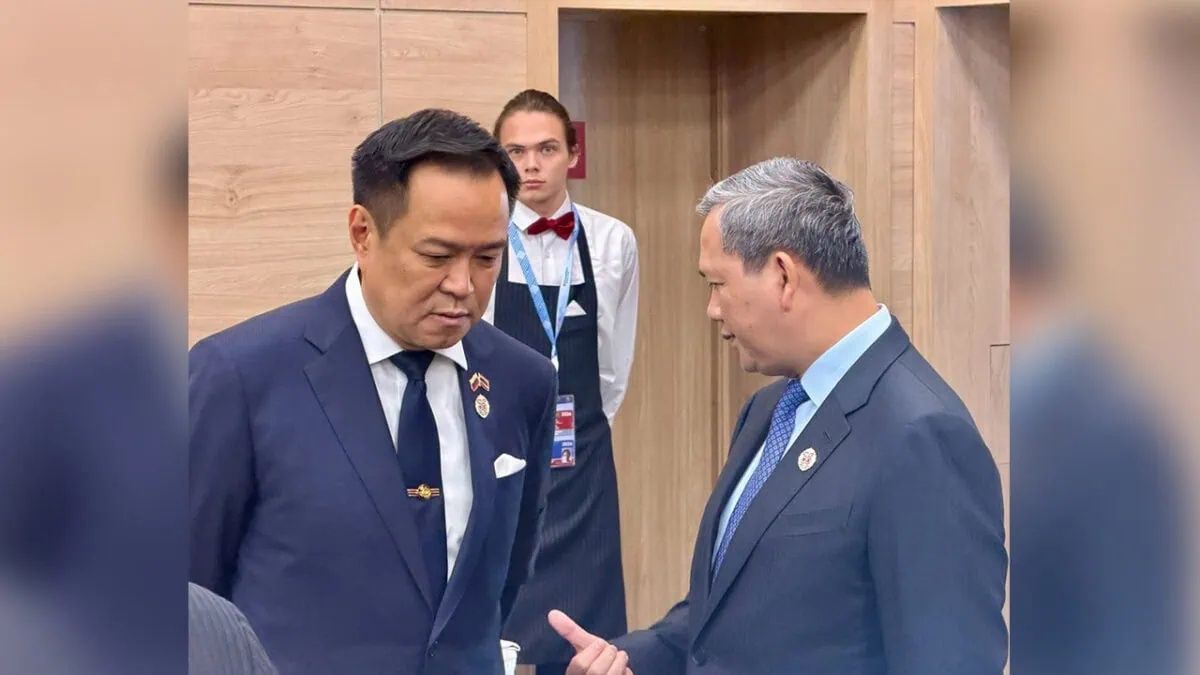
Cambodian Prime Minister Hun Manet has stepped up pressure on Thailand to move forward with long-stalled border demarcation efforts, calling for the appointment of a Joint Boundary Commission chief and the commencement of joint boundary surveys. The appeal came during an informal exchange with Thai Prime Minister Anutin Charnvirakul at an Asean-Russia engagement held in Kazan, Russia, signalling that despite periodic tensions, both capitals remain engaged in diplomatic dialogue over boundary issues that have periodically strained regional relations.
Manet's intervention reflects Phnom Penh's frustration with the pace of progress on a bilateral matter that has long plagued Cambodia-Thailand relations. In a social media statement posted on Friday, the Cambodian leader outlined his position clearly, emphasising that Cambodia maintains unwavering commitment to resolving border disputes peacefully and in accordance with established international law. The messaging was carefully calibrated to demonstrate Cambodia's reasonableness while placing responsibility for acceleration squarely on Bangkok's shoulders, particularly regarding Thailand's failure thus far to nominate a JBC chief.
The Cambodian premier specifically referenced Point Three of a Joint Statement signed on December 27, 2025, which apparently obligates both countries to commence survey and demarcation work. By invoking this agreement, Manet sought to ground his appeal in mutual commitments rather than unilateral demands, lending his call for action greater diplomatic weight and making it harder for Thailand to dismiss the request as overreach. This approach reflects Cambodia's strategy of building international and contractual pressure for compliance with existing accords.
Cambodia's dual-track strategy on border matters has become increasingly evident in recent diplomatic exchanges. For maritime disputes, Phnom Penh has invoked the compulsory conciliation process under the United Nations Convention on the Law of the Sea, a mechanism already engaged with Thailand. For land boundaries, however, Cambodia continues to prefer bilateral negotiations through the Joint Boundary Commission and other existing bilateral agreements. This distinction matters considerably, as it demonstrates Phnom Penh's willingness to utilise international arbitration when necessary but a preference for maintaining bilateral channels where possible, likely reflecting concerns about losing negotiating flexibility or appearing overly confrontational.
Thailand's response, delivered through Anutin's characterisation of the conversation as merely a brief exchange—described colourfully as "pulling each other aside by the elbow"—suggested Bangkok intended to downplay the significance of Cambodia's overtures. The Thai premier told journalists that limited time availability at the Kazan meetings prevented extended discussion, a framing that effectively minimised what Manet had presented as an important diplomatic intervention. Anutin's reluctance to elevate the conversation's importance may reflect domestic political sensitivities in Thailand regarding border concessions or the appearance of yielding to Cambodian pressure.
Anutin's acknowledgment that Thailand remained committed to international and bilateral frameworks, including UNCLOS, the JBC, and the General Border Committee, indicated agreement in principle with the peaceful resolution approach. His statement that both nations explicitly reiterated they did not want conflict provided reassurance that the current period poses no immediate risk of military escalation. However, his apparent laughter when asked about reopening border checkpoints—coupled with his comment that Thai citizens would be "furious" if such discussions occurred—revealed the domestic political constraints shaping Bangkok's approach to border normalisation.
The divergent emphases in the two leaders' public statements, while subtle, underscored different negotiating positions beneath a veneer of consensus. Cambodia presented itself as the party actively pushing for progress, willing to invest diplomatic capital in advancing demarcation work, while Thailand adopted a more passive posture, stressing commitment to frameworks without demonstrating urgency about implementation. This asymmetry in rhetoric suggests that Phnom Penh is keenly aware of the stalled nature of border work and believes time may be working against it, whereas Bangkok may perceive advantage in maintaining the status quo.
For regional observers and Malaysian policymakers monitoring Cambodia-Thailand relations, these developments carry implications beyond the bilateral context. Border stability in mainland Southeast Asia remains crucial to broader regional security and economic integration efforts. The persistence of undemarcated boundaries creates vulnerabilities to misunderstanding and miscalculation, potentially affecting transport corridors and trade routes that benefit the entire region. Thailand's apparent reluctance to advance demarcation work, despite Cambodian diplomatic efforts, raises questions about Bangkok's underlying calculations regarding border issues and whether domestic political factors are constraining its negotiating flexibility.
Cambodia's invocation of international law and established agreements reflects a sophisticated diplomatic strategy aimed at internationalising what might otherwise be dismissed as a purely bilateral concern. By anchoring Cambodia's position in UNCLOS and formal Joint Statements, Phnom Penh signals to the international community and regional partners that it is operating within accepted legal frameworks and that Thailand's pace of progress may not meet international norms for boundary resolution. This approach may gradually build subtle pressure on Bangkok to act, even as it maintains the appearance of respecting bilateral mechanisms.
The Kazan meeting also illustrated how regional multilateral forums such as Asean events continue to serve as important venues for bilateral dialogue among neighbouring states. The informal nature of the exchange—occurring on the margins of larger meetings—allowed both leaders to engage substantively while maintaining diplomatic flexibility and avoiding the formal structures that might lock either party into more rigid positions. This pattern of engagement, while permitting continued conversation, has not yet translated into concrete progress on the disputed boundaries themselves.
Looking forward, the critical question remains whether Cambodia's diplomatic pressure will translate into Thai action on appointing a JBC chief and commencing surveys. Should Thailand continue to delay, Cambodia may face pressure to escalate through international arbitration mechanisms or to seek support from regional partners. Conversely, successful completion of border demarcation would represent a significant achievement for both governments and could serve as a foundation for deeper bilateral cooperation on broader economic and security matters affecting mainland Southeast Asia's stability and prosperity.

