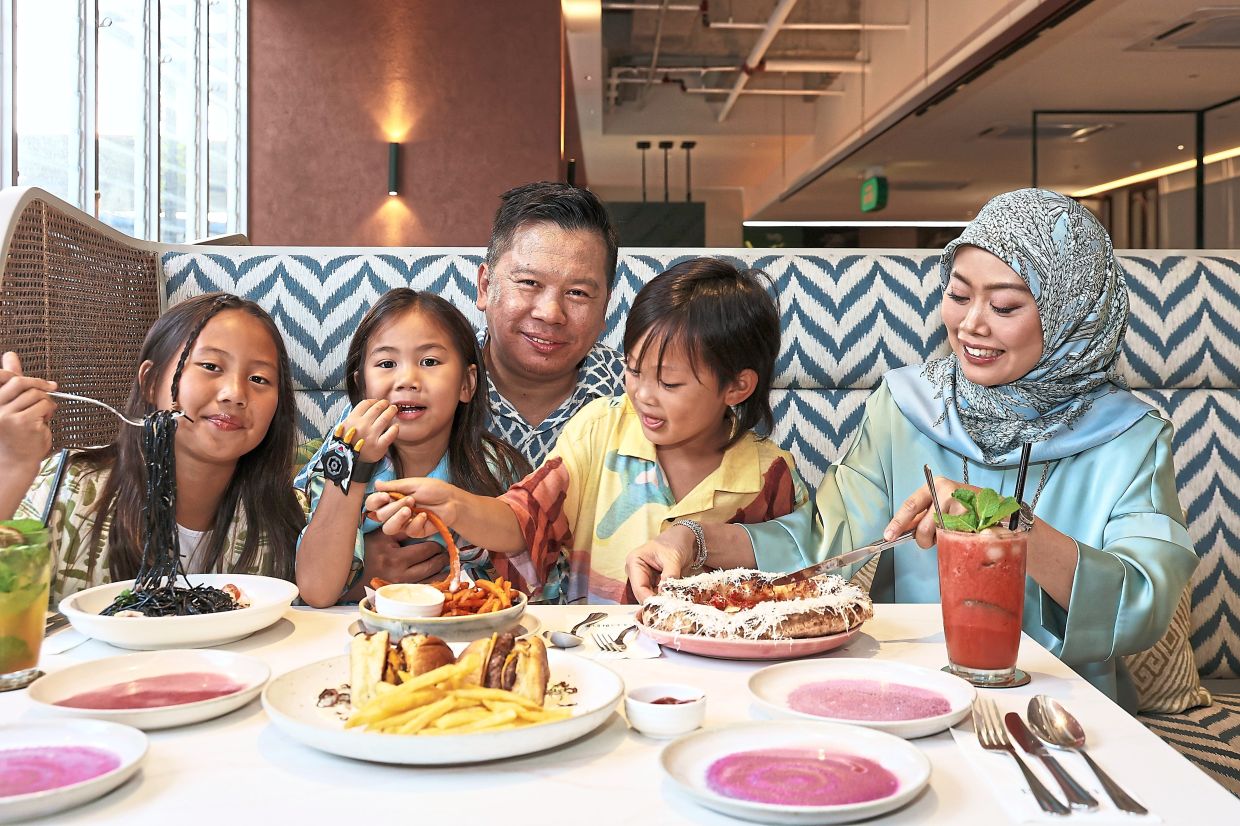
Inside the stylish Super Blonde restaurant at KLGCC Mall in Kuala Lumpur, a scene of familial ease unfolds as Datuk Mohd Najib Abdul Hamid's three children move about with the casual confidence of those who have grown up surrounded by hospitality. Ten-year-old Arya Iman darts between the dining room and the adjoining Taffy gelato shop owned by her aunt, ordering ice cream with the familiarity of someone who understands the inner workings of these establishments intimately. Her younger brothers, eight-year-old Arman Noah and five-year-old Arif Azeez, lounge contentedly on banquettes, occasionally receiving warm greetings from passing staff members. The ease with which the children navigate these spaces reflects more than mere privilege—it speaks to a deliberate parenting philosophy that has woven family life inseparably into the fabric of a thriving hospitality business.
Datuk Mohd Najib and his wife Datin Qistina Taff, both directors of the Serai Group, have created something increasingly rare in contemporary Malaysia: a family enterprise where childhood memories are forged not in suburban homes but in restaurant kitchens and dining rooms. The Serai Group has evolved into a formidable collection of establishments, encompassing beloved homegrown brands such as Serai, Super Blonde, Jibby & Co, and Jibby Chow, alongside international ventures including the prestigious Meet Bros steakhouse from London, operated through a partnership with Menate Steak Hub. What distinguishes this operation is not merely its commercial success but its philosophy of integrating familial values into every aspect of business development.
Neither Najib nor Qistina arrived at their current position without deep roots in the restaurant world. Qistina's mother, Rina Abdullah, pioneered the first Serai Thai establishment in 1990 in Shah Alam, establishing a template for culinary excellence that would define the family's future ventures. Najib's own childhood in Sabah was similarly shaped by food entrepreneurship—his father experimented with a makeshift food business before eventually establishing a restaurant, selling homemade nasi lemak and mee goreng from large baskets to government offices. Young Najib participated in these early operations, lugging heavy containers and absorbing lessons about market testing and customer service that would prove invaluable decades later. Both partners, in essence, inherited not just entrepreneurial ambition but a lived understanding of hospitality's demands and rewards.
The couple's journey began unexpectedly in Melbourne, Australia, where both were living during their university years. Though they were acquainted, they were not initially close. Only when Qistina had returned to Malaysia and Najib made a brief visit home did their romantic relationship blossom, eventually developing into a long-distance commitment that required patience and dedication. Najib had already accumulated over a decade of intensive restaurant experience in Melbourne, regularly working sixteen-hour days and developing the technical and managerial skills that would later anchor his Malaysian enterprises. When he relocated to Malaysia in 2009 and married Qistina in 2010, the pair embarked on a deliberate strategy to elevate and expand the Serai brand, which had been operating for 37 years.
The vision Najib articulated—creating "Serai 2.0"—was not about abandoning the legacy but reimagining its potential through multiple branded concepts under a unified corporate structure. The early years demanded sacrifice of a magnitude that few modern entrepreneurs experience. Both husband and wife handled virtually every operational detail themselves: they rose before dawn to visit markets, personally selected ingredients, and managed the restaurants' day-to-day functions. Najib served as the primary kitchen chef while Qistina managed the cash register and customer relations. This period of hands-on intensity lasted through the first five years of their marriage, creating a foundation of shared struggle that would shape their management philosophy.
When their first child, Arya, arrived five years into their marriage, she was absorbed seamlessly into this environment rather than cordoned off from it. Najib recalls with evident affection how Arya would sit among her colouring books in the restaurant while her parents worked, gradually progressing from a quiet observer to a miniature self-appointed manager who would interact with staff and mimic the operations she witnessed. Rather than viewing their children's presence in commercial spaces as an inconvenience, Najib and Qistina recognized an opportunity for organic education. Their younger sons, arriving subsequently, absorbed similar lessons through osmosis. Today, despite their ages, all three children possess genuine familiarity with culinary matters and display surprising sophistication about food quality and restaurant operations.
The philosophy underlying this integration deserves careful examination, as it reflects broader questions about work-life integration in demanding industries. Najib and Qistina did not separate their professional world from their parental responsibilities but rather created conditions where both could coexist productively. When developing the London operations for Meet Bros, rather than accepting separation from their children, they relocated the entire family for a four-month period, reasoning that maintaining family cohesion outweighed the temporary disruption to routine. This decision reveals a conviction that shared experience—even when it complicates logistics—strengthens familial bonds more effectively than physical proximity alone.
Qistina emerges in Najib's account as the essential ballast that prevents entrepreneurial ambition from consuming family life entirely. Described as exceptionally hands-on in her parenting, she maintains the daily rhythm of home-cooked meals for schoolchildren and retained primary responsibility for childrearing even when household help was available. Najib candidly acknowledges that without a partner who understood and shared his industry's demands, he might well have become the stereotypical workaholic entrepreneur who arrives home to emptiness. Instead, they have negotiated a division of labour where both contribute substantively to business expansion while protecting crucial family time. This balance has only become consciously strategic since the arrival of their third child, when Najib experienced what he describes as a fundamental reorientation of priorities.
The expansion trajectory has been remarkable: the Serai Group now operates more than 30 outlets employing over 1,000 staff across multiple brands and geographic regions. Beyond Malaysian operations, Meet Bros has established two locations in London with a third under development in Manchester, representing a significant international presence for a Southeast Asian hospitality company. Additionally, Najib is constructing a boutique resort in Sabah bearing his daughter Arya's name, a tangible monument to his effort to weave his children into his entrepreneurial legacy. Yet rather than allowing commercial expansion to accelerate uncontrollably, Najib has implemented deliberate safeguards: he now personally drives his children to school most mornings, restricts his outlet visits to brief hours, and frequently brings family members along when business necessitates his presence.
The discipline of taking family holidays represents another conscious counterweight to entrepreneurial pressure. Najib allocates a minimum of two weeks annually for holidays dedicated entirely to family, a practice rooted in a poignant memory from his wife's family history. Qistina's aunt, who baked cakes for the Naj and Belle restaurant, had a daughter who would frequently telephone her mother at work, only to be unable to reach her due to pressing business demands. That unmet need—a child seeking connection with her preoccupied parent—crystallized for Najib the cost of unchecked workaholism. Witnessing his own daughter ask where he is and when he will return creates emotional urgency that no business metric could replicate.
What emerges from Najib's account is a nuanced understanding that family and business integration need not mean family subordination to commerce. Instead, the Serai Group model demonstrates that children can be simultaneously protected from inappropriate adult pressures while learning organic lessons about work, responsibility, and value creation. His eldest daughter Arya, when asked whether she is proud of her parents' accomplishments, responded with disarming honesty: "Yes, because the restaurants make us money!" The response delighted Najib precisely because it revealed age-appropriate understanding rather than sophisticated corporate thinking—she grasps the functional reality without yet bearing the psychological weight of entrepreneurial responsibility.
For Malaysian entrepreneurs operating in demanding sectors like hospitality, Najib's example offers a counternarrative to the mythologized solo founder archetype. His success relies fundamentally on partnership with a spouse who shares his values and industry knowledge, on deliberate boundary-setting that protects family time despite commercial pressure, and on an acceptance that true wealth includes presence in his children's lives. The restaurants will endure or decline based on operational excellence and market conditions, but the quality of his relationship with Arya, Arman, and Arif cannot be outsourced or delegated. In choosing to spend four months in London with his family rather than maximizing efficiency through separation, Najib demonstrated that the most important business decisions sometimes involve stepping back from the business itself.
As the Serai Group continues its expansion across Malaysia and international markets, Datuk Mohd Najib remains anchored to principles forged in his childhood watching his father carry baskets of food through Sabahan streets and in the early years of his marriage when he and Qistina managed every detail of their restaurants themselves. Those experiences taught him that sustainable enterprise requires not heroic individual effort but genuine partnership—with business collaborators, with family members, and fundamentally with oneself regarding what constitutes a life well-lived. The three children growing up surrounded by food, hospitality, and their parents' visible commitment to both excellence and family represent the truest measure of his entrepreneurial achievement.

