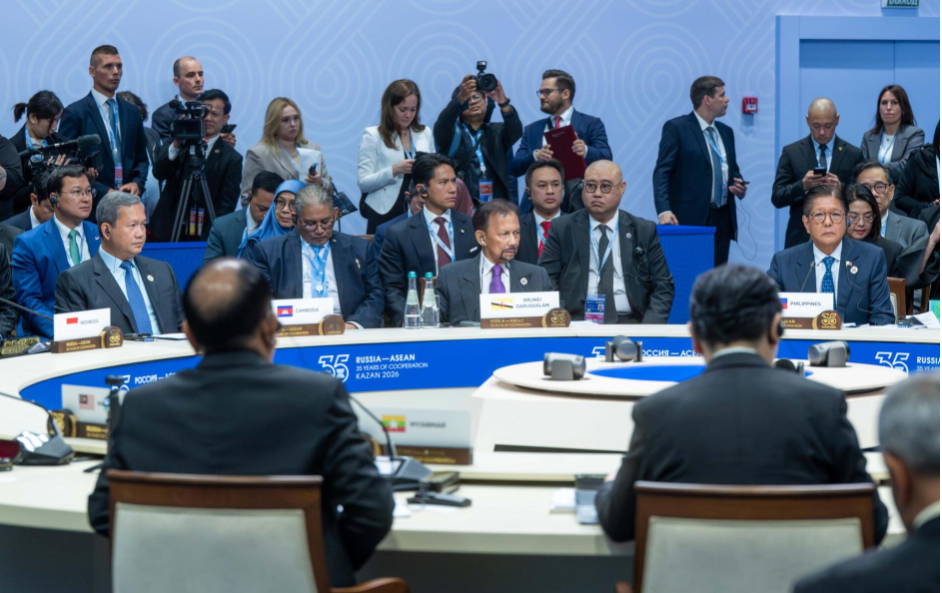
Sultan Hassanal Bolkiah travelled to Kazan, Russia on Thursday, June 18, to participate in the Asean-Russia Commemorative Summit held at the Kazan Expo International Exhibition Centre. The occasion marked a significant diplomatic moment, with the Brunei monarch extending his gratitude to President Vladimir Putin for the reception afforded to the visiting Asean delegation. The Sultan also acknowledged the hospitality extended by the government of the Republic of Tatarstan and the city of Kazan itself, underlining the warm reception that characterised the gathering. Among those accompanying the Sultan was Minister of Foreign Affairs Prince 'Abdul Mateen, reflecting Brunei's commitment to the dialogue process. In remarks delivered at the opening session, the Sultan took the opportunity to convey sympathies to Thai Prime Minister Anutin Charnvirakul following the recent death of Princess Bajrakitiyabha of Thailand.
The commemorative summit provided a platform to reflect on the 35-year history of the Asean-Russia Dialogue Partnership, a relationship that has evolved significantly since its inception. According to Sultan Hassanal Bolkiah, this partnership has proven resilient despite the considerable shifts in the global political and economic landscape. The dialogue has expanded considerably beyond traditional diplomatic channels, encompassing cooperation across all three pillars of the Asean Community framework—political and security cooperation, economic integration, and socio-cultural exchange. This comprehensive engagement demonstrates how the relationship has matured from a basic diplomatic arrangement into a multifaceted partnership touching virtually every aspect of bilateral and regional interaction.
The Sultan articulated how Asean-Russia cooperation has generated tangible benefits for both sides while strengthening the human connections that underpin state-to-state relations. These people-to-people linkages have contributed meaningfully to the pursuit of shared objectives centred on maintaining peace, ensuring security and advancing economic prosperity across the respective regions. This emphasis on mutual benefit reflects a diplomatic approach that positions the partnership not as a transactional arrangement but as a relationship grounded in common interests and values. For Southeast Asia, the Russian connection represents an important counterbalance in the region's broader geopolitical ecosystem, offering economic opportunities and strategic alternatives in an increasingly multipolar world.
Looking forward, Sultan Hassanal Bolkiah positioned Asean-Russia cooperation as essential to realising the region's Asean Vision 2045 agenda. He emphasised that as the bloc pursues this long-term development framework, sustained engagement with Russia becomes increasingly important for navigating the complex global challenges that will shape the region's future. The Sultan identified several specific areas of concern: escalating political tensions across various regions, the fragmentation of global economic systems, the accelerating impacts of climate change, and the rapid technological transformations reshaping societies. Each of these challenges transcends national borders and requires coordinated responses that benefit from diverse perspectives and capabilities. The breadth of these concerns underscores why deepening the Asean-Russia partnership matters not only for bilateral relations but for regional stability more broadly.
Among the specific cooperation areas the Sultan highlighted were energy security and food security, two domains of acute concern for Southeast Asian nations. The region's rapid economic development and growing populations create substantial demand for reliable energy supplies and adequate food production, making these sectors critical to sustained prosperity. Climate action emerged as another priority, reflecting the vulnerability of many Southeast Asian countries to environmental degradation, rising sea levels, and shifting weather patterns. Disaster management capabilities also featured prominently, given that the region experiences frequent typhoons, floods, and earthquakes requiring coordinated regional responses. Beyond these traditional security and environmental challenges, the Sultan underscored the importance of addressing non-traditional security threats, a category encompassing transnational crime, pandemics, cyber threats, and other emerging risks that demand cooperative solutions.
Recognising that geopolitical and economic partnerships ultimately depend on the capabilities and perspectives of future generations, Sultan Hassanal Bolkiah emphasised the critical role of human capital development in sustaining the Asean-Russia relationship. Educational exchanges, professional training programmes, and cultural initiatives serve as the foundation for building networks of individuals across both regions who understand each other's contexts and can collaborate effectively. These soft power investments create enduring connections that persist beyond political cycles and contribute to the institutional memory of the partnership. By investing in education and people-to-people exchanges, Asean and Russia create constituencies in both regions committed to deepening cooperation and navigating occasional disagreements within a framework of mutual respect and shared history.
The Sultan welcomed the adoption of the Kazan Declaration 2026, a document intended to guide Asean-Russia relations toward the end of the current decade. This declaration establishes the strategic framework within which both sides will operate, codifying commitments and identifying priority areas for enhanced cooperation. Accompanying the declaration were three additional outcome documents reflecting the breadth of the partnership. The Comprehensive Plan of Action to Implement the Asean-Russian Federation Strategic Partnership for 2026 to 2030 provides operational specificity, translating high-level political commitments into concrete action plans with timelines and measurable objectives. The Joint Statement on Energy Cooperation acknowledges the strategic importance of this sector to both regions, while the Joint Statement on Cultural Cooperation recognises that sustained political relationships require cultural understanding and people-to-people engagement.
The summit's agenda extended beyond opening remarks and formal declarations to include substantive working sessions addressing specific regional integration challenges. A second plenary session, structured as a working lunch and titled "Integration Processes in Eurasia," brought together Asean leaders with senior officials from allied international organisations. These included the Secretary-General of Asean, the secretary-general of the Shanghai Cooperation Organisation, which includes Russia as a prominent member, and the chairman of the Board of the Eurasian Economic Commission. This arrangement reflected the interconnectedness of regional integration processes across Eurasia and the recognition that Asean's development cannot be separated from broader continental dynamics. The inclusion of SCO and EEC representatives highlighted how Asean-Russia cooperation fits within larger frameworks of regional cooperation spanning multiple continents.
Complementing the formal summit proceedings was the Asean-Russia Business Forum, convened on June 17 as a side event. This forum provided an opportunity for business leaders, investors, and entrepreneurs from both regions to explore commercial opportunities, identify potential partnerships, and discuss sectoral cooperation. Business engagement represents a critical dimension of any strategic partnership, translating political agreements into economic activity that generates employment, technology transfer, and wealth creation. The positive reception afforded to the business forum's outcomes suggests momentum in private-sector engagement between Asean member states and Russian companies, complementing the governmental dimension of the relationship. This dual-track approach—combining political-strategic cooperation with commercial engagement—creates a more resilient partnership less vulnerable to the fluctuations of diplomatic relations.

