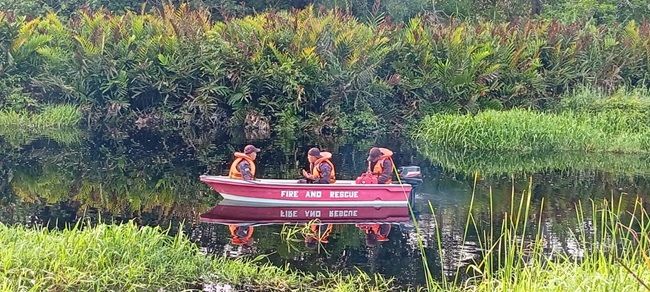
Rescue operations in Brunei have extended into their third day as teams comb the waters and banks of Sungai Bera searching for a man thought to have fallen victim to a crocodile attack in Kampong Baru. Despite intensive efforts involving multiple government agencies and sophisticated search technology, authorities have yet to locate any trace of the missing individual, raising concerns about the man's survival following the suspected wildlife encounter on Wednesday, June 24.
The Fire and Rescue Department (FRD) has deployed considerable resources to locate the victim, employing a comprehensive multi-layered search strategy that combines traditional and modern rescue techniques. The operation has maintained constant patrols along the river using FRD boats, while teams systematically search the surrounding riverbanks on foot. Aerial reconnaissance missions have been conducted using departmental drone equipment to survey areas inaccessible from ground level and provide a broader perspective of the search zone. This integrated approach reflects the challenging nature of locating someone in a densely vegetated riverine environment where a large predator may be involved.
The incident prompted a rapid emergency response when the FRD received the initial distress call reporting the crocodile attack. Two fire engines carrying nine personnel, under the command of Acting Station Officer Mohd Zulkifli Md Tahir, were dispatched immediately to Kampong Baru Sungai Bera. Upon reaching the location, responders conducted preliminary investigations with family members of the victim, who confirmed that the man had been fishing in the river when he was believed to have been attacked by a crocodile. This information established the baseline understanding of the incident and helped guide the subsequent rescue operation.
Authentication of the threat level led authorities to establish a dedicated Tactical Command Post from which the expanded search operation would be coordinated and managed. The FRD mobilized additional firefighting personnel and assets to support the search efforts, with drone technology proving particularly valuable in surveying the river and its margins. The decision to deploy aerial surveillance early in the operation acknowledged both the urgency of the situation and the practical limitations of ground-based searching in a crocodile-inhabited waterway.
The search operation has benefited from inter-agency coordination that reflects Brunei's structured approach to emergency response. The Royal Brunei Police Force (RBPF) contributed significant personnel to the effort, with officers from Seria Police Station providing ground support. The force's specialized Marine Police unit, known as POLMAR, brought particular expertise relevant to river operations and water-based search procedures. Additionally, Brunei's Wildlife Division participated in the operation, contributing knowledge about crocodile behavior and habitat patterns that could inform where the victim or evidence might be located. This multi-departmental approach brought together diverse skill sets and resources essential for such a complex rescue scenario.
Senior Superintendent Amirul Hadi Junaidi, the Commanding Officer of the Operations Branch, has assumed leadership of the search operation, indicating the priority and seriousness with which Brunei's authorities are treating the incident. The appointment of a senior-ranking officer to oversee operations ensures that decisions are made at an appropriate level of command and that adequate resources continue to be allocated despite the passage of time without positive developments. The three-day duration of the search underscores both the determination to recover the victim and the substantial resources being committed to an operation that has so far yielded no breakthrough.
Crocodile attacks remain a significant hazard in Southeast Asian waterways, where human settlement and wildlife habitats increasingly overlap. The incident in Sungai Bera serves as a stark reminder of the risks inherent in fishing and water-based activities in regions where saltwater and estuarine crocodiles inhabit rivers and coastal zones. Brunei's rivers, like those throughout the region, support thriving crocodile populations that can pose genuine danger to people who venture into these waters, particularly in areas remote from built-up zones where crocodiles remain relatively undisturbed. The suspected attack reflects a collision between traditional subsistence activities and wildlife that communities have long shared these waterways with.
For Malaysian and Southeast Asian readers, incidents such as this underscore the importance of heeding local warnings about crocodile-inhabited waterways and understanding that wildlife encounters can escalate rapidly with little warning. Similar hazards exist across Malaysia, particularly in Peninsular waters and in Sabah and Sarawak, where crocodile populations inhabit mangrove forests and river systems. The Brunei incident illustrates how rescue operations can be extraordinarily challenging when conducted in tropical riverine environments where visibility is poor, terrain is difficult, and predatory animals may still pose a threat to rescuers themselves.
The continuation of the search operation into its third day reflects both the hope that the victim might yet be found and the procedural commitment to exhausting all reasonable efforts before concluding such operations. Rescue authorities recognize that time is critical in situations involving water and large predators, yet systematic searching sometimes requires sustained effort across multiple days to cover all relevant terrain. The absence of any physical evidence or sighting after seventy-two hours inevitably raises questions about survival prospects, though search efforts typically continue until definitive evidence of outcome is established or resource constraints force a reassessment of operational priorities.

