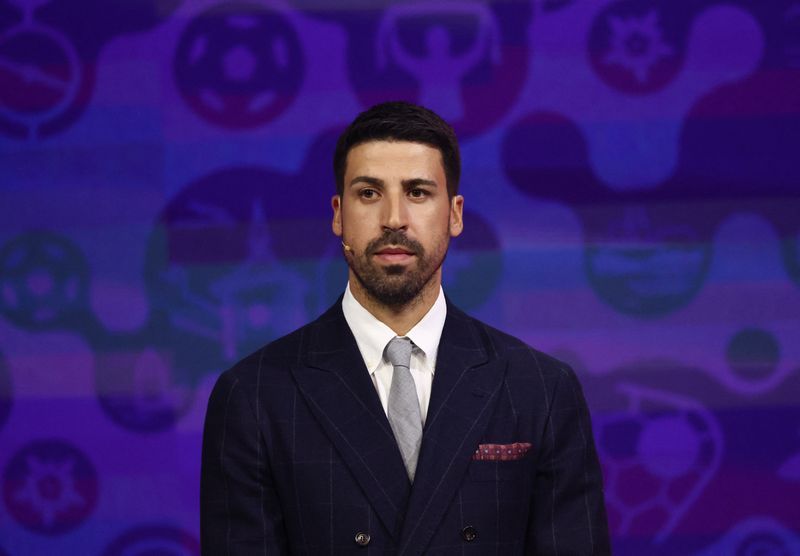
The sight of brothers singing opposing national anthems before taking to the pitch for their countries represents something far deeper than a football curiosity. For Sami Khedira, Germany's 2014 World Cup champion, such moments encapsulate the beautiful complexity of contemporary global sport—a world where identity transcends the confines of a single passport. Speaking at the Home of Football museum in New York, Khedira articulated a perspective that challenges conventional thinking about international football loyalty, offering instead a vision of belonging that acknowledges the lived reality of millions across Southeast Asia and beyond who navigate multiple cultural identities daily.
Khedira's own biography illuminates why he sees no contradiction in brothers representing different nations. Born and raised in Germany to a Tunisian father and German mother, he has spent his life negotiating the space between two cultures, two identities, two homelands. His brother Rani currently competes for Tunisia at the World Cup, their father's nation of origin, a choice that Khedira views not as a betrayal of Germanness but as a legitimate expression of heritage and belonging. When he describes carrying "both nations in our heart," he speaks from genuine experience—the kind that cannot be manufactured by federation pressure or political posturing. This lived duality informs his conviction that the modern game should celebrate rather than question such arrangements.
The 2026 World Cup will feature eight sets of brothers, a statistic that underscores how commonplace such situations have become in contemporary football. Four pairs will represent the same nation, maintaining the traditional narrative of family unity, while the other four embody a different story altogether. The cases of Iñaki and Nico Williams, representing Spain and Ghana respectively despite both playing for Athletic Bilbao, or Guela and Désiré Daoué split between Ivory Coast and France, demonstrate how modern international football reflects the genuine composition of contemporary society. Similarly, Derrick Lukassen and Brian Brobbey—brothers through their mother but separated by their fathers' surnames—represent Ghana and the Netherlands, instances where bureaucratic naming conventions intersect with identity formation. Harry and John Souttar's division between Australia and Scotland, along with various other sibling pairings, collectively paint a portrait of football grappling with reality rather than retreating into outdated orthodoxies.
What moved Khedira profoundly was witnessing the Daoué brothers sing both anthems before France faced Ivory Coast in a recent friendly. The emotional authenticity of that moment—two young men publicly honouring both countries they called home—crystallized for him why this phenomenon transcends sporting novelty. He recognised in that image a powerful statement about multicultural coexistence that extended far beyond the ninety minutes of competition. For Khedira, such instances demonstrate football's unique capacity to articulate truths about human experience that politicians and institutions often struggle to express. In a world fractured by nationalism and exclusion, the sight of brothers representing different nations becomes a quiet protest against the idea that loyalty must be singular and absolute.
The expansion of the World Cup to forty-eight teams has fundamentally altered the global competitive landscape in ways that Khedira believes deserve serious consideration. Nations such as Cape Verde, Curaçao, and Haiti now possess genuine pathways to the world's premier tournament, a development that has historically incentivised players from diaspora communities to explore multiple international options. This democratisation of World Cup participation means that smaller nations and developing football programmes can now attract talent that might previously have been unavailable, elevating standards across continents. Khedira notes that African and Asian football continues closing the gap on European and South American dominance, driven partly by improved infrastructure, coaching, and educational systems in emerging football nations. Yet he maintains a critical perspective on Europe's role, arguing that rather than simply benefiting from dual-nationality players, established football powers bear responsibility for supporting development at its source.
The human cost of these opportunities, however, cannot be overlooked. Young players courted simultaneously by multiple national federations face decisions of staggering personal significance before possessing the maturity to fully comprehend the implications. Khedira speaks from memory about the pressure cooker environment of being eighteen years old and confronted with such a monumental choice. The decision cannot be coerced by federation officials, parental heritage, or political messaging—it must emerge from what Khedira terms "a gut feeling," an instinctive alignment with one community over another. Yet recognising this principle provides little comfort to adolescents navigating competing expectations from family, coaches, administrators, and their own emerging sense of self. The psychological burden of such decisions, Khedira insists, falls disproportionately on young people barely old enough to understand the permanence and gravity of their choice.
Khedira himself encountered such pressures approaching manhood, and he spoke respectfully of his conversations with Tunisian football authorities regarding his own international decision. He emphasises that young players deserve space to determine their own path rather than having it dictated to them, yet simultaneously acknowledges the legitimacy of federations engaging in dialogue about the matter. This nuanced position reflects maturity gained through living the very experience most young dual-national players confront. He recognises that identity formation cannot be rushed, that the feeling guiding such choices emerges gradually through lived experience rather than intellectual analysis. For Southeast Asian readers particularly, many of whom come from families spanning multiple nations and cultures, Khedira's perspective offers validation for the complexity they navigate routinely.
The question of what constitutes authentic national representation has long troubled football's governing institutions. Traditionally, sport enforced rigid boundaries around nationality, assuming that individuals could and should pledge singular allegiance. Khedira's worldview fundamentally challenges this assumption, proposing instead that modern football must accommodate the reality that millions possess divided loyalties not as a source of shame but as an expression of genuine belonging. When he states he sees the phenomenon as "wonderful" rather than problematic, he articulates a vision of inclusion that extends beyond football into broader questions about how diverse societies function and thrive. His perspective acknowledges that people are not puzzles to be solved but complex beings whose identities deserve recognition in their fullness.
The power of football to serve as a messenger for broader social values becomes evident when considering Khedira's observations about multicultural representation. He recognises that when brothers represent different nations, when players sing multiple anthems with genuine feeling, football communicates something essential about human possibility to audiences across the globe. In an era of rising nationalism and identity politics, such moments offer counternarrative suggesting that shared humanity transcends passport boundaries. The sport's global reach means that millions witness these scenes, absorbing implicit lessons about coexistence and respect. For developing nations in Southeast Asia still negotiating their own relationship with international representation and soft power projection through sport, Khedira's celebration of multicultural identity provides an alternative vision to zero-sum competition framed solely through winning and losing.
Yet Khedira's optimism remains tempered by realism about ongoing inequalities within global football. While he celebrates the expanded World Cup and emerging talent from smaller nations, he simultaneously warns against wealthy European federations exploiting players from diaspora communities without investing in football development at source. The ethical dimension he raises—that benefit should flow bidirectionally rather than extractively—points to systemic imbalances that cannot be resolved through warm rhetoric about multiculturalism alone. True equity in global football requires not merely celebrating diversity but fundamentally restructuring how resources, opportunities, and knowledge flow between established and emerging football nations.
Ultimately, Khedira's perspective offers Malaysian audiences a particularly resonant framework for understanding modern football. In a Southeast Asian context where migration, diaspora, and multicultural identity define contemporary reality, his validation of brothers representing different nations feels neither exotic nor troubling but rather like the everyday experience of millions. Football, through figures like Khedira willing to articulate this vision publicly, can serve as a vehicle for normalising the fluid, complex identities that increasingly characterise the modern world. His insistence that the right choice must emerge from internal feeling rather than external pressure acknowledges a fundamental human truth: authentic belonging cannot be manufactured, only discovered.

