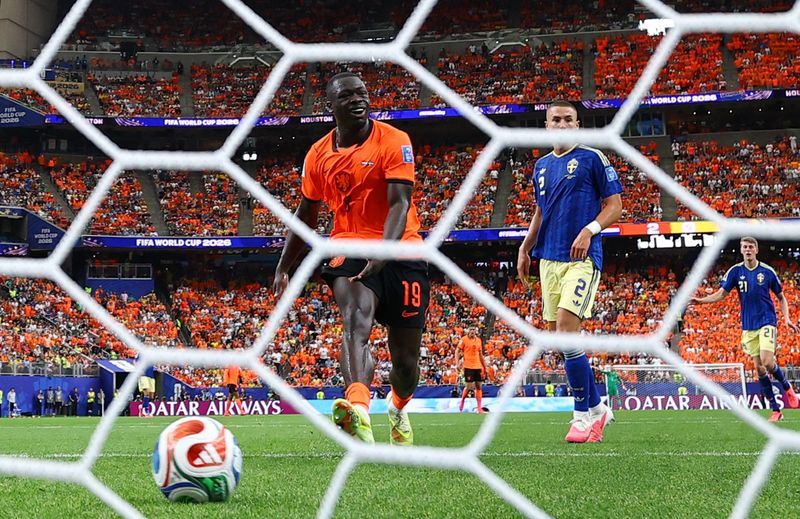
Ronald Koeman's redemption arc at the World Cup took a dramatic turn on Saturday as the Netherlands manager's tactical acumen was vindicated in spectacular fashion. Just days after enduring withering criticism for ineffective substitutions during a disappointing 2-2 draw with Japan, Koeman orchestrated a commanding 5-1 victory over Sweden that announced the Dutch as genuine contenders in Group F. The turnaround hinged largely on one inspired personnel decision: deploying 24-year-old Brian Brobbey as the focal point of the attack, a choice that would prove transformative for both the player and the national team's trajectory in the tournament.
Brobbey's impact was immediate and devastating. The Ajax forward netted twice within the opening seventeen minutes, establishing a pattern of clinical finishing and intelligent movement that set the tone for the Netherlands' rout of the Swedes. His performance transcended mere statistical achievement; it represented a complete validation of Koeman's faith in a player who had languished at the periphery of the squad for extended periods. The brace immediately shifted the discourse surrounding the manager from one of tactical incompetence to shrewd decision-making, demonstrating how football's narrative can pivot entirely within the span of a ninety-minute encounter.
The context of Brobbey's selection carries particular significance when examining his trajectory prior to this tournament. The striker had been sidelined from international duty for an entire year, his absence a reflection of doubts regarding his suitability for the Dutch national setup. When he was recalled to the squad in March, it represented a calculated gamble by Koeman, a decision that appeared questionable given Brobbey's peripheral status during the qualifying campaign for the 2026 World Cup. His omission had suggested the coaching staff harboured reservations about his readiness for the highest level, making his emergence as a leading candidate for the primary attacking role a significant reversal of fortune.
The catalyst for Brobbey's resurgence can be traced to his season at Sunderland in the English Premier League, an experience that has fundamentally reshaped his capabilities as a forward. The 24-year-old has articulated this transformation with clarity, explaining that his time in England extended far beyond the traditional physicality associated with leading the line in British football. He has developed into a more nuanced operator, enhancing his capacity to execute intelligent runs from deeper positions, exploit space with greater precision, and adjust his positioning relative to defensive structures. These refinements represent the evolution from a rudimentary target man into a complete forward, attributes increasingly essential in modern football's fluid tactical landscape.
The supporting cast assembled around Brobbey provides a compelling framework for his success at the tournament. Cody Gakpo's creative force on the left flank, combined with the aggressive overlapping runs of right-back Denzel Dumfries, generates consistent attacking opportunities. The addition of Crysencio Summerville to the Dutch lineup adds another layer of offensive dynamism, creating multiple passing angles and movement patterns that stretch opposing defences. This constellation of attacking talent suggests that the supply line to the lead striker will remain consistent throughout the competition, allowing Brobbey to focus on the primary responsibility of converting chances with the clinical finishing he demonstrated against Sweden.
The significance of Brobbey's emergence extends beyond immediate tournament considerations, as it addresses a succession planning imperative that has preoccupied Dutch football for some time. Memphis Depay, the Netherlands' record goalscorer, has long represented the archetype of the Dutch number nine, combining technical proficiency with an understanding of tactical positioning honed through years of international experience. However, Depay's prolonged injury layoff has created both a temporary and strategic vacuum. The national team has acknowledged that time constraints require the identification and development of a reliable successor, a process that cannot be left to chance or relegated to contingency planning.
Brobbey's performance against Sweden suggests he possesses the requisite sharpness and intensity to fill that void with minimal transitional friction. While Depay retains his considerable qualities, his recent absence from competition means he arrives at the tournament lacking the match fitness that characterizes peak performance. Brobbey, conversely, arrives with momentum and momentum in his favour, having demonstrated through consistent club football that he has evolved into a more complete and reliable operator. The contrast in their physical and mental states creates an opening for the younger player to establish himself as the preferred option, potentially altering the hierarchical structure of Dutch attacking football.
The manner in which Brobbey has seized this opportunity reflects a maturity that extends beyond his years and experience level. Rather than viewing the recall after twelve months of exclusion as merely another chance, he has approached the World Cup with the mentality of a player determined to prove that doubts were unfounded. His articulation of his development suggests an intellectual approach to his craft, an understanding that longevity at international level demands constant evolution and refinement. This psychological dimension often separates players who achieve transient success from those who establish themselves as established fixtures within the national setup.
The broader implications for the Netherlands' campaign remain considerable. The discovery of a reliable, sharp, and motivated lead striker provides Koeman with tactical flexibility and confidence going forward in the tournament. Rather than nursing concerns about attacking capacity or managing the workload of aging personnel, the Dutch can proceed with conviction that their primary offensive weapon has been identified and energized. This psychological advantage should not be underestimated; confidence in personnel selection filters through the squad and influences competitive performance in measurable ways.
As the Netherlands progress through the competition, the question of whether Brobbey can maintain the standards demonstrated against Sweden will become increasingly pertinent. Opponents will adjust their defensive approaches, seeking to neutralize his movement patterns and disrupt the service from his supporting cast. However, his two-goal introduction to the tournament has established a foundation of belief, both in his own capacity and in the minds of teammates who will provide the creative platform for his success. Whether Brobbey ultimately secures his position as the long-term successor to Depay remains uncertain, but his trajectory from the margins to centrality within just one match suggests that the Dutch have identified a genuine prospect for their attacking future.

