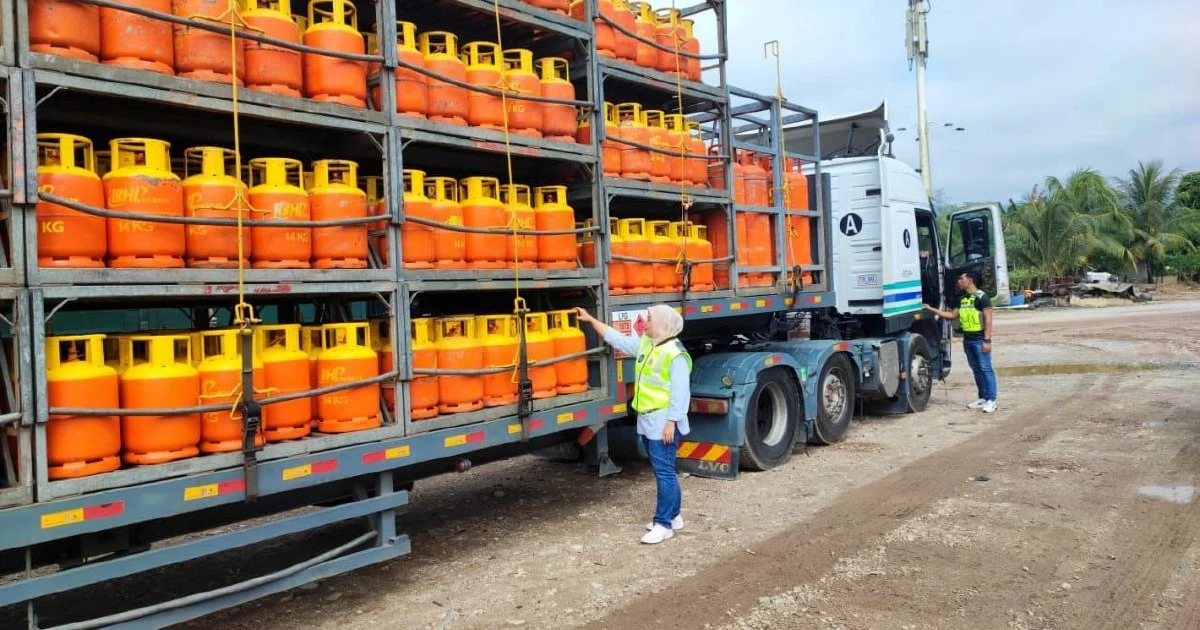
In a significant enforcement operation, authorities in Bentong uncovered a substantial stockpile of liquefied petroleum gas cylinders valued at RM405,000 during a raid on a secured storage compound. The discovery, made at a fenced facility, revealed the cylinders neatly arranged on a trailer, raising questions about the legality and purpose of such a large concentration of the volatile fuel product in a single location.
Liquefied petroleum gas remains a critical fuel source across Malaysia, particularly in households and small businesses that rely on bottled gas for cooking, heating, and other essential needs. The sheer volume of cylinders found during this operation—sufficient to stock multiple retail outlets or distribution centres—suggests either an unauthorised distribution operation or a deliberate hoarding scheme designed to exploit potential supply shortages or market volatility.
The enforcement officers' discovery at the fenced compound highlights the ongoing challenge Malaysian authorities face in monitoring and controlling the distribution channels of regulated fuel products. The fact that the facility was enclosed and secured indicates an attempt by those involved to conceal their operations, adding another layer of concern regarding the legitimacy of the stockpiling activity.
Beyond the immediate seizure, this raid underscores a broader pattern of enforcement actions targeting irregular trade in controlled commodities. The liquefied petroleum gas market, while essential to the Malaysian economy, remains vulnerable to market manipulation and illegal trading practices that can disrupt legitimate supply chains and affect consumer access to affordable fuel.
For ordinary Malaysian households, such enforcement actions carry important implications. Unauthorised stockpiling operations can artificially reduce market supply, potentially driving up prices for consumers who depend on reasonably priced gas cylinders for their daily needs. By dismantling these operations, authorities work to maintain equilibrium in the market and protect vulnerable households from price fluctuations caused by scarcity.
The Bentong facility discovery also reflects the resourcefulness of enforcement agencies in identifying and accessing unauthorised storage compounds. The operation demonstrates proactive investigation work that extends beyond simple roadside checks, requiring officers to identify suspicious facilities and secure the necessary permissions to conduct thorough inspections.
Southeast Asia's broader energy security landscape makes such enforcement operations increasingly important. As regional demand for energy continues to grow, ensuring the integrity of fuel distribution networks becomes essential for economic stability and public safety. Malaysia's experience managing liquefied petroleum gas supplies offers lessons for neighbouring countries facing similar challenges with fuel security and market regulation.
The circumstances surrounding this particular cache remain subject to further investigation. Authorities will likely pursue inquiries into the facility's ownership, the identity of individuals responsible for accumulating such a large quantity of cylinders, and the intended distribution network. These details are crucial for determining whether the operation was purely commercial in nature or involved elements of market manipulation or resource hoarding.
Public safety represents another critical dimension of this enforcement action. Large concentrations of pressurised cylinders, particularly when stored in unregulated facilities, pose significant fire and explosion hazards. Proper storage of liquefied petroleum gas requires adherence to strict safety standards, specialised infrastructure, and regular maintenance to ensure structural integrity and prevent leaks or catastrophic failures.
The seizure value of RM405,000 suggests this was not merely a small-scale informal operation but rather an organised venture with considerable financial investment. The scale of the discovery indicates authorities are dealing with networks capable of managing complex logistics and supply chain operations, requiring sophisticated enforcement responses to dismantle effectively.
Moving forward, the Bentong raid serves as a reminder of the importance of maintaining vigilant oversight of fuel distribution channels throughout Malaysia. As enforcement agencies continue identifying and shutting down unauthorised operations, they contribute to a more stable and equitable market that better serves ordinary consumers while protecting legitimate businesses engaged in authorised distribution activities.

