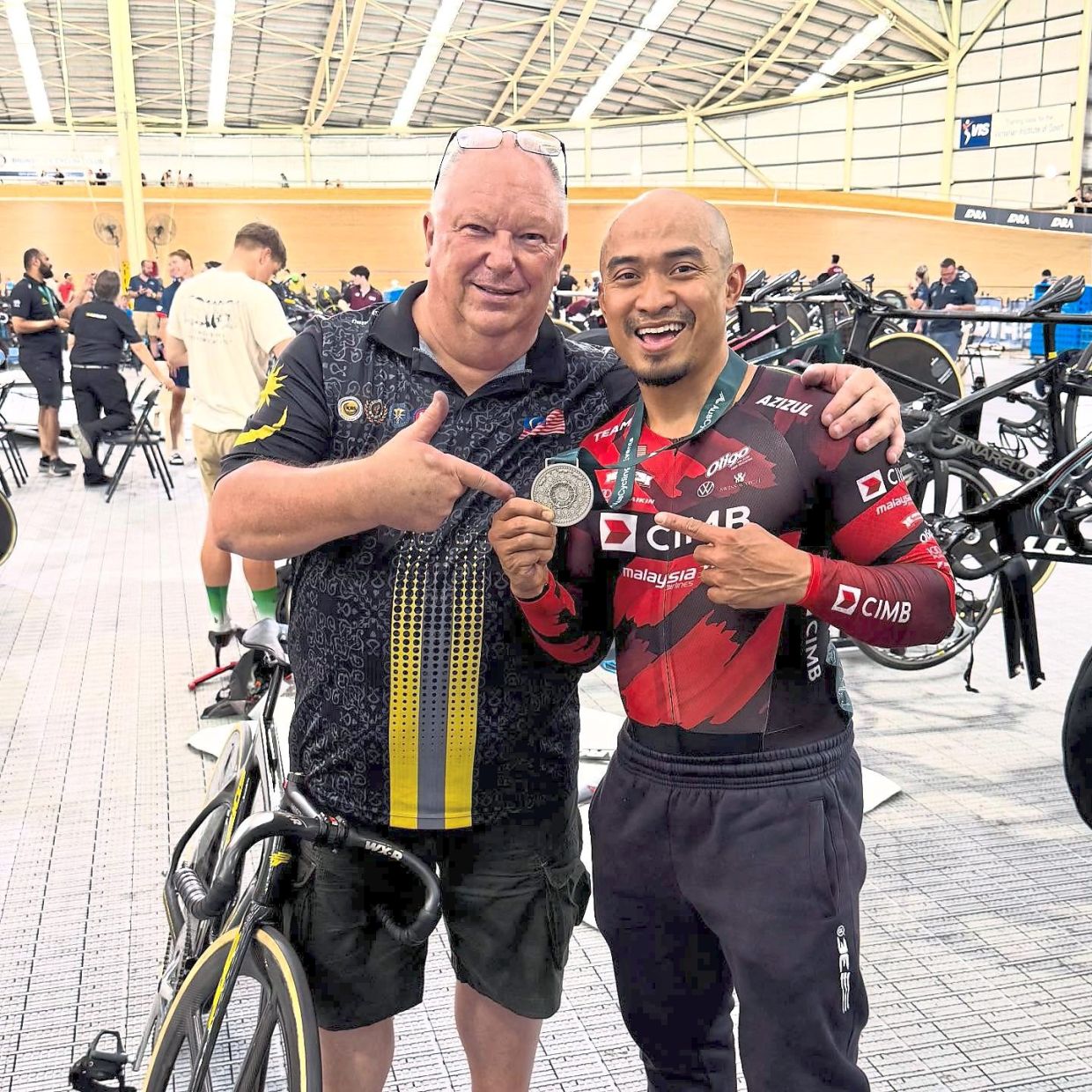
National track cyclist Azizulhasni Awang has acknowledged that his decision to publicly defend technical director John Beasley against mounting criticism may invite considerable fallout, including coordinated efforts to discredit him, yet the two-time Olympic medallist has declared himself prepared for whatever consequences emerge if the national team fails to meet expectations at the forthcoming Commonwealth Games and Asian Games.
Beasley, an Australian who has spearheaded Malaysia's track cycling programme for two decades, has become the subject of vocal criticism in recent weeks. When Awang stepped forward to champion the technical director's contributions to Malaysian cycling's global standing, he effectively placed himself in the line of fire. The decision reflects a calculated personal risk rooted in principle rather than pragmatism.
Awang articulated his understanding of the political dynamics at play with striking candour. By associating himself with Beasley's defence, he acknowledged that detractors may attempt to undermine his own credibility and reputation. The cyclist recognised that in the volatile world of international sports administration, loyalty to a controversial figure can become a liability when performance targets slip.
The two-time medallist demonstrated particular prescience regarding the potential consequences. He noted that should the national team's results at the Commonwealth Games and Asian Games disappoint stakeholders and the public, media scrutiny and critical commentary would inevitably flow in his direction. This prediction reflects the often-unforgiving nature of Malaysian sports discourse, where accountability frequently becomes personalised when collective goals prove elusive.
Despite this clear-eyed assessment of the risks involved, Awang maintained an unwavering resolve rooted in spiritual conviction rather than strategic calculation. He emphasised that his sense of security derives from faith rather than political manoeuvrability, stating that he places his trust in divine will above the contingencies of public opinion. This perspective granted him psychological insulation against the prospect of becoming a target for critics or rival factions within Malaysian cycling administration.
Awang's rationale for supporting Beasley centres on substantive contribution rather than personal loyalty. He underscored that the technical director has meaningfully shaped Malaysia's track cycling success and produced numerous world-class competitors, including Awang himself. This framing positions the defence as an acknowledgment of documented achievement rather than emotional or factional allegiance, though such distinctions often become blurred in the heated atmosphere surrounding sports governance.
The broader context illuminates why Awang's intervention carries such significance. The Malaysia National Cycling Federation last week announced disciplinary proceedings against two individuals from state affiliates, issuing them show-cause letters for publicly criticising Beasley without channelling their grievances through proper administrative procedures. This action sought to establish boundaries around acceptable discourse regarding the technical director and to protect the federation's institutional reputation from what officials characterised as reputational damage.
Awang's public defence directly contradicts this attempt to circumscribe criticism. By legitimising open discussion of Beasley's role and contributions, he implicitly challenged the federation's preferred approach of managing dissent through internal mechanisms. His intervention thereby enlarged the sphere of acceptable public commentary, though simultaneously exposing him to the vulnerabilities he explicitly acknowledged.
The cyclist's stated focus remains squarely on preparation for the upcoming major competitions. Awang articulated hopes that all stakeholders—including critics, administrators, and media—could unite around supporting athletes and the national contingent in pursuit of international success. This appeal for solidarity represents a pragmatic attempt to depoliticise the team environment ahead of crucial competitions where divisive internal dynamics could prove counterproductive.
Malaysia's track cycling programme faces a delicate moment. The Commonwealth Games and Asian Games will provide the immediate measure of whether Beasley's technical direction continues to yield competitive dividends. Should performances disappoint, Awang's willingness to defend the Australian will be retrospectively reinterpreted through the lens of results, potentially validating or undermining his strategic gamble depending entirely on podium outcomes.
For Malaysian readers and regional observers, Awang's stance illustrates broader tensions within sports governance across Southeast Asia. The conflict between protecting technical staff from organisational instability and maintaining channels for legitimate institutional scrutiny remains unresolved. Awang's personal conviction—that results-based evaluation should not preclude acknowledgment of genuine contributions—presents one perspective within this enduring debate.
The unfolding situation also reflects how individual athletes in high-performance programmes navigate complex relationships between personal principle, organisational politics, and professional obligation. Awang's willingness to articulate his position publicly, accepting personal risk in the process, demonstrates a form of moral clarity increasingly rare in professional sports environments where caution typically prevails. Whether this approach ultimately strengthens or undermines Malaysian track cycling depends fundamentally on whether the team delivers the performances both Awang and Beasley have publicly staked their credibility upon.

