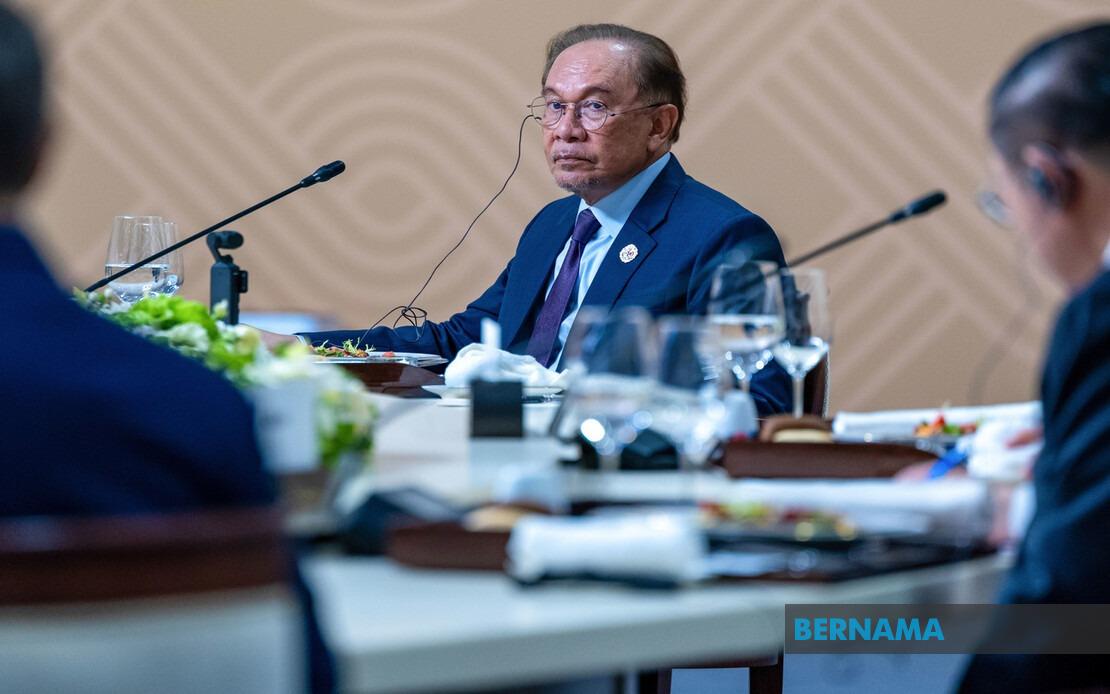
Prime Minister Datuk Seri Anwar Ibrahim has called on ASEAN and the Shanghai Cooperation Organisation to combine their strengths in addressing transnational crime and bolstering energy cooperation, emphasizing that both challenges demand coordinated action across borders to yield meaningful results. Speaking during an ASEAN-Russia working lunch in Kazan on June 18, Anwar highlighted the urgency of deepening institutional collaboration between the two multilateral groupings, which he noted already possess robust foundational agreements dating back nearly two decades.
The two organizations have long maintained a 2005 memorandum of understanding that establishes pathways for cooperation spanning counter-terrorism, narcotics enforcement, money laundering prevention, and economic and financial collaboration. Anwar argued that rather than merely preserving these frameworks, both ASEAN and the SCO should actively build upon them by concentrating efforts and funding on specific priority areas where demonstrable achievements can be realized within set timeframes. This strategic focus, he suggested, would move beyond broad declarations toward concrete, measurable outcomes that benefit member populations.
Anwar underscored the pressing nature of transnational criminal activity, noting that online fraud schemes, illicit fund transfers, and human trafficking networks operate with a speed and sophistication that frequently outpace the response capabilities of individual nations. He stressed that cooperative intelligence-sharing and capacity-building initiatives would enable the combined membership to mount far more effective countermeasures. The Premier emphasized that in an era of digital borderlessness, no single country can adequately defend itself against such threats acting unilaterally, making regional coordination not merely advantageous but essential for security.
On the energy front, Anwar pointed to the SCO's composition as a unique advantage, noting that the organization assembles several of the world's leading energy producers alongside nations with cutting-edge technological expertise in power generation and distribution. This concentration of resources and knowledge creates unprecedented opportunity for practical cooperation on energy security and the broader transition toward environmentally sustainable power sources. Malaysia, through its Prime Minister, signaled readiness to engage in technology-driven initiatives that address multiple dimensions of the regional energy challenge simultaneously.
The energy cooperation agenda, as outlined by Anwar, encompasses energy efficiency improvements, grid modernization and reliability enhancements, liquefied natural gas and conventional gas infrastructure development, renewable energy integration into existing systems, and collaborative learning on operational safety and system resilience. By pursuing these dimensions in concert rather than isolation, member states can accelerate technological adoption, reduce duplicative investment, and establish shared standards that facilitate cross-border energy commerce. The emphasis on knowledge-sharing reflects recognition that technological advancement and risk management protocols represent public goods that benefit the entire region when made available collectively.
Beyond security and energy, Anwar extended his collaborative vision to encompass the Eurasian Economic Union, proposing that ASEAN leverage existing partnership frameworks to strengthen commercial ties and investor confidence. He suggested that the business sectors of both blocs should convene with greater regularity and participate actively in each other's major economic forums, including business dialogues conducted at the Eastern Economic Forum and the St Petersburg International Economic Forum. Such increased private-sector engagement would generate networking effects that translate formal diplomatic agreements into tangible trade and investment flows.
Anwar identified the plight of smaller enterprises as a particular focus area, contending that medium and small firms from both ASEAN and the EAEU require targeted support mechanisms including preferential market access, technology transfer initiatives, and capacity-building programs to enable genuine participation in cross-regional commerce. Without such scaffolding, he implied, economic integration risks remaining confined to large corporations capable of navigating regulatory complexity independently, thereby limiting the diffusion of benefits across broader business communities. This emphasis on inclusive economic cooperation distinguishes Anwar's approach from purely elite-focused integration models.
The Premier highlighted emerging domains of shared interest between ASEAN and the EAEU that warrant joint exploration and development. The digital economy represents perhaps the most dynamic of these, offering opportunities for technology companies, fintech entrepreneurs, and digital service providers to operate across both regional markets. Artificial intelligence capabilities, cybersecurity standards and frameworks, and food security resilience have similarly become pressing concerns for both blocs, each facing distinctive regional challenges that might yield to collaborative research and policy harmonization. By addressing these frontier issues jointly, both ASEAN and the EAEU could shape emerging global standards rather than merely adapting to rules established elsewhere.
Anwar's remarks during the ASEAN-Russia Commemorative Summit in Kazan, where he was attending a two-day working visit, reflect Malaysia's broader strategic positioning as a bridge between Asian and Eurasian security and economic ecosystems. His emphasis on practical, measurable cooperation rather than symbolic declarations suggests a maturing approach to multilateral engagement that prioritizes implementation over rhetoric. For Malaysian readers, Anwar's vision implies potential expansion of bilateral opportunities with SCO and EAEU members across energy, technology, and digital domains, positioning the country advantageously within emerging regional architecture.
The SCO itself comprises a significant portion of global population and economic output, currently including ten full member states—Belarus, China, India, Iran, Kazakhstan, Kyrgyzstan, Pakistan, Russia, Tajikistan and Uzbekistan—alongside two observer states. This composition means that genuine ASEAN-SCO cooperation would create one of the world's largest unified regional frameworks, potentially rivaling or exceeding other major institutional arrangements in geopolitical significance. Anwar's call for resource pooling and strategic focus reflects awareness that such a framework, if effectively mobilized, could shape the contours of regional development and security architecture for decades to come.