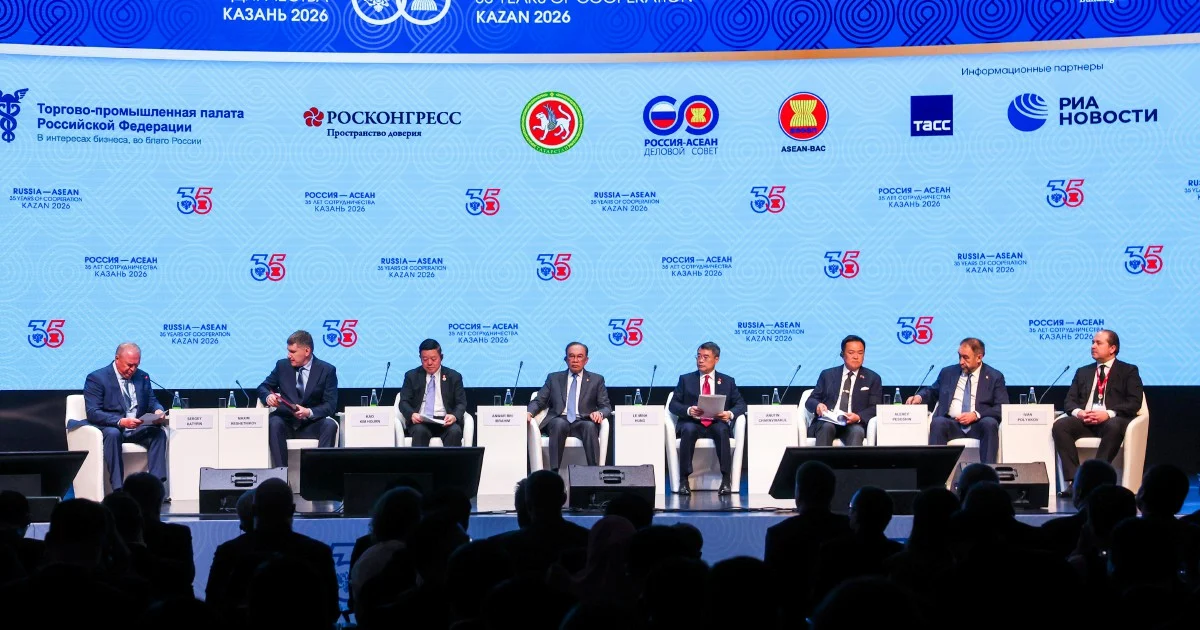
Prime Minister Datuk Seri Anwar Ibrahim has stepped up calls for Asean and Russia to substantially expand their multilateral engagement across a range of strategically important sectors. Speaking in Kazan, Anwar outlined an ambitious vision for deepened partnership that would span food security, energy markets, advanced manufacturing capabilities, digital technology innovation, and educational collaboration.
The appeal reflects Malaysia's broader diplomatic positioning as a bridge between the 10-member Asean bloc and the broader Eurasian sphere. As a middle-power regional voice, Malaysia under Anwar's leadership has consistently advocated for pragmatic economic engagement regardless of geopolitical tensions elsewhere. The emphasis on food security carries particular weight in Southeast Asia, where rising global commodity prices and supply chain volatility have created genuine vulnerabilities across the region. Several Asean members depend heavily on rice and other staple imports, making agricultural collaboration with major producing nations like Russia strategically prudent.
Energy cooperation represents equally compelling territory for expansion. Russia remains a dominant global energy producer with vast reserves of oil and natural gas. While Asean nations have pursued diversified sourcing strategies following recent global market disruptions, the region's energy appetite continues growing with economic development. Developing reliable energy partnerships with Moscow could offer alternatives to concentrated supply chains and potentially stabilize regional energy costs. Southeast Asian economies have demonstrated willingness to maintain pragmatic commercial relationships with major powers across various political divides.
The prime minister's reference to advanced manufacturing underscores a longer-term vision extending beyond commodity trade. Russia possesses significant industrial and technological capabilities that could complement Asean's manufacturing ecosystems. Collaborative ventures in precision engineering, materials science, and specialized production could help the region climb manufacturing value chains. Malaysia itself has aspirations to develop higher-end manufacturing sectors, and Russian expertise in certain industrial domains could prove valuable for capacity building and technology transfer initiatives.
Digital technology cooperation presents another frontier gaining urgency. Russia has demonstrated considerable strength in software development, cybersecurity applications, and information technology services. As Asean nations accelerate digital transformation across their economies—driven by pandemic-related acceleration and ongoing modernization efforts—partnerships with technologically advanced nations become increasingly relevant. Such collaboration could encompass everything from developing digital infrastructure to building local expertise in emerging fields like artificial intelligence and quantum computing.
Educational exchanges form the softer side of this proposed deepening. Cross-border student flows and academic partnerships typically generate long-term relationship benefits extending far beyond immediate commercial metrics. Russian universities maintain respected programs in engineering, science, and mathematics disciplines. Expanding scholarship opportunities and academic partnerships could strengthen people-to-people connections while building human capital across Asean. Malaysia has historically supported substantial educational exchanges with various partners, recognizing their value in fostering mutual understanding.
The Kazan setting itself carries significance. The city hosts major international forums and serves as a venue where Russia actively engages with emerging economies and regional organizations. Anwar's remarks there signal Malaysia's continued commitment to maintaining active diplomatic channels with Moscow despite broader international complexities. This positioning aligns with Malaysia's historical practice of maintaining constructive relationships across multiple poles of influence.
For Southeast Asian nations, the proposed cooperation agenda addresses genuine contemporary challenges. Food price inflation has affected consumer welfare across the region, while energy transition complexities create both opportunities and risks. Manufacturing competitiveness requires continuous technological upgrading. Digital divides between urban and rural areas persist. Educational capacity building remains an ongoing requirement. Russian engagement on these fronts could complement existing partnerships with other nations and multilateral institutions.
The timing of such appeals also reflects evolving regional dynamics. Asean has emphasized its centrality in regional affairs and its commitment to maintaining relationships across different geopolitical blocs. By publicly advocating for expanded practical cooperation with Russia, Anwar reinforces Malaysia's particular brand of non-aligned internationalism. This approach seeks mutual benefits through engagement rather than isolation, a philosophy increasingly important as Southeast Asia navigates competing great-power interests.
Implementing such ambitious cooperation frameworks will require substantial diplomatic groundwork and commercial interest from both sides. Formal mechanisms, joint commissions, and sectoral working groups would need establishment. Private sector participation remains essential, as government initiatives succeed only when underpinned by genuine commercial incentives. Nevertheless, Anwar's articulation of these possibilities signals clear Malaysian intent to explore expanded bilateral and multilateral pathways with Russia across multiple domains beyond traditional trade relationships.
The emphasis on multilateral rather than bilateral channels deserves particular attention. By framing cooperation within Asean's collective framework, Anwar suggests a vision transcending purely national interests. This approach potentially strengthens Asean's negotiating position while distributing benefits and risks across the membership. It also reflects recognition that complex global challenges from food security to digital transformation require coordinated regional responses rather than individual national solutions pursued in isolation.

