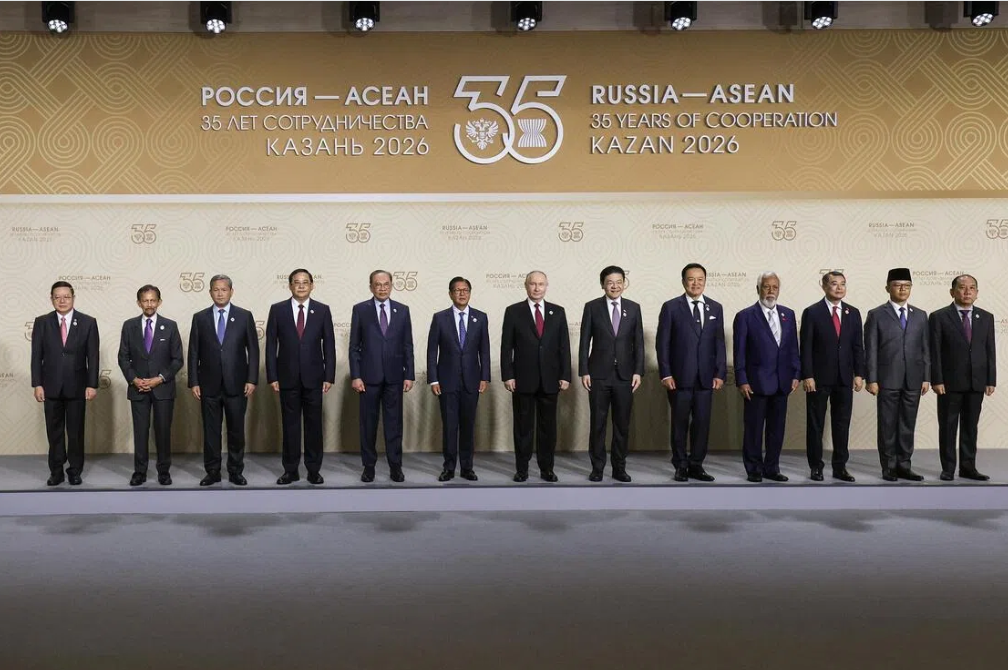
Asean and Russia have moved to solidify their partnership by adopting a suite of new agreements at a two-day summit in Kazan, the historic city in southwestern Russia. The Asean-Russia Commemorative Summit, convened on June 17 and 18, served as a stocktaking exercise ahead of what both sides hope will be a more intensive collaborative period over the next five years. The gathering carries particular symbolic weight, marking three and a half decades of formal relations between the 10-member Southeast Asian bloc and Moscow, as well as three decades since their dialogue partnership was formally established.
Three principal documents emerged from the summit to guide the relationship forward. The Kazan Declaration provides a comprehensive review of how Asean-Russia ties have evolved since the late 1980s, while simultaneously establishing a roadmap for future engagement. The declaration identifies maritime cooperation, trade and investment promotion, energy collaboration, infrastructure connectivity, security matters, education and cultural exchange as priority areas requiring intensified focus. These broad categories reflect the pragmatic interests both sides share despite their divergent approaches to global affairs, particularly regarding conflicts in Ukraine and the Middle East.
Complementing this overarching framework are two more specialized instruments. A Joint Statement on Cultural Cooperation explicitly seeks to deepen people-to-people connections and facilitate cultural exchanges at the grassroots level, recognizing that sustained bilateral relationships require foundations built beyond government-to-government engagement. The Asean-Russia Comprehensive Plan of Action for 2026 to 2030 provides the operational blueprint, detailing concrete initiatives and timelines for translating broad diplomatic commitments into measurable outcomes across identified cooperation sectors.
Singapore's Prime Minister Lawrence Wong, speaking on the summit's final day, articulated a carefully calibrated position that acknowledges both convergence and difference between Asean and Russia. He emphasized that meaningful partnership should concentrate on areas where mutual interests align, while simultaneously advancing initiatives that foster sustained dialogue, confidence-building and regional peace. This framing allows Singapore—which chairs Asean and hosts the organization's secretariat—to maintain the bloc's cherished strategic autonomy while engaging Moscow constructively. Wong particularly highlighted Russia's longstanding participation in Asean-led mechanisms, notably the Asean Regional Forum and the East Asia Summit, and invited continued Russian engagement when the Philippines hosts these meetings later in 2024 and when Singapore assumes the Asean rotating chair in 2027.
The practical cooperation agenda spans several domains of genuine utility to Southeast Asia. Wong identified disaster management and narcotics enforcement as areas where Asean and Russia could meaningfully collaborate, given Russia's technical expertise and Asean's vulnerability to natural disasters and transnational drug trafficking. Educational and cultural exchanges received explicit emphasis, with Wong noting that Russian officials regularly participate in civil service training courses across Asean capitals including Singapore itself. These people-to-people initiatives carry particular significance for Southeast Asia, where demographic youth and development aspirations create appetite for international exposure and skill transfer.
Wong's remarks underscored a central tension animating Asean's approach to Russia during a period of heightened global fragmentation. He stressed that Asean's twin priorities—deepening internal integration while simultaneously expanding international partnerships—have become increasingly vital precisely because the contemporary geopolitical environment exhibits unprecedented volatility and unpredictability. This framing positions Asean's Russia engagement not as ideological alignment but as prudent diversification of diplomatic relationships in an era when no single power can guarantee regional stability.
The Prime Minister's comments on international law and dispute resolution reflected Singapore's carefully articulated position on global conflicts. He reaffirmed Asean's consistent advocacy for peaceful resolution of disputes through dialogue, principled restraint, and adherence to international legal frameworks—a stance applicable to conflicts from Ukraine to Gaza. Wong explicitly connected this commitment to Asean's longstanding emphasis on unimpeded transit rights through vital international waterways, invoking the United Nations Convention on the Law of the Sea as the governing framework. For maritime-dependent Southeast Asia, freedom of navigation carries existential economic importance, making this emphasis genuinely central to regional interests rather than mere rhetorical convention.
Wong welcomed recent developments in the Middle East, specifically the emerging peace agreement between the United States and Iran and prospects for reopening the Strait of Hormuz. This reference carries substantial significance for Southeast Asia, where most oil imports transit through this critical chokepoint, making regional energy security directly dependent on stability in the Persian Gulf. His comments regarding Ukraine similarly emphasized principle over alignment, noting that Singapore's position stems from unwavering commitment to sovereignty and territorial integrity rather than preference for any particular geopolitical bloc. Simultaneously, Wong underscored Singapore's continued support for diplomatic pathways toward ceasefire and lasting peace consistent with international law and the UN Charter.
The bilateral dimension of Wong's visit added significant substance to the summit's outcomes. His meeting with Russian President Vladimir Putin, conducted at Putin's specific request, covered bilateral relations alongside regional and international developments. Wong subsequently noted that the discussion underscored the value of sustained engagement even when nations maintain fundamental disagreements on substantive issues. This emphasis on dialogue-despite-difference reflects a sophisticated understanding that in a multipolar environment, compartmentalizing disagreements while advancing cooperation in other domains serves national interests far better than ideological rigidity.
Additionally, Wong met with Rustam Minnikhanov, the Rais (leader) of the Republic of Tatarstan, building on longstanding Singapore-Tatarstan relations established through then-Minister Mentor Lee Kuan Yew's 2007 visit to the region. The discussion covered cultural, educational and people-to-people dimensions, extending Singapore's engagement beyond federal Russian structures into constituent republics. This bilateral track represents an important dimension of Asean's Russia engagement, particularly for smaller member states seeking to develop specialized relationships that complement broader bloc-level diplomacy.
It bears noting that Singapore's Russia engagement occurs against the backdrop of significant international discord over Ukraine. Singapore has consistently condemned Russian military operations there as violations of international law and has maintained sanctions regimes implemented in 2022. The Kazan summit demonstrates, however, that Southeast Asian states can maintain principled positions on specific conflicts while simultaneously engaging Russia across other domains deemed mutually beneficial. This approach reflects the pragmatic flexibility that has long characterized Asean's engagement with major powers—a diplomatic posture increasingly valuable as global alignment pressures intensify.
For the broader Southeast Asian region, the Asean-Russia summit reaffirms that the 10-member bloc retains capacity to maintain substantive relationships across the geopolitical spectrum. As great power competition intensifies and as external actors seek to constrain Asean's strategic autonomy through pressure toward alignment, the organization's ability to cooperate with Russia on defined mutual interests while maintaining independence on contentious issues demonstrates enduring diplomatic sophistication. The five-year action plan provides concrete mechanisms for translating this principle into practice across sectors ranging from maritime cooperation and energy to education and cultural exchange—areas where Southeast Asian interests genuinely align with Russian capabilities and interests.

