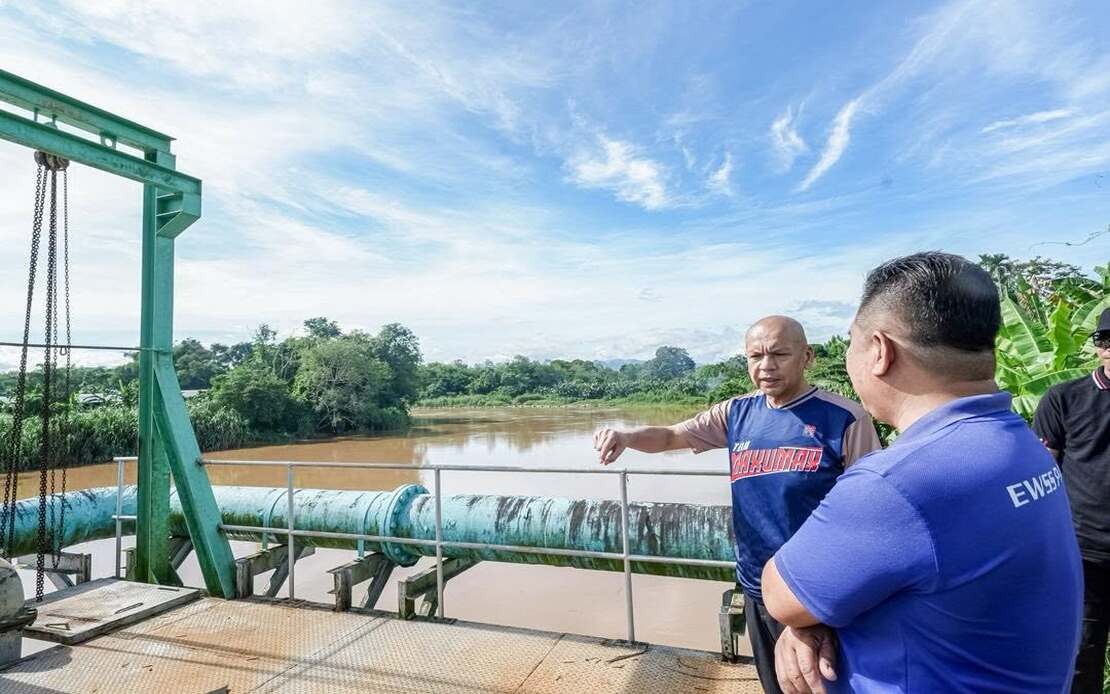
Datuk Armizan Mohd Ali, the Domestic Trade and Cost of Living Minister and Member of Parliament for Papar, conducted an on-site inspection of the district's water infrastructure this week to assess progress on multiple water supply stabilization initiatives. The visit follows a coordination meeting held on June 15 to evaluate implementation status across several projects aimed at addressing persistent supply challenges affecting residents in the district.
Two major infrastructure upgrades currently underway form the backbone of the district's water security strategy. The Kogopon Water Treatment Plant is being expanded to double its daily capacity from 40 million litres to 80 million litres, while a separate project involves upgrading the Kampung Kabang water intake system. These complementary initiatives represent a significant investment in Papar's water infrastructure, targeting the growing demand pressures that have strained the existing network in recent years.
The district's water supply challenges reflect a broader issue affecting many regions in Sabah where rapid population growth and economic development have outpaced infrastructure expansion. The Kogopon upgrade addresses this capacity constraint directly, effectively doubling the treatment facility's throughput. For a district experiencing consistent demand increases, this doubling of capacity represents a crucial step toward meeting resident expectations and supporting local economic activity. The Kampung Kabang intake upgrade complements this expansion by improving raw water acquisition efficiency and reliability at the source.
However, the minister's visit also highlighted immediate operational difficulties threatening supply stability. Both the EWSS Plant and JETAMA Limbahau Plant experienced forced shutdowns during the week preceding the inspection due to elevated turbidity levels in raw water entering the treatment systems. Turbidity, measured in nephelometric turbidity units (NTU), indicates suspended particles and cloudiness in water. When raw water turbidity exceeds treatable standards at plant intake points, water treatment operators must halt operations temporarily, a safety and quality measure that directly disrupts service to connected areas.
These turbidity incidents underscore a critical vulnerability in Papar's water supply chain: the quality and consistency of raw water upstream. Even as treatment capacity improvements are implemented, the source water quality remains a limiting factor. High turbidity can result from various causes including heavy rainfall, riverbank erosion, agricultural runoff, or inadequate water intake design. The recurring nature of these problems in recent weeks suggests either seasonal factors or structural issues with how raw water is being collected and delivered to treatment facilities.
Armizan's emphasis on direct field monitoring reflects recognition that effective infrastructure management requires regular on-ground assessment rather than reliance solely on reports. Understanding the actual conditions at treatment plants, seeing firsthand how turbidity events unfold, and evaluating operational response capabilities provides policymakers with insights that statistics alone cannot convey. This approach also signals to residents that their water challenges are receiving senior-level political attention, which carries practical importance for public confidence in utility services.
For Malaysian readers, the Papar situation illustrates challenges common across Southeast Asia as urbanization pressures mount on aging and inadequate water infrastructure. Many districts across Malaysia face similar capacity constraints and raw water quality issues, particularly in areas experiencing rapid development. The investments Papar is undertaking—doubling treatment capacity and upgrading intake systems—represent standard responses, but their success will depend on complementary investments in source water protection and pollution control in catchment areas.
The turbidity problems also highlight the interdependence between urban water supply reliability and upstream environmental management. Even the most advanced treatment plants become ineffective if raw water quality deteriorates significantly. This suggests that any long-term solution in Papar requires coordination between water utility operators and environmental regulators to manage land use and pollution in catchment zones feeding the Kogopon and Kampung Kabang intake points.
From a regional perspective, Papar's experience provides useful lessons for other rapidly developing districts in Sabah and throughout Malaysia. The coordination between different government levels and agencies—evidenced by the June 15 meeting preceding this inspection—appears essential for managing complex water infrastructure challenges. A single ministry or utility cannot solve turbidity problems without cooperation from agricultural, forestry, and urban planning authorities managing the catchment and source water areas.
The timeline for completing both major projects remains important, though not explicitly detailed in available statements. Water infrastructure expansion in Malaysia typically faces various constraints including procurement complexity, environmental clearances, and construction challenges. For Papar residents currently experiencing service disruptions, the gap between project announcement and completion directly affects quality of life and economic activity.
Looking forward, the inspection signals that water supply improvements remain a priority in Papar despite resource constraints elsewhere in the Malaysian economy. The dual approach—expanding treatment capacity while addressing immediate operational disruptions—reflects pragmatic infrastructure management. However, sustained political attention and adequate funding allocation will be necessary to bring both the Kogopon upgrade and Kampung Kabang project to completion, ensuring residents receive the stable, adequate water supply that modern districts require.

