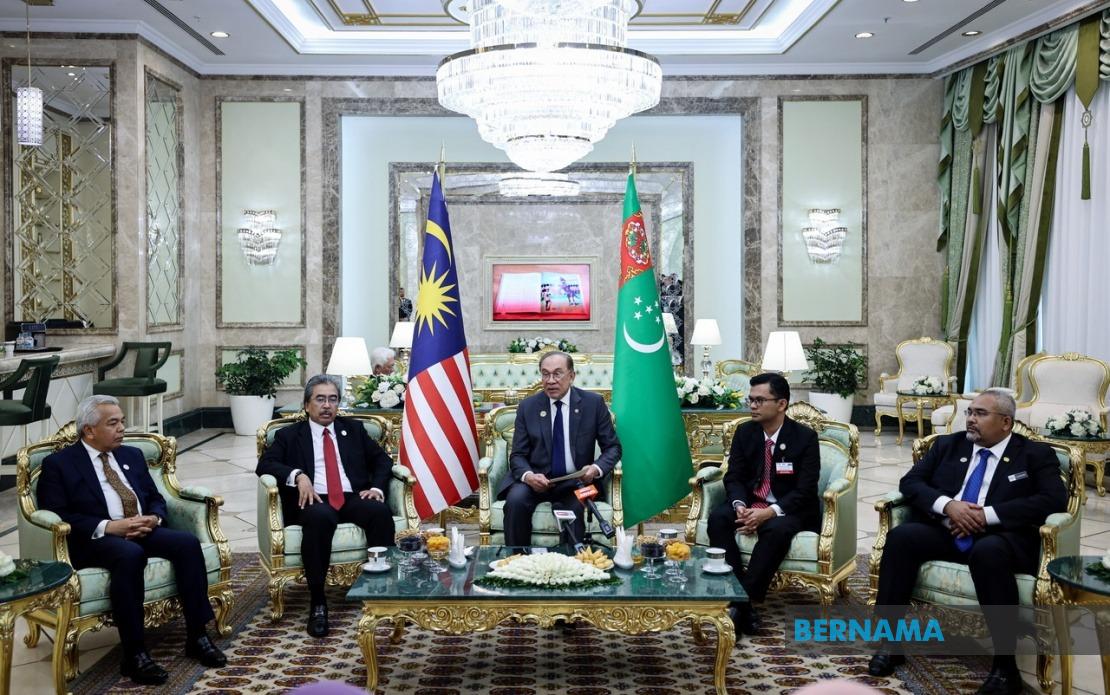
Prime Minister Datuk Seri Anwar Ibrahim has declared his official working visit to Turkmenistan a success, highlighting the advancement of strategic partnerships and friendly relations between Malaysia and the Central Asian nation. The two-day visit, which commenced on June 18, represents Anwar's inaugural trip to Turkmenistan since assuming Malaysia's highest office in November 2022, arriving on an invitation from Turkmenistan President Serdar Berdimuhamedov.
The delegation that travelled to Ashgabat comprised a broad cross-section of Malaysia's economic and diplomatic leadership. Accompanying Anwar were Minister of Investment, Trade and Industry Datuk Seri Johari Abdul Ghani, Minister of Economy Akmal Nasrullah Mohd Nasir, and key personnel from the Prime Minister's Office and Foreign Ministry. The composition of the delegation underscores the economic dimensions of the visit, signalling Malaysia's seriousness in pursuing substantive commercial engagement alongside traditional diplomatic courtesies.
Energy cooperation has emerged as the centrepiece of the bilateral engagement framework. Anwar specifically identified the energy sector as holding tremendous untapped potential for both nations, suggesting that the visit has crystallised mutual interest in exploring this avenue more deliberately. For Malaysia, engagement with Turkmenistan's energy resources carries strategic significance given the country's long-term hydrocarbon needs and the imperative to diversify energy sourcing beyond traditional suppliers in the Middle East and Southeast Asia.
Turkmenistan's vast natural gas reserves represent one of the world's largest proven deposits, and the nation has consistently sought to expand its export horizons beyond China and Russia. The Malaysian delegation's inclusion of PETRONAS officials—a representative delegation member—indicates that Malaysia's national petroleum company sees commercial opportunities worthy of serious exploration. This engagement could potentially unlock new avenues for Malaysian companies in the energy sector while providing Turkmenistan with a valued new trading partner in Southeast Asia.
In his public statement, Anwar extended gratitude to President Berdimuhamedov for the warm reception accorded the Malaysian delegation, a conventional diplomatic courtesy that nonetheless reflects the cordial atmosphere that characterised the visit. He also acknowledged the coordinated effort of multiple institutions and personnel who facilitated the mission's execution, ranging from ministry officials and diplomatic staff in Ashgabat to security personnel and media representatives who managed the logistics of the visit.
The timing of this inaugural visit carries broader geopolitical implications. Malaysia's engagement with Central Asian nations has traditionally been limited compared to its involvement in Southeast Asia or the broader Asia-Pacific region. By prioritising a visit to Turkmenistan, Anwar is signalling a deliberate expansion of Malaysia's diplomatic reach and economic interests beyond established regional spheres. This represents a pragmatic response to Malaysia's evolving strategic interests and the reality that prosperity increasingly depends on cultivating relationships across diverse geographic and cultural landscapes.
Bilateral cooperation frameworks established during the visit extend beyond the energy sector, though specific details of these additional areas remain largely unreported. The communiqué's emphasis on cooperation in multiple sectors suggests that the Malaysian and Turkmen governments have identified complementary interests spanning sectors such as trade, investment, education, and possibly defence cooperation. This multisectoral approach reflects modern diplomacy's recognition that enduring partnerships rest on diverse foundations rather than narrow commercial interest.
From a Malaysian perspective, the visit also provides an opening for Malaysian enterprises to participate in Turkmenistan's development agenda. As a middle-income nation with substantial resource wealth, Turkmenistan represents an emerging market where Malaysian expertise in sectors ranging from petrochemicals to infrastructure development could find receptive demand. Conversely, Turkmenistan's vast energy reserves present Malaysian companies with acquisition and partnership opportunities aligned with long-term energy security planning.
The successful completion of this inaugural trip establishes a platform for deepening Malaysia-Turkmenistan relations. It also demonstrates Anwar's commitment to expanding Malaysia's diplomatic footprint beyond traditional spheres of engagement, a strategy consistent with his broader vision of strengthening Malaysia's international standing through diversified partnerships. For observers of Malaysian foreign policy, the visit signals a subtle but meaningful reorientation toward Central Asia, a region long overshadowed in Malaysian strategic calculations by Southeast Asian concerns and broader Indo-Pacific considerations.

