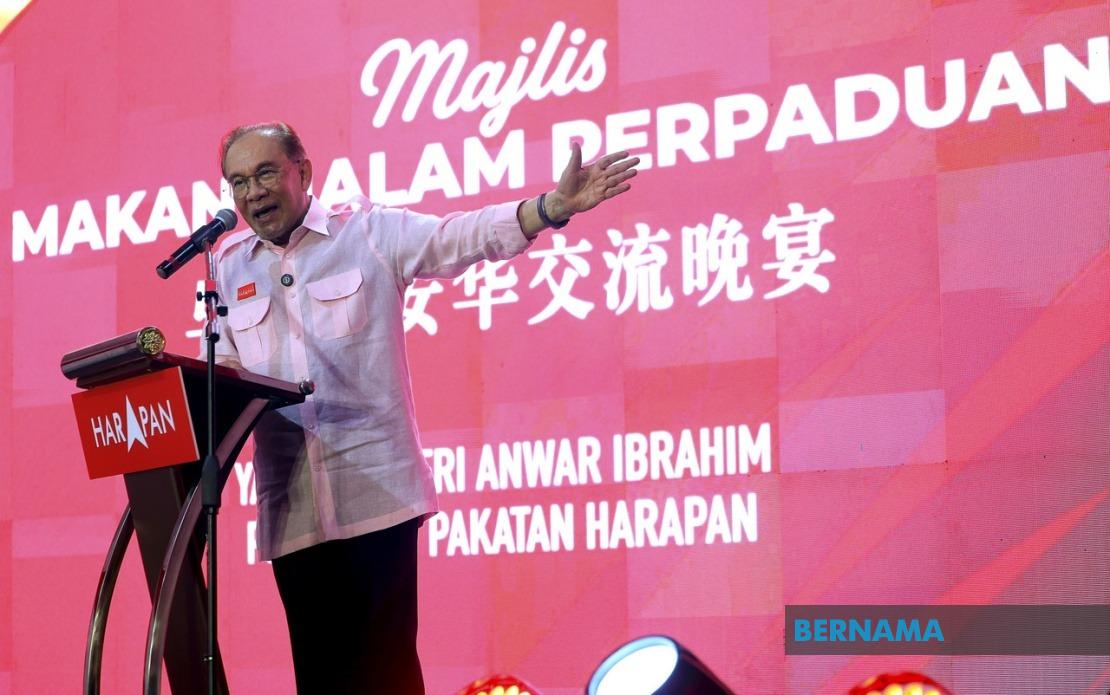
Pakatan Harapan chairman Datuk Seri Anwar Ibrahim has launched a pointed critique at opposition rivals, questioning what he characterises as their unseemly scramble for the menteri besar position in Negeri Sembilan ahead of the state election. Speaking at a campaign dinner in Sikamat on Monday night, the Prime Minister contrasted what he sees as PH's focus on governance and public service with what he claims is opposition preoccupation with internal power struggles, suggesting voters should reward the coalition with their support rather than allow competing factions to tear each other apart once elected.
The underlying tension in Anwar's remarks reflects deeper anxieties within Malaysian politics about leadership legitimacy and administrative competence. By highlighting the opposition's apparent infighting before the ballots are even cast, PH's strategy aims to frame the election as a choice between a coalition committed to serving constituents and a divided opposition more interested in self-enrichment through high office. This rhetorical approach carries particular weight in Negeri Sembilan, a state where governance performance and leadership stability have historically influenced voter behaviour.
Anwar's criticism extends beyond mere tactical positioning. He emphasised that the paramount concern in any electoral contest should be the capability and integrity of those seeking public office. The Prime Minister articulated a vision in which elected representatives prioritise effective administration and protection of citizens' interests over personal ambition. This framing attempts to elevate the political conversation beyond personality-driven or factional politics, positioning PH as the mature, responsible choice for voters weary of internal party disputes.
In a clear endorsement of the incumbent administration's record, Anwar highlighted Negeri Sembilan Menteri Besar Datuk Seri Aminuddin Harun as a model of principled leadership. Aminuddin, who is contesting the Linggi constituency under the PH banner, represents continuity and proven competence according to Anwar's narrative. The Prime Minister credited the current menteri besar with steering the state administration with integrity while maintaining vigilance against corruption and abuse of power—issues that resonate strongly with Malaysian voters across the political spectrum.
The campaign dinner, held in Taman Sri Penaga, drew senior PH figures including PH Sikamat candidate Nor Azman Mohamad and PH Ampangan candidate Datuk Muhammad Nazri Kassim, underlining the coalition's determination to project organisational unity and depth of leadership in the state. The presence of multiple candidates and officials at such events serves to demonstrate that PH has prepared succession planning and institutional readiness, contrasting with opposition parties that Anwar suggests are consumed by leadership rivalries.
Anwar also turned his attention to campaign rhetoric, specifically condemning what he characterises as divisive racial narratives being deployed by certain quarters to mobilise political support. This criticism reflects PH's broader commitment to the Unity Government framework, which the coalition has positioned as an antidote to polarisation and identity-based politics that have historically fragmented Malaysian society. By calling out such tactics, Anwar sought to reclaim the moral high ground on governance inclusivity and social cohesion.
The Prime Minister reinforced the Unity Government's policy agenda as evidence of its commitment to inclusive administration. He pointed to expanded socio-economic allocations, housing initiatives, and salary adjustments for civil servants as concrete demonstrations that PH-led governance benefits all community segments irrespective of ethnicity or religious affiliation. In the Malaysian context, where resource allocation and social welfare provision are frequently viewed through communal lenses, such explicit framing of PH's inclusive approach constitutes a significant political argument.
PH's electoral preparation in Negeri Sembilan reflects the coalition's confidence in the state contest. The coalition is fielding candidates across all 36 state seats, with PKR contesting 16 seats, DAP 11, and Amanah nine. This comprehensive slate indicates that PH intends to compete vigorously throughout the state rather than concede any constituencies, signalling that party leaders believe electoral momentum favours them as polling day approaches.
The Negeri Sembilan state election, scheduled for August 1 with early voting on July 28, arrives at a pivotal moment for the Unity Government. State elections serve as important barometers of public sentiment toward federal administrations, and PH will be eager to demonstrate continued voter confidence. A strong performance in Negeri Sembilan would bolster the coalition's narrative of political stability and popular support, while providing momentum for potential federal-level developments.
Anwar's campaign messaging reflects a deliberate strategy to shift electoral discourse from personality-centred competition to institutional and policy-based comparison. By depicting the opposition as fractious and self-interested while positioning PH as organised and service-oriented, the Prime Minister attempts to frame voting as a choice between functional governance and dysfunctional squabbling. Whether this framing resonates with Negeri Sembilan voters will become evident once the polls close and results are tallied, offering insights into broader patterns of Malaysian electoral behaviour and voter priorities in an era of coalition politics.

