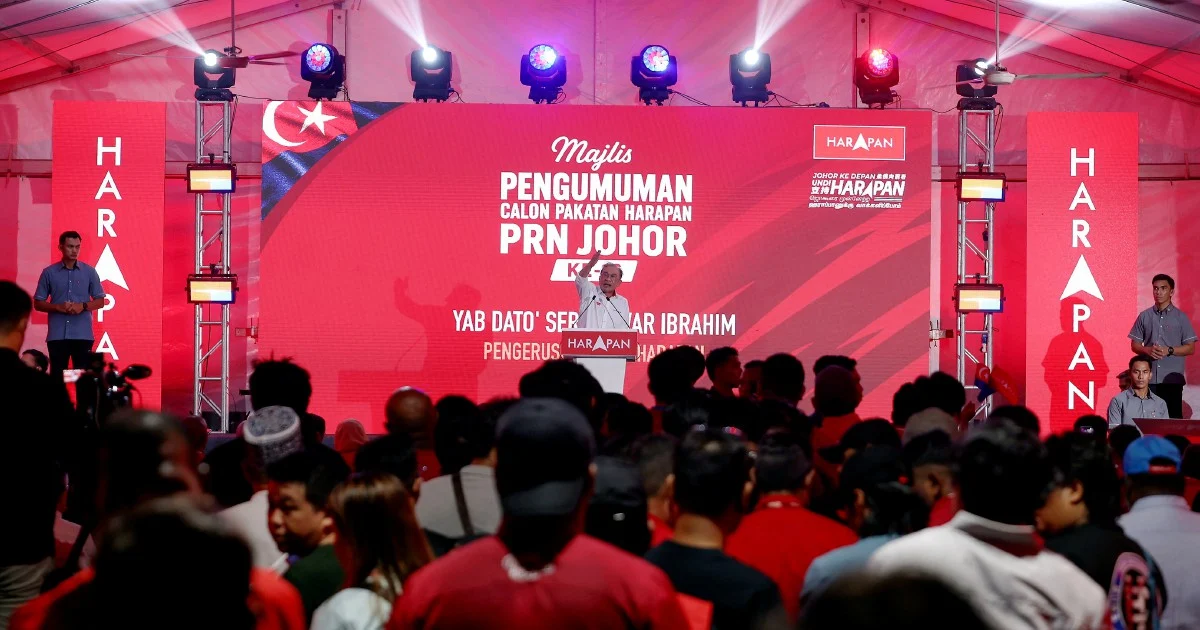
Prime Minister and Pakatan Harapan chairman Datuk Seri Anwar Ibrahim has drawn a clear line between electoral politics and constitutional monarchy, calling for the forthcoming Johor state election to be waged strictly as a political contest without entangling the state's Malay Rulers or their institutions. Speaking in Tangkak, the premier's remarks signal his concern that the campaign may risk crossing into constitutional sensitivity if royal institutions become intertwined with partisan political battles.
Anwar's intervention reflects a broader anxiety within the ruling coalition about maintaining the delicate balance between parliamentary democracy and Malaysia's constitutional monarchy at a time of heightened political polarization. The Johor election, a crucial test of Pakatan Harapan's mandate in a strategic state, has become a focal point for political mobilization across the country. By emphasizing this boundary, Anwar appears to be cautioning both his own party members and opposition rivals against instrumentalizing royal authority or seeking royal sanction for partisan objectives.
The statement carries particular weight given Johor's unique constitutional framework and the significant political authority vested in its throne. The Johor Sultanate has historically wielded considerable influence over state affairs, and its relationship with the federal government has shaped major political outcomes throughout Malaysia's modern history. Any suggestion that a state election might be influenced by or dependent upon royal institutions could undermine confidence in the democratic process and blur constitutional boundaries that have been carefully maintained for decades.
For Malaysian observers, Anwar's emphasis on political independence reflects a maturation in how the country manages its constitutional arrangements. Unlike emerging democracies where military or institutional actors frequently overstep electoral boundaries, Malaysia has generally preserved formal neutrality of royal institutions during campaigns. Anwar's statement suggests this convention remains vital, even as election campaigns grow fiercer and more personality-driven.
The warning also implies potential tension within Johor's political establishment. If some quarters had been attempting to invoke royal support or institutional leverage—even implicitly—for electoral advantage, Anwar's public clarification would serve as both a corrective and a deterrent. This approach protects not only the integrity of the election but also shields the institution of the monarchy from becoming a contested political asset that different factions might claim to represent.
Contextually, the Johor election holds significance for Pakatan Harapan's broader political survival. The coalition's performance in state-level contests has become essential to demonstrating continued electoral viability after a mixed record in recent by-elections and municipal contests. A clear, uncontroversial victory contested on straightforward political merits would strengthen the government's legitimacy far more effectively than any victory shadowed by questions about institutional involvement.
The timing of Anwar's intervention, coming as campaign intensity builds, suggests his leadership team is actively managing the political atmosphere to prevent escalation into constitutionally sensitive territory. This reflects sophisticated political management—recognizing that electoral victory achieved through appeals to institutional bias would ultimately weaken both the government and the monarchy.
For Southeast Asian perspectives, Malaysia's approach to separating electoral politics from constitutional institutions offers a model of institutional restraint. As democratic practices face pressure from personalism and institutional overreach across the region, maintaining such boundaries reinforces the legitimacy of both electoral and constitutional systems. Anwar's statement, though seemingly defensive, actually affirms commitment to democratic norms.
The opposition will likely interpret the statement as an acknowledgment of constraints on government power, while Pakatan Harapan supporters may understand it as leadership setting ethical guardrails for their campaign. Both interpretations reinforce the principle that Malaysia's elections should be decided by voters responding to policy platforms and political arguments, not by institutional preferences channeled through traditional authority structures.
Looking forward, Anwar's framing of the Johor contest as properly political terrain—distinct from constitutional monarchy—provides a template for how subsequent elections should be conducted. Should the ruling coalition face pressure to mobilize royal support in future campaigns, this statement creates a documented precedent establishing that such approaches contradict the premier's own stated principles about democratic integrity.
Ultimately, the Johor election will be assessed on whether Pakatan Harapan can win voter support through conventional campaign means. Anwar's intervention effectively raises the bar for his own coalition while simultaneously delegitimizing any opposition attempt to invoke institutional advantage. This positions the contest firmly where electoral outcomes belong: in the realm of popular preference and democratic choice rather than institutional prerogative.

