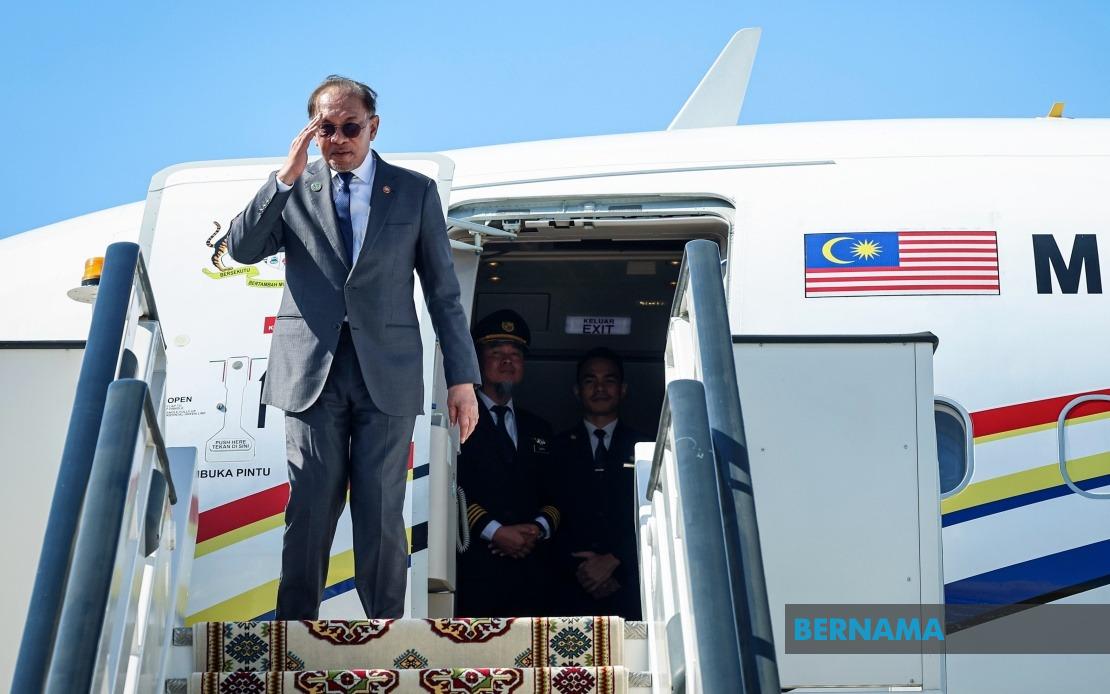
Prime Minister Datuk Seri Anwar Ibrahim wrapped up his diplomatic mission to Turkmenistan and touched down in Penang yesterday for an intensive one-day working schedule spanning major industrial, media and civic events. The whirlwind visit underscores the government's dual focus on strengthening international ties while maintaining momentum on domestic economic and institutional priorities. His aircraft departed Ashgabat International Airport at 4.45 pm local time, setting the stage for an evening arrival ahead of a morning packed with ribbon-cutting ceremonies and high-profile engagements across the state.
The Penang leg began with the official inauguration of MKS Instruments Malaysia Sdn Bhd at Bandar Cassia Technology Park in Batu Kawan at 11 am, marking the Prime Minister's commitment to supporting electronics and precision manufacturing enterprises in the nation's premier industrial corridor. The facility represents growing investment in value-added manufacturing clusters that anchor Penang's position as a hub for technology-driven production serving regional and global supply chains. Such openings carry symbolic weight beyond ribbon-cutting formalities, signalling government backing for sectors critical to Malaysia's broader industrialisation agenda and foreign direct investment strategy.
Following the manufacturing facility launch, Anwar proceeded to the groundbreaking for Setia Fontaines Industrial Park at the Setia Experience Centre in Bandar Setia Fontaines, Kepala Batas, scheduled for 1 pm. The development reflects the property developer's long-term commitment to catalysing industrial expansion within Penang and the Northern Corridor region—a zone designated for special economic development and infrastructure investment. During the ceremony, Setia unveiled two additional strategic partnerships within the broader township, positioning the park as a multi-anchor development with clusters spanning manufacturing, logistics, and technology services. These integrated industrial parks have become vital mechanisms for attracting both domestic and international investors seeking consolidated operational ecosystems with supporting infrastructure.
The centrepiece of Anwar's Penang schedule was the HAWANA 2026 Grand Finale at PICCA Convention Centre @ Butterworth Arena at 3 pm, bringing together approximately 1,000 media practitioners from Malaysia and international delegations. Organised by the Communications Ministry and implemented by Bernama (Pertubuhan Berita Nasional Malaysia), HAWANA serves as the premier platform recognising journalistic contributions and dedication to public discourse development. The event carries particular importance given ongoing global scrutiny of media freedoms and the role of professional journalism in democratic societies—a concern resonating across Southeast Asia where press autonomy remains contested terrain.
During the HAWANA ceremony, the Prime Minister presented both the HAWANA Award and Special HAWANA Award to individuals recognised for significant contributions to journalism and cultivation of informed public thought. Beyond ceremonial recognition, the event featured distribution of contributions from Tabung Kasih@HAWANA to media practitioners facing financial hardship. Such provisions underscore the government's acknowledgement that journalism's professional sustainability remains threatened by economic pressures, particularly in digital-disrupted markets where traditional revenue models have collapsed. The benevolence fund represents a practical intervention addressing journalist welfare, a concern affecting newsrooms across Malaysia and the broader Southeast Asian region.
Anwar's Turkmenistan visit itself marked his inaugural state visit to the Central Asian nation since assuming the premiership in November 2022, undertaking the journey at the invitation of President Serdar Berdimuhamedov. The two-day engagement beginning June 18 positioned Malaysia within broader Central Asian diplomatic frameworks, particularly relevant as the nation seeks to diversify strategic partnerships beyond traditional Western and East Asian alignments. Turkmenistan's energy resources and geographic position along Belt and Road Initiative corridors suggest potential collaboration areas spanning infrastructure, trade, and investment cooperation—sectors of strategic concern for Malaysian policymakers navigating evolving regional geopolitics.
Preceding his Turkmenistan deployment, Anwar attended the 35th ASEAN-Russia Commemorative Summit in Kazan, accompanied by Investment, Trade and Industry Minister Datuk Seri Johari Abdul Ghani and Economy Minister Akmal Nasrullah Mohd Nasir. The Russian engagement signals Malaysia's commitment to maintaining substantive ASEAN-Russia dialogue amid broader geopolitical fragmentation. The Prime Minister's Russia visit immediately followed by Central Asian engagement demonstrates a deliberate calendar seeking to strengthen Malaysian-Eurasian connectivity and positioning the nation as a Southeast Asian hub for broader Eurasian engagement—a diplomatic positioning increasingly important as regional powers seek middle-power partnerships.
The intensity of Anwar's international calendar—cycling through Russia, Turkmenistan, and domestic commitments within consecutive days—reflects the multitasking demands placed upon Malaysia's political leadership navigating simultaneous international obligations and domestic governance. The return to Penang for industrial park inaugurations and media recognition ceremonies maintains political visibility within a crucial state while demonstrating government commitment to non-Kuala Lumpur development initiatives. Such scheduling exercises, though logistically demanding, serve essential functions in sustaining political capital across Malaysia's federal structure and maintaining engagement with key constituencies including business, media, and civil society.
Following the Penang conclusion, the Prime Minister proceeded to Negeri Sembilan for the Himpunan Pertubuhan Lima Generasi (PLG) Malaysia dinner that evening, extending the working visit cycle with additional stakeholder engagement. The cumulative schedule spanning three states and multiple sectors illustrates the government's attempt to demonstrate simultaneous international diplomatic engagement, economic development prioritisation, and civil society recognition within compressed timeframes. For Malaysian observers and regional analysts, such itineraries signal commitment to balanced policymaking spanning economic, diplomatic, and institutional spheres while maintaining political momentum across geographically dispersed constituencies.

