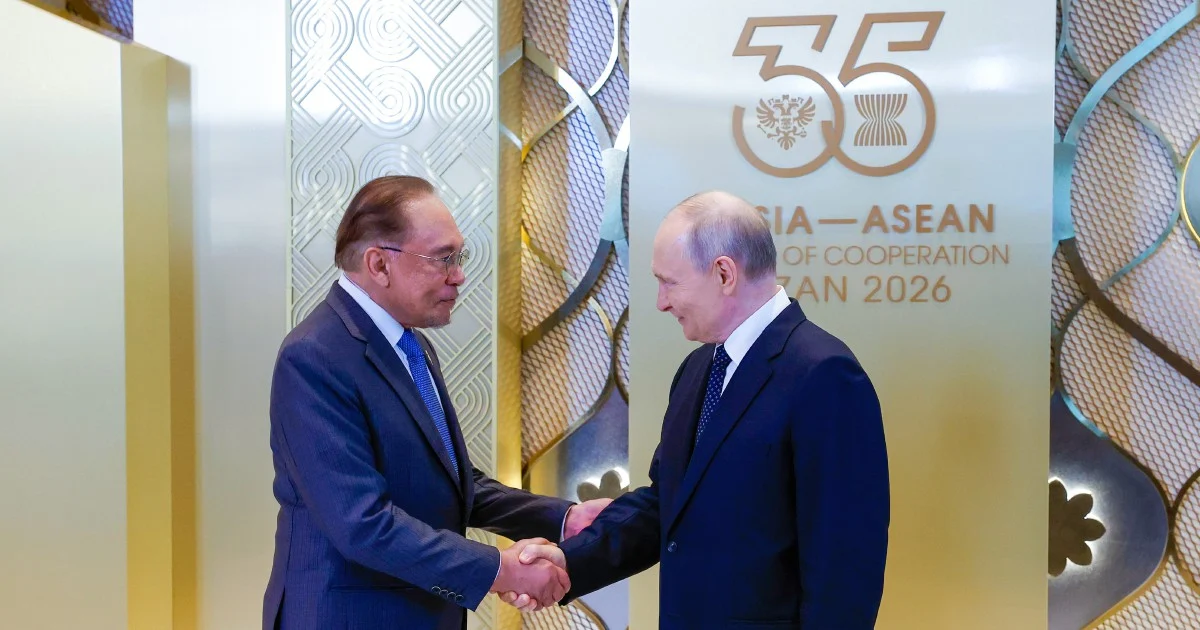
Prime Minister Datuk Seri Anwar Ibrahim and Russian President Vladimir Putin held substantive talks in Kazan aimed at broadening Malaysia's economic engagement with Moscow, with particular emphasis on bolstering energy security arrangements and facilitating cross-border commerce through non-dollar mechanisms. The bilateral discussions underscore Malaysia's deliberate effort to diversify its international partnerships and reduce reliance on traditional Western-dominated trade structures, a positioning that carries significant implications for regional balance in Southeast Asia.
The focus on energy security reflects Malaysia's ongoing concerns about stable fuel supplies and pricing stability in an increasingly volatile global market. As a nation dependent on hydrocarbon imports for industrial power generation and transportation fuel, Malaysia's interest in strengthening ties with a major energy exporter like Russia aligns with broader national economic strategies. Russia's position as one of the world's largest oil and natural gas producers makes it a logical partner for countries seeking to diversify their energy procurement networks and negotiate more favorable long-term supply contracts.
The discussion of conducting trade in local currencies—Malaysian ringgit and Russian ruble—signals both nations' commitment to reducing exposure to currency fluctuations and decreasing dependence on the United States dollar for bilateral transactions. This approach mirrors similar initiatives undertaken by other nations seeking to circumvent Western financial sanctions regimes and create alternative payment infrastructure. For Malaysia, such arrangements could provide greater stability in cross-border business dealings while simultaneously strengthening monetary sovereignty.
Anwar's engagement with Putin occurs within a broader context of Malaysia seeking to maintain strategic autonomy in its foreign policy. The country has traditionally pursued a non-aligned approach, cultivating relationships across different geopolitical camps rather than aligning exclusively with any single power bloc. These talks with Russia complement Malaysia's existing partnerships with Western nations, China, and other regional powers, reflecting a pragmatic approach to international relations that prioritizes economic and security benefits.
Russia's growing pivot toward Asia, partly driven by Western sanctions following its military actions in Ukraine, has created new opportunities for engagement with Southeast Asian nations. Malaysia, as the second-largest economy in Southeast Asia by some measures and a key player in regional affairs, represents an attractive partner for Moscow's efforts to expand influence and economic ties in the region. Such partnerships help Russia offset the economic isolation it faces in Western markets.
The energy dimension of these discussions carries particular significance for Malaysia's long-term development planning. With growing industrial demand and an expanding population, securing reliable energy sources at competitive prices is essential for maintaining economic competitiveness. Diversifying supplier relationships, particularly with major producers like Russia, provides negotiating leverage and reduces the risk of supply disruptions from geopolitical tensions concentrated in any single region.
Local currency trading arrangements between Malaysia and Russia could also stimulate bilateral commerce more broadly beyond energy. When transactions occur in native currencies rather than dollars, transaction costs decrease and businesses gain natural hedging benefits. This structural advantage can encourage greater cross-border investment, tourism, and commercial exchange across multiple economic sectors. Malaysian exporters seeking new markets find Russia's vast consumer base and geographic reach into Europe and Central Asia particularly attractive.
These discussions must be understood against the backdrop of Malaysia's broader Southeast Asian role. As a founder of ASEAN and a member of regional groupings like the Regional Comprehensive Economic Partnership, Malaysia's bilateral relationships influence regional dynamics. Malaysia's engagement with Russia demonstrates that Southeast Asian nations are increasingly comfortable conducting independent foreign policies that reflect their specific national interests, rather than automatically following Western policy preferences.
The timing of such high-level engagement also reflects Malaysia's confidence in its diplomatic standing. Anwar Ibrahim, having consolidated his position as Prime Minister following years of political turbulence, is actively pursuing international engagements that position Malaysia as a forward-thinking nation capable of managing complex relationships with diverse partners. Such diplomatic activity enhances Malaysia's international profile and demonstrates active leadership in navigating an increasingly multipolar world order.
For Malaysian businesses, particularly those in energy-intensive sectors such as petroleum refining, petrochemicals, and heavy manufacturing, improved bilateral relations with Russia open new opportunities for cooperation, technology transfer, and joint ventures. The availability of competitively-priced Russian energy could enhance the competitiveness of Malaysian industrial products in regional and global markets, potentially attracting foreign investment to Malaysian manufacturing hubs.
The emphasis on energy security and alternative payment mechanisms in these discussions also reveals shared concerns between Malaysia and Russia about economic vulnerability and the need for greater strategic autonomy. Both nations face external pressures—Russia through sanctions and Malaysia through regional geopolitical competition—that make diversified international partnerships and resilient economic structures increasingly important for national stability and prosperity.
Moving forward, the success of these bilateral initiatives will depend on concrete follow-through in implementing agreements, establishing institutional frameworks for cooperation, and building business-to-business networks that transform political commitments into economic reality. The depth of Malaysia-Russia engagement will ultimately be measured not by the rhetoric of high-level talks but by the volume and diversity of actual commercial transactions and collaborative projects that emerge from these strategic discussions.

