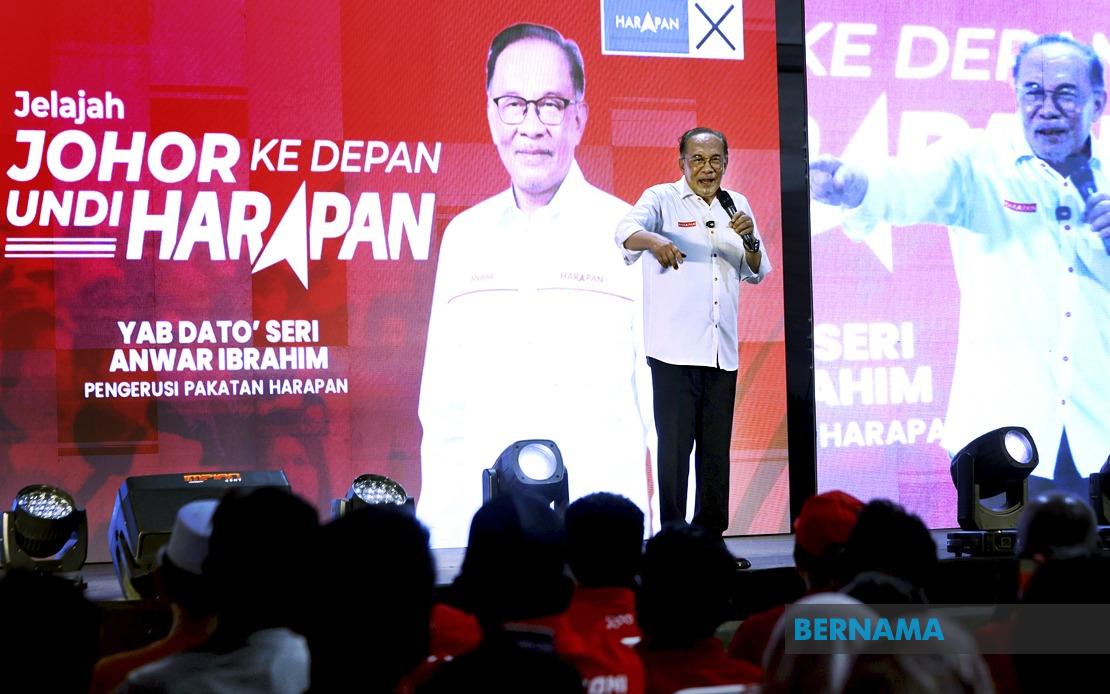
Prime Minister Datuk Seri Anwar Ibrahim has drawn a firm line under what he terms the era of systemic plunder and patronage, signalling that his MADANI Government will pursue integrity as a governing principle that transcends communal boundaries. Speaking in Muar during the Johor State Election campaign, Anwar articulated a vision of leadership evaluated on character and honest conduct rather than on demographic identity or political affiliation, positioning this approach as central to restoring public trust and Malaysia's international standing.
The Prime Minister's emphasis on dismantling entrenched corrupt practices reflects growing recognition that Malaysia's administrative institutions have been weakened by decades of abuse. Anwar framed the government's immediate priority as a comprehensive cleanup of systems that have allowed public funds to be diverted into private coffers and networks of favoured contractors. This framing moves beyond rhetoric by positioning anti-corruption work as foundational to economic recovery and social stability, directly linking governance reform to tangible improvements in citizens' lives.
Anwar's declaration that leaders should be judged by integrity rather than racial identity carries particular weight in Malaysia's polarised political environment. His specific statement that he welcomes honest Malays, Chinese, and implicitly other communities into leadership roles addresses a persistent narrative in Malaysian politics that frames integrity and communal loyalty as opposing values. By rejecting this dichotomy, Anwar challenges opposition claims that anti-corruption efforts represent bias against any group, while simultaneously setting measurable standards against which his own government can be held accountable.
The Prime Minister explicitly rejected the practice of using state power for personal enrichment through family members and government contracts, characterising this as the defining feature of the previous political order. His naming of specific corrupt practices—awarding contracts to family members, channelling state resources through wives' companies—suggests a targeted approach rather than abstract moralising. This specificity matters for implementation, as it identifies concrete mechanisms through which corruption operates and where institutional safeguards can be strengthened.
Crucially, Anwar provided an assurance that no individual would receive government protection if implicated in corruption during his tenure. This commitment extends implicitly to members of the ruling coalition and their associates, though the historical record shows that protecting political allies has been a consistent challenge for successive Malaysian governments. The credibility of this pledge will depend on whether high-profile corruption cases involving government-linked figures result in prosecutions and convictions, or whether enforcement remains selective.
The Johor campaign context is significant, as the state has historically been a stronghold of more transactional politics and patronage networks. Anwar's direct appeal to Johor voters to reject leaders lacking integrity represents an attempt to reframe state-level electoral competition around governance quality rather than ethnic or factional loyalty. This approach carries risks, particularly if voters perceive that anti-corruption enforcement is applied inconsistently across different communities or political factions.
Anwar's characterisation of opposition political pressure as driven by personal agendas to regain federal control presents a defensive argument that may resonate with supporters but risks dismissing legitimate criticism. The opposition's attacks on governance issues, while sometimes partisan, may reflect genuine concerns about implementation gaps or selective enforcement that deserve substantive response beyond attributing them to power-seeking motives. Malaysia's political maturation would benefit from engagement with the substance of governance concerns rather than assumption that all criticism originates from bad faith.
The broader significance of this campaign messaging lies in its attempt to reposition anti-corruption as a unifying national project rather than a tool of factional struggle. If sustained across different state and federal contexts, this framing could gradually shift Malaysian political discourse away from zero-sum ethnic or religious narratives toward performance-based evaluation of leaders. However, the gap between rhetoric and implementation remains substantial, and the public's confidence in anti-corruption efforts will depend on visible consequences for powerful figures.
The Johor State Election, with 172 candidates competing for 56 seats and polling scheduled for July 11, provides an early test of whether voters respond to the integrity-centred messaging that Anwar has been promoting. Johor's significance as Malaysia's second-largest state and historically a proving ground for new political directions means that results here could influence broader perceptions of whether the MADANI Government's anti-corruption commitment represents genuine change or another cycle of political theatre.
For Malaysian readers and the broader Southeast Asian region, Anwar's statements carry implications for institutional reform and rule of law. Countries across the region have grappled with embedded corruption and the challenge of breaking cycles of patronage politics. The success or failure of Malaysia's experiment with integrity-centred governance could influence how other nations approach similar institutional reforms, particularly given Malaysia's position as a middle-income democracy with relatively sophisticated institutions and civil society.
The presence of Penang Chief Minister Chow Kon Yeow and Ledang MP Syed Ibrahim Syed Noh at the event signalled cross-state coalition solidarity around the anti-corruption message. This alignment suggests that the Pakatan Harapan coalition has attempted to position clean governance as a shared commitment rather than an initiative of any single party. Whether this unity translates into coordinated enforcement action across different state and federal jurisdictions remains to be demonstrated through concrete administrative decisions.

